

Home
Class 11
PHYSICS
A trolley of mass 8 kg is standing on a...

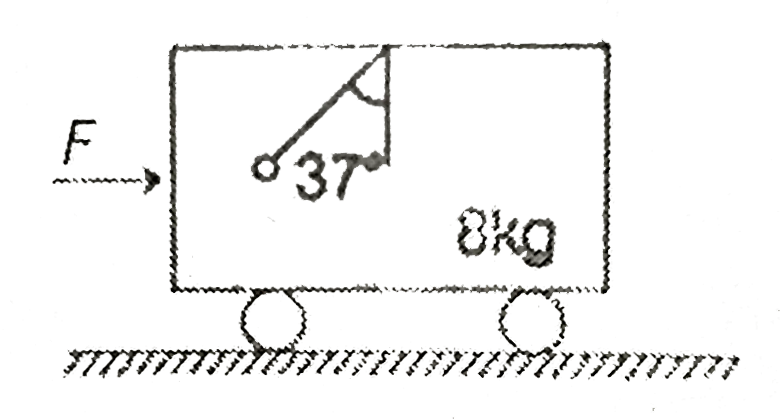
A trolley of mass 8 kg is standing on a frictionless surface inside which an object of mass 2kg is suspended .A conatant force F starts acting on the trolley ,as a result of which the string stood at an angle of `37 ^(@)` from the vertical (bob at rest relative to troley ) then,

Promotional Banner

Similar Questions

Explore conceptually related problems

A body of mass 1 kg is suspended by means of a string. It is then pulled aside by a horizontal force so that the string makes an angle of 30^(@) with the vertical. Find the horizontal force.

A trolley of mass 360 kg is lying on a horizontal frictionless surface. A mas of mass 40 kg runs with uniform speed on the trolley by a distance of 2m in 0.5 second. What is the velocity of the trolley relative to earth ?

A bob of mass m=50g is suspended form the ceiling of a trolley by a light inextensible string. If the trolley accelerates horizontally, the string makes an angle 37^(@) with the vertical. Find the acceleration of the trolley.

A bob of mass 1 kg is suspended from an inextensible string of length 1 m. When the string makes an angle 60^(@) with vertical, speed of the bob is 4 m/s Net acceleration of the bob at this instant is

A bob of mass 1 kg is suspended from an inextensible string of length 1 m. When the string makes an angle 60^(@) with vertical, speed of the bob is 4 m/s Net acceleration of the bob at this instant is

A bob of mass m=50g is suspended form the ceiling of a trolley by a light inextensible string. If the trolley accelerates horizontally, the string makes an angle thata=37^(@) with the vertical. Find the acceleration of the trolley.

A pendulum bob of mass m is suspended at rest. A constant horizontal force F = mg starts acting on it. Find (a) the maximum angular defection of the string. (b) the maximum possible tension in the string.

A projectile of mass 1.2 kg undergoes a perfectly inelastic collision with a trolley of mass 3.6 kg as shown in the figure. At the time of the collision, the second of the projectile is 5ms^(-1) at an angle of 37^(@) with the horizontal. The trolley is free to move, only along a horizontal rail which coincides with the direction of the projectile's horizontal motion. Assuming that the trolley doesn't topple, calculate the amount of heat energy (in J) released in the collision. ["Take "sin 37^(@)=3//5 and cos 37^(@)=4//5]

A projectile of mass 1.2 kg undergoes a perfectly inelastic collision with a trolley of mass 3.6 kg as shown in the figure. At the time of the collision, the second of the projectile is 5ms^(-1) at an angle of 37^(@) with the horizontal. The trolley is free to move, only along a horizontal rail which coincides with the direction of the projectile's horizontal motion. Assuming that the trolley doesn't topple, calculate the amount of heat energy (in J) released in the collision. ["Take "sin 37^(@)=3//5 and cos 37^(@)=4//5]