

Home
Class 12
PHYSICS
A solid sphere of mass m and radius R is...

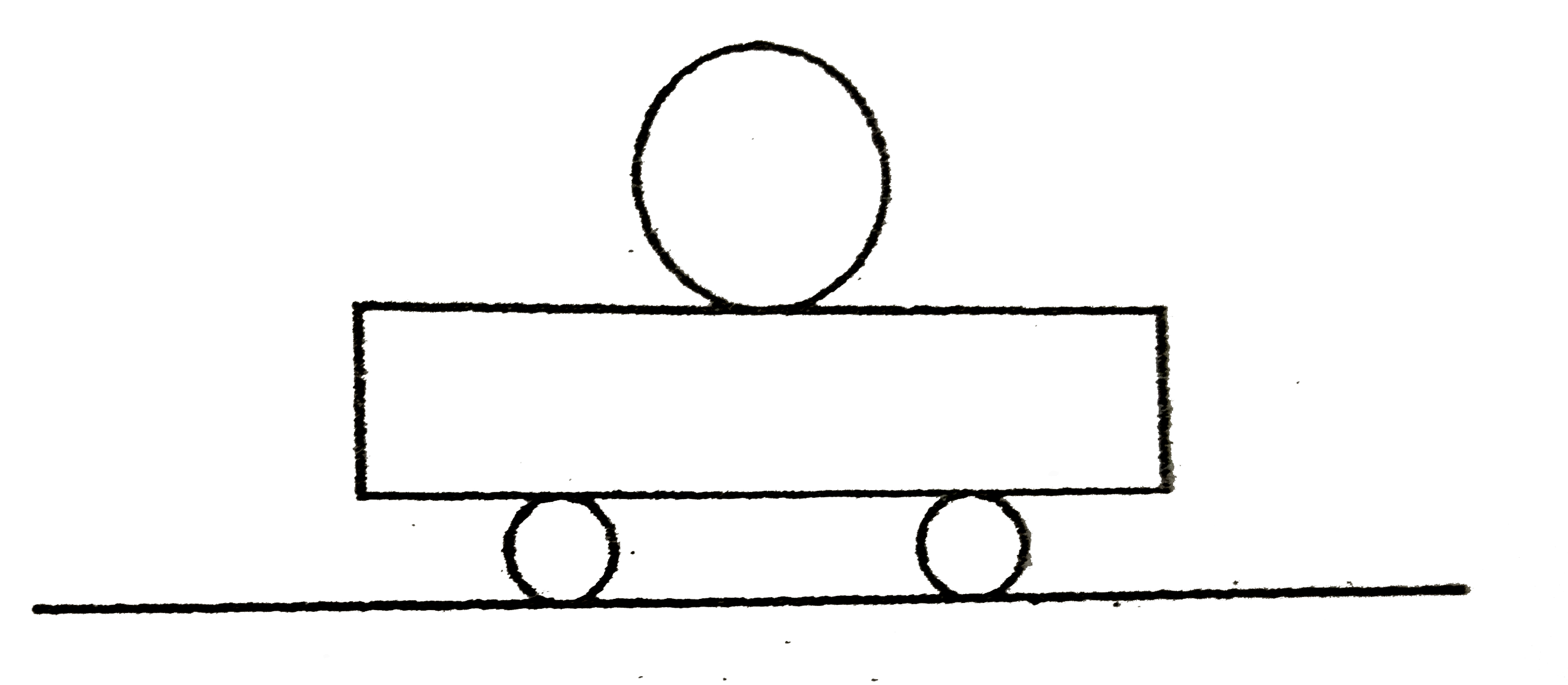
A solid sphere of mass `m` and radius `R` is placed over a plank of same mass `m`. There is sufficient friction between sphere and plank to prevent slipping.

Force of friction between sphere and plank is

Promotional Banner

Similar Questions

Explore conceptually related problems

A solid sphere of mass m and radius R is placed over a plank of same mass m . There is sufficient friction between sphere and plank to prevent slipping. Angular acceleration of sphere is

A solid sphere of mass m and radius R is placed over a plank of same mass m . There is sufficient friction between sphere and plank to prevent slipping. Acceleration of centre of mass of sphere is

A solid sphere of mass m and radius R is placed over a plank of same mass m . There is sufficient friction between sphere and plank to prevent slipping. A Horizontal force F is applied on the plank. What is the maximum value of F , if mu is coefficient of friction between sphere movment and plank and there is no slipping ?

A solid sphere of mass m and radius R is placed over a plank of same mass m . There is sufficient friction between sphere and plank to prevent slipping. When a horizontal force F is applied at centre of sphere, acceleration of the plank is

A disc of mass m and radius R is placed over a plank of same mass m. There is sufficient friction between disc and plank to prevent slipping. A force F is applied at the centre of the disc. Acceleration of the plank is

A disc of mass m and radius R is placed over a plank of same mass m. There is sufficient friction between disc and plank to prevent slipping. A force F is applied at the centre of the disc. Force of friction between the disc and the plank is

A plank of mass 10 kg and a block of mass 2 kg are placed on a horizontal plane as shown in the figure. There is no friction between plane and plank. The coefficient of friction between block and plank is 0.5 .A force of 60 N is applied on plank horizontally. In first 2 s the work done by friction on the block is

A cylinder of mass M = 2 kg and radius R = 12 cm lies on a plank of the same mass as shown in the figure. The surface between plank and ground is smooth but there is friction between cylinder and plank. If the coefficient of friction between the cylinder and the plank is mu=0.4 , then what maximum initial compression (in cm) can be given to the spring such that the cylinder moves without slipping with respect to the plank ? ["Given, "k="200 N m"^(-1)]