

Home
Class 11
PHYSICS
A solid spherical ball of radius R colli...

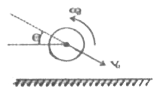
A solid spherical ball of radius R collides with a rough horizontal surface as shown in figure. At the time of collision its velocity is `v_(0)` at an angle `theta` to the horizontal and angular velocity `omega_(0)` as shown . After collision, the angular velocity of ball may

Promotional Banner

Similar Questions

Explore conceptually related problems

As per the shown figure the central solid cylinder starts with initial angular velocity omega_(0) Find the time after which the angular velocity becomes half.

A ball of mass moving with constant velocity u collides with a smooth horizontal surface at O as shown in Fig. Neglect gravity and friction. The y -axis is drawn normal to the horizontal surface at the point of impact O and x -axis is horizontal as shown. About which point will the angular momentum of ball be conserved?

A uniform solid sphere of mass m and radius r = 3m is projected along a rough horizontal surface with the initial velocity v_(0) = 6m//s and angular omega_(0) velocity as shown in the figure. If the sphere finally comes to complete rest then angular velocity is x rad/s. Find x.

A solid spherical ball rolling without slipping collides elastically with an identical ball at rest, as shown in the figure. Assuming that the frictional forces are small enough to have negligible effect during the instant of collision, calculate, the velocity of each ball along enough time after the collision when each ball is again rolling without slipping.

A solid sphere of radius R is set into motion on a rough horizontal surface with a inear speed v_(0) in forward direction and an angular with a linear speed v_(0) in forward directioin and an angular velocity omega_(0)=v_(0)//2R in counter clockwise direction as shown in figure. If coefficient of friction mu then find a. the time after which sphere starts pure rolling, b. the linear speed of sphere when it starts rolling and c. the work down by friction over a long time.

A uniform circular disc of radius r is placed on a rough horizontal surface and given a linear velocity v_(0) and angular velocity omega_(0) as shown. The disc comes to rest after moving some distance to the right. It follows that

A ball is projected horizontal from the top of a tower with a velocity v_(0) . It will be moving at an angle of 60^(@) with the horizontal after time.