

Home
Class 11
PHYSICS
A block is kept inside a hemispherical b...

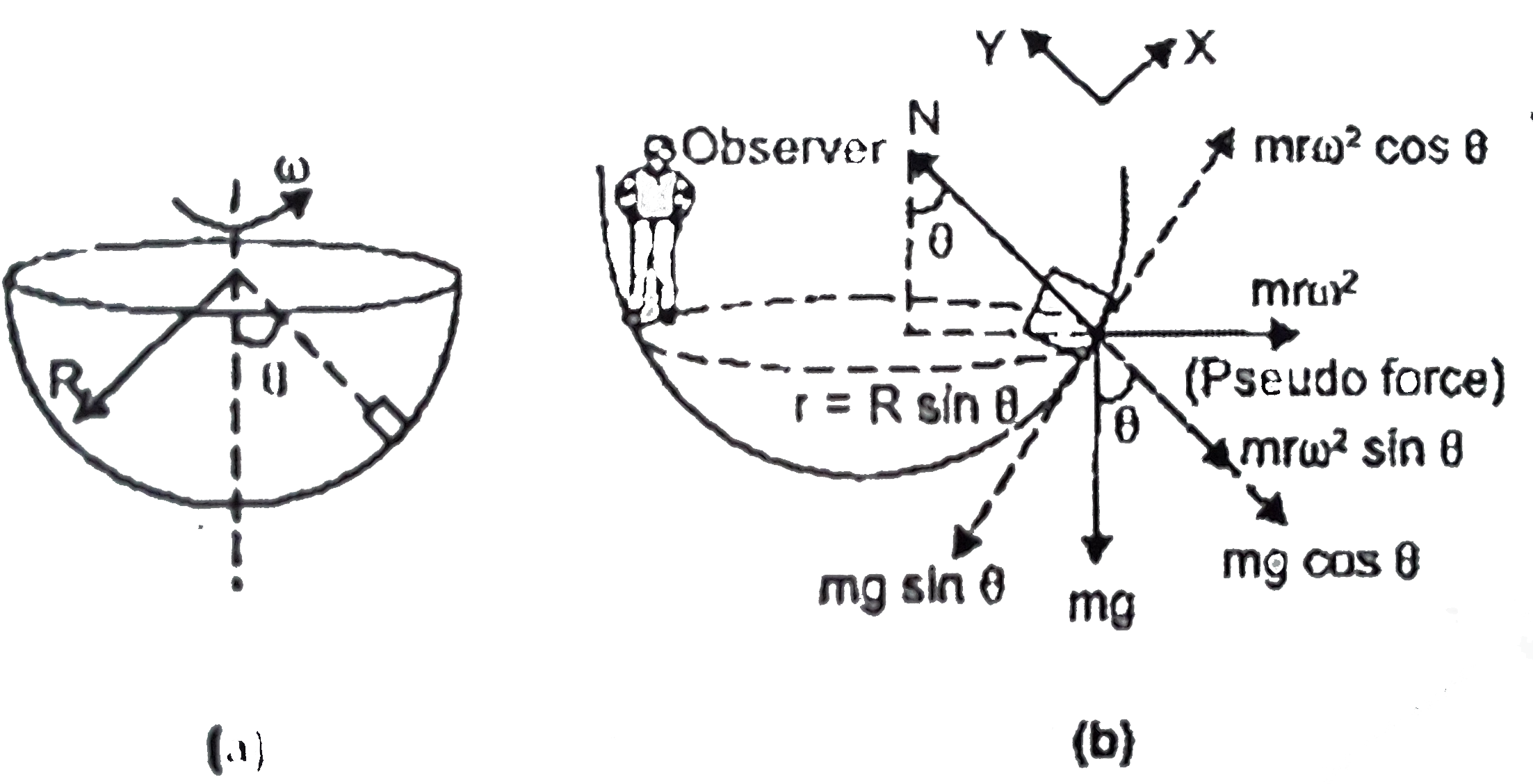
A block is kept inside a hemispherical bowl rotating with angular velocity `omega`. Inner surface of bowl is rough, coefficient of friction is `mu`. The block is kept at a position where radius makes an angle `theta` with the vertical. What is the range of the angular speed for which the block will stay at the given position?

Promotional Banner

Similar Questions

Explore conceptually related problems

A disc of mass m and radius R rotating with angular speed omega_(0) is placed on a rough surface (co-officient of friction =mu ). Then

A body of mass m and radius r is rotated with angular velocity omega as shown in the figure & kept on a surface that has sufficient friction then the body will move

A hemisphericla bowl of rdius R is rotated about its axis of symetry which is kept vertical.A small block is kept in the bowl at a position where the radius makes an angle theta with the vertical. The block rottes with the bowl without any sliping. The friction coefficient between the block and teh bowl surface is mu . Find the range of the angular speed for which the block will not slip.

A block of mass m rests on a rough horizontl surface as shown in figure (a) and (b). Coefficient of friciton between block and surface is mu . A force F-mg acting at an angle theta with the vertical side of the block. Find the condition for which block will move along the surface.

A hemispherical bowl of radius R is set rotating about its axis of symmetry which is kept vertical. A small block kept in the bowl rotates with the bowl without slipping on its surface. If the surfaces of the bowl is smooth, and the angle made by the radius through the block with the vertical is theta , find the angular speed at which the bowl is rotating.

A cylinder with radius R spins about its horizontal axis with angular speed omega . There is a small block lying on the inner surface of the cylinder. The coefficient of friction between the block and the cylinder is mu . Find the value of omega for which the block does not slip, i.e., stays at rest with respect to the cylinder.

A ring of radius R is first rotated with an angular velocity omega and then carefully placed on a rough horizontal surface. The coefficient of friction between the surface and the ring is mu . Time after which its angular speed is reduced to half is