Home
Class 12
PHYSICS
Consider the following arrangement of fo...

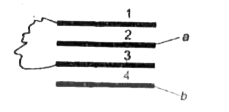
Consider the following arrangement of four plates interconnected as follows . Each plate has the area A and the polate separation is d . Here plates 1 and 3 are interconnected . Find the equivalent capacitance between a and b

Text Solution

Verified by Experts
Note that this kind of arrangement is done when we want to constant more capacitors using less number of plates . In the above arrangement we have in total three capacitors using only four plates (however ordinarily you require six plates to construct three capacitors ). This has been done by sharing the plate 2 with plate 1 and 3 has been shared by plate 2 as well as plate 4 . The method of solving this kind of problem is to sketchthe complete network of three capacitors showing each of three capacitors separately.

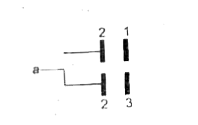
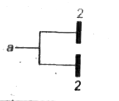
Here plate 2 and plate 3 are being shared by twop adjacent plates so in the diagram they will appear twice . Remember you have to show three capacitors using plate groups 1-2,2-3 and ,3-4 . First start with point a and you can see it is connected to plate 2 and plate has to appear twice in your network because it is being shared with plate 1 and 3 . So draw it as shown :
Now since plate 1 is on one side of plate 2 and plate 3 on the other side. draw them in front of plate 2 as shown :

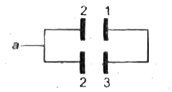
Now you see plate 1 and 3 are inter connected so join them as follow :

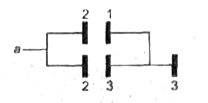
Then you see that even plate 3 is being shared by two plates viz . plate 2 and 4 . So plate 3 should also appear twice in your diagram as shown below:

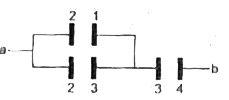
Now you note that plate 4 is in front of plate 3 and 4 is connected to point b . so draw it as follows :

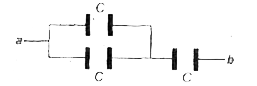
So your final diagram has three capacitors each of capacitance C`(C=(epsilon_(0)A)/(d))` in which two are connected in parallel and in series with the third one as shown :

Hence the final capacitance is `(2C'C)/(2C+C)=(2C)/(3) or (2)/(3) (epsilon_(0)A)/(d)`
Promotional Banner

Topper's Solved these Questions

  • ELECTROSTATIC POTENTIAL AND CAPACITANCE

    AAKASH INSTITUTE|Exercise TRY YOURSELF|110 Videos
  • ELECTROSTATIC POTENTIAL AND CAPACITANCE

    AAKASH INSTITUTE|Exercise ASSIGNMENT (SECTION-A) Objective Type Questions (Only one answer)|47 Videos
  • ELECTROMAGNETIC WAVES

    AAKASH INSTITUTE|Exercise ASSIGNMENT SECTION - D Assertion-Reason Type Questions|25 Videos
  • GRAVITATION

    AAKASH INSTITUTE|Exercise ASSIGNMENT SECTION - D (ASSERTION-REASON TYPE QUESTIONS)|16 Videos

Similar Questions

Explore conceptually related problems

Six plates of equal area A and plate separation as shown in figure as shown are arranged. The equivalent capacitance between A and B is

If the area of each plate is A and the separation between them is d, then find the equivalent capacitance between P and Q

If the area of each plate is A and then successive separations are d, 2d and 3d , then find the equivalent capacitance across A and B. .

Six plates each of area A arranged as shown· in figure. The separation between adjoining plates is d . Find the equivalent capacitance between points A and B :

Find out equivalent capacitance between A and B. (take each plate Area = A)

Find out equivalent capacitance between A and B. (take each plate Area = A)

Find out the capacitance of parallel plate capacitor of plate area A and plate separation d.

Consider the following arrangement of four parallel plates with plate area A each. The separation between each consecutive plate is d. The leftmost and rightmost plates are connected by a metal wire. Calculate the effective capacitance between points P and Q.

The following arrangement consists of four plates each of area A. the separation between the consecutive plates is d. what is the ratio of the effective capacitance between P and Q as shown in figures (1) and (2).

Four square plates, each with edge length a, are arranged as shown in the following figure. The equivalent capacitance between A and C is