Home
Class 11
CHEMISTRY
Which of the following curves may repres...

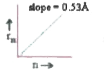
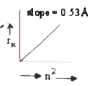
Which of the following curves may represent the radius of orbit `(r_n)` in a H-atoms as a function of principal quantum number(n)

A

B

C

D

None of these

Text Solution

AI Generated Solution

The correct Answer is:

To determine which curve represents the radius of orbit \( r_n \) in a hydrogen atom as a function of the principal quantum number \( n \), we can follow these steps: ### Step-by-Step Solution: 1. **Understand the Formula**: According to Bohr's model of the hydrogen atom, the radius of the nth orbit is given by the formula: \[ r_n = \frac{0.529 \, n^2}{Z} \text{ angstroms} \] For hydrogen, \( Z = 1 \), so the formula simplifies to: \[ r_n = 0.529 \, n^2 \text{ angstroms} \] 2. **Identify the Relationship**: The relationship between the radius \( r_n \) and the principal quantum number \( n \) is quadratic, meaning that \( r_n \) is proportional to \( n^2 \). This indicates that if we plot \( r_n \) on the y-axis and \( n \) on the x-axis, the graph will be a parabola. 3. **Analyze the Options**: - **Option 1**: If \( r_n \) is plotted against \( n \), it will not be a straight line but a curve (parabola), which is incorrect. - **Option 2**: If \( r_n \) is plotted against \( n^2 \), we can express it as: \[ r_n = 0.529 \times n^2 \] Here, if we let \( n^2 \) be on the x-axis and \( r_n \) on the y-axis, this is a linear relationship of the form \( y = mx \) where \( m = 0.529 \). This is a straight line, which is correct. - **Option 3**: This option suggests a graph that starts as a straight line and then curves, which is incorrect because the relationship is purely linear when plotted against \( n^2 \). - **Option 4**: This option states "none of these," which is also incorrect since we have identified Option 2 as correct. 4. **Conclusion**: The correct option that represents the radius of orbit \( r_n \) in hydrogen atoms as a function of the principal quantum number \( n \) is **Option 2**.

To determine which curve represents the radius of orbit \( r_n \) in a hydrogen atom as a function of the principal quantum number \( n \), we can follow these steps: ### Step-by-Step Solution: 1. **Understand the Formula**: According to Bohr's model of the hydrogen atom, the radius of the nth orbit is given by the formula: \[ r_n = \frac{0.529 \, n^2}{Z} \text{ angstroms} \] ...
Promotional Banner

Topper's Solved these Questions

  • STRUCTURE OF ATOM

    NARAYNA|Exercise EXERCISE - I (H. W.) dE-BROGLIE.S & HEISENBERG.S|2 Videos
  • STRUCTURE OF ATOM

    NARAYNA|Exercise EXERCISE - I (H. W.) QUANTUM MECHANICAL MODEL OF ATOM|6 Videos
  • STRUCTURE OF ATOM

    NARAYNA|Exercise EXERCISE - I (H. W.) H-SPECTRUM|5 Videos
  • STATES OF MATTER

    NARAYNA|Exercise A & R TYPE QUESTIONS|16 Videos
  • THERMODYNAMICS

    NARAYNA|Exercise Assertion- Reason|5 Videos

Similar Questions

Explore conceptually related problems

Which of the following curves may represent the radius of orbit (r_(n)) in H-atoms as a function of principal quantum number (n)

Which ofthe following curves may represent the energy of electron in hydrogen atom as a function of principal quantum number n:

Which of the plots shown in the figure represents speed (v_n) of the electron in a hydrogen atom as a function of the principal quantum number (n)?

Which of the following expressions represents the spectrum of Balmer series (If n is the principal quantum number of higher energy level) in Hydrogen atom ?

The principal quantum number, n describes

For a shell of principal quantum number n=4, there are:
