Home
Class 11
CHEMISTRY
AgI darr+2Na(2)S(2)O(3) to Na(3)[Ag(S(2)...

`AgI darr+2Na_(2)S_(2)O_(3) to Na_(3)[Ag(S_(2)O_(3))_(2)]+NaI`

Text Solution

Verified by Experts
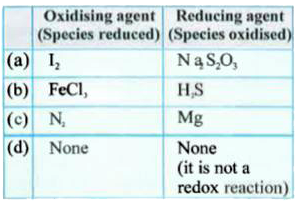

(it is not a redox reaction)
(e) `Na_(2)O_(2)" "Cr_(2)O_(3)`
(f)` Ag_(2)O" "H_(2)O_(2)`
Promotional Banner

Topper's Solved these Questions

  • REDOX REACTION

    NARAYNA|Exercise Evaluate Yourself -1|3 Videos
  • REDOX REACTION

    NARAYNA|Exercise Evaluate Yourself -2|3 Videos
  • PERIODIC TABLE

    NARAYNA|Exercise All Questions|568 Videos
  • S-BLOCK ELEMENTS

    NARAYNA|Exercise LEVEL-4|15 Videos

Similar Questions

Explore conceptually related problems

Maximum mole of Na_(4)[Cu_(6)(S_(2)O_(3))_(5)] which can be produced by 6 moles of CuSO_(4) and 10 moles of Na_(2)S_(2)O_(3) using following series of reaction- CuSO_(4)+Na_(2)S_(2)O_(3) to CuS_(2)O_(3)+Na_(2)SO_(4) 2CuS_(2)O_(3)+Na_(2)S_(2)O_(3) to Cu_(2)S_(2)O_(3)+Na_(2)S_(4)O_(6) 3Cu_(2)S_(2)O_(3)+2Na_(2)S_(2)O_(3) to Na_(4)[Cu_(6)(S_(2)O_(3))_(5)] Fill your answer to nearest integer.

632 g of sodium thiosulphate (a_(2)S_(2)O_(3)) reacts with copper sulphate to form cuproc thiosulphate which is reduced by sodium thiosulphate to give cuprous compound which is dissolved in excess of sodium thiosulphate to form a complex compound sodium cuprothisosulphate (Na_(4)[Cu_(6)(S_(2)O_(3))_(5)]) , (MW=1033) CuSO_(4) + Na_(2)S_(2)O_(3) rarr CuS_(2)O_(3) + Na_(2)SO_(4)" " [very fast] 2CuSO_(4)+Na_(2)S_(2)O_(3)+Na_(2)S_(2)O_(3) rarr Cu_(2)S_(2)O_(3) + Na_(2)S_(4)O_(6) 3Cu_(2)S_(2)O_(3) + 2Na_(2)S_(2)O_(3) rarr Na_(4)[Cu_(6)(S_(2)O_(3))_(5)] " " (Sodium cuprothisoulphate ) In this process , 0.2 mole of sodium cuprothiosulphate is formed .(O=16 , Na=23 , S=32) It instead of given amount of sodium thiosulphate, 2 moles of sodium thiosulphate along with 3 moles of CuSO_(4) were taken initially . Then, moles of sodiu cuprothiosulphate formed is:

632 g of sodium thiosulphate (a_(2)S_(2)O_(3)) reacts with copper sulphate to form cuproc thiosulphate which is reduced by sodium thiosulphate to give cuprous compound which is dissolved in excess of sodium thiosulphate to form a complex compound sodium cuprothisosulphate (Na_(4)[Cu_(6)(S_(2)O_(3))_(5)]) , (MW=1033) CuSO_(4) + Na_(2)S_(2)O_(3) rarr CuS_(2)O_(3) + Na_(2)SO_(4)" " [very fast] 2CuSO_(4)+Na_(2)S_(2)O_(3)+Na_(2)S_(2)O_(3) rarr Cu_(2)S_(2)O_(3) + Na_(2)S_(4)O_(6) 3Cu_(2)S_(2)O_(3) + 2Na_(2)S_(2)O_(3) rarr Na_(4)[Cu_(6)(S_(2)O_(3))_(5)] " " (Sodium cuprothisoulphate ) In this process , 0.2 mole of sodium cuprothiosulphate is formed .(O=16 , Na=23 , S=32) Moles of sodium thiosulophate reacted and unreacted after the reaction are respectively,

Na_(2)S_(2)O_(3)+BaCl_(2) to BaS_(2)O_(3)darr+2NaCl

NARAYNA-REDOX REACTION-Exercise -4
  1. AgI darr+2Na(2)S(2)O(3) to Na(3)[Ag(S(2)O(3))(2)]+NaI

    Text Solution

    |

  2. Which of the following represents a redox reaction?

    Text Solution

    |

  3. In the reaction SO(2)+2H(2)Srarr3S+2H(2)O the substance oxidised i...

    Text Solution

    |

  4. In the reaction 3Cl(2)+6NaOHrarrNaClO(3)+5NaCl+3H(2)O the element ...

    Text Solution

    |

  5. The oxidation number of oxygen in OF(2) is

    Text Solution

    |

  6. An oxidation process involves

    Text Solution

    |

  7. Which of the following is the strongest reducing agent in aqueous medi...

    Text Solution

    |

  8. Which of the following is the strongest oxidising agent?

    Text Solution

    |

  9. The oxidation number of phosphorus in Ba(H(2)PO(2))(2) is:-

    Text Solution

    |

  10. Which of the following reactions do not involve oxidation reduction ? ...

    Text Solution

    |

  11. For the redox reaction MnO(4)^(ө)+C(2)O(4)^(2-)+H^(o+)rarrMn^(2+)+CO...

    Text Solution

    |

  12. The oxidation state of nitrogen is correctly given for

    Text Solution

    |

  13. The oxidation state of chromium in Cr(CO)(6) is

    Text Solution

    |

  14. Which of the following is not a redox reaction?

    Text Solution

    |

  15. In the chemical reaction, K(2)Cr(2)O(7)+xH(2)SO(4)+ySO(2)rarrK(2)SO(...

    Text Solution

    |

  16. One mole of N(2)H(4) loses ten moles of electrons of form a new compou...

    Text Solution

    |

  17. When copper is treated with a certain concentration of nitric acid, ni...

    Text Solution

    |

  18. In which of the following pairs is there the greatest difference in th...

    Text Solution

    |

  19. In the reaction 3Br(2) + 6CO(3)^(2-) + 3H(2)O to 5Br^(-) + 2BrO(3)^(...

    Text Solution

    |

  20. In the reaction 2FeCl(3)+H(2)Srarr2FeCl(2)+2HCl+S

    Text Solution

    |

  21. The oxidation number of cobalt in K[Co(CO)(4)] is:

    Text Solution

    |

