Home
Class 11
CHEMISTRY
Fe^(2+)(aq.)+Cr(2)O(7)^(2-)+H^(+) to Fe^...

`Fe^(2+)(aq.)+Cr_(2)O_(7)^(2-)+H^(+) to Fe^(3+)(aq.)+Cr^(3+)`

Text Solution

Verified by Experts
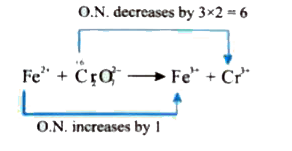
Step -1,2

For equation multiplied with 6 and `Cr_(2)O_(7)^(-2)` equation multiplied with 1
`6Fe^(2+)+overset(+6)(Cr_(2)O_(7)^(2-)) to 6Fe^(3+)+2Cr^(3+)`
Balance all the atoms other than O and H `6Fe^(2+)+Cr_(2)O_(7)^(2-) to 6Fe^(3+)+2Cr^(3+)`
Balance the O by adding `H_(2)O` molecule
`6Fe^(2+)+Cr_(2)O_(7)^(2-)+14H^(+) to 6Fe^(3+)+7H_(2)O`
Promotional Banner

Topper's Solved these Questions

  • REDOX REACTION

    NARAYNA|Exercise Evaluate Yourself -1|3 Videos
  • REDOX REACTION

    NARAYNA|Exercise Evaluate Yourself -2|3 Videos
  • PERIODIC TABLE

    NARAYNA|Exercise All Questions|568 Videos
  • S-BLOCK ELEMENTS

    NARAYNA|Exercise LEVEL-4|15 Videos

Similar Questions

Explore conceptually related problems

Balance the equation by lon-electron method (ix) Cr_(2)O_(7)^(2-) + Fe^(2+) to Fe^(3+) +Cr^(3+) (In acidic medium)

A 100 mL sample of water was treated to convert any iron present to Fe^(2+) . Addition of 25mL of 0.002M K_(2)Cr_(2)O_(7) resulted in the reaction. 6Fe^(2+)+Cr_(2)O_(7)^(2-)+14H^(+) to 6Fe^(3+)+2Cr^(3+)+7H_(2)O The excess K_(2)Cr_(2)O_(7) was back- titrated with 7.5mL of .01M Fe^(2+) solution. Calculate the parts per million (ppm) of iron in the water sample.

Complete the following chemical equations : (i) MnO_(4)^(-) (aq) + S_(2)O_(3)^(2-) (aq) + H_(2) O(l) to1 (ii) Cr_(2)O_(7)^(2-) (aq) + Fe^(2+)(aq) + H^(+) (aq) to

In the following redox reactionn, Cr_(2)O_(7)^(2-) + Fe^(2+) to Fe^(3+) + Cr^(3+) 1 mole of Cr_(2)O_(7)^(2-) oxidises.

Standard electrode potential data are useful for understanding the suitability of an oxidant in a redox titration. Some half cell reaction and their standard potentials are given below: MnO_(4)^(-)(aq) +8H^(+)(aq) +5e^(-) rarr Mn^(2+)(aq) +4H_(2)O(l) E^(@) = 1.51V Cr_(2)O_(7)^(2-)(aq) +14H^(+) (aq) +6e^(-) rarr 2Cr^(3+)(aq) +7H_(2)O(l), E^(@) = 1.38V Fe^(3+) (aq) +e^(-) rarr Fe^(2+) (aq), E^(@) = 0.77V CI_(2)(g) +2e^(-) rarr 2CI^(-)(aq), E^(@) = 1.40V Identify the only incorrect statement regarding quantitative estimation of aqueous Fe(NO_(3))_(2)

NARAYNA-REDOX REACTION-Exercise -4
  1. Fe^(2+)(aq.)+Cr(2)O(7)^(2-)+H^(+) to Fe^(3+)(aq.)+Cr^(3+)

    Text Solution

    |

  2. Which of the following represents a redox reaction?

    Text Solution

    |

  3. In the reaction SO(2)+2H(2)Srarr3S+2H(2)O the substance oxidised i...

    Text Solution

    |

  4. In the reaction 3Cl(2)+6NaOHrarrNaClO(3)+5NaCl+3H(2)O the element ...

    Text Solution

    |

  5. The oxidation number of oxygen in OF(2) is

    Text Solution

    |

  6. An oxidation process involves

    Text Solution

    |

  7. Which of the following is the strongest reducing agent in aqueous medi...

    Text Solution

    |

  8. Which of the following is the strongest oxidising agent?

    Text Solution

    |

  9. The oxidation number of phosphorus in Ba(H(2)PO(2))(2) is:-

    Text Solution

    |

  10. Which of the following reactions do not involve oxidation reduction ? ...

    Text Solution

    |

  11. For the redox reaction MnO(4)^(ө)+C(2)O(4)^(2-)+H^(o+)rarrMn^(2+)+CO...

    Text Solution

    |

  12. The oxidation state of nitrogen is correctly given for

    Text Solution

    |

  13. The oxidation state of chromium in Cr(CO)(6) is

    Text Solution

    |

  14. Which of the following is not a redox reaction?

    Text Solution

    |

  15. In the chemical reaction, K(2)Cr(2)O(7)+xH(2)SO(4)+ySO(2)rarrK(2)SO(...

    Text Solution

    |

  16. One mole of N(2)H(4) loses ten moles of electrons of form a new compou...

    Text Solution

    |

  17. When copper is treated with a certain concentration of nitric acid, ni...

    Text Solution

    |

  18. In which of the following pairs is there the greatest difference in th...

    Text Solution

    |

  19. In the reaction 3Br(2) + 6CO(3)^(2-) + 3H(2)O to 5Br^(-) + 2BrO(3)^(...

    Text Solution

    |

  20. In the reaction 2FeCl(3)+H(2)Srarr2FeCl(2)+2HCl+S

    Text Solution

    |

  21. The oxidation number of cobalt in K[Co(CO)(4)] is:

    Text Solution

    |

