Home
Class 11
CHEMISTRY
Balance the net equtation fro th reactio...

Balance the net equtation fro th reaction of potassium dichromate (VI), `K_(2) Cr_(2) O_(7)`, with sodium sulphite, `Na_(2)SO_(3)`, in an acid solution to give chromium (III) ion and and sulphate ion.
Strategy : Follow the seven -step proceduce , one step at a time.

Text Solution

Verified by Experts
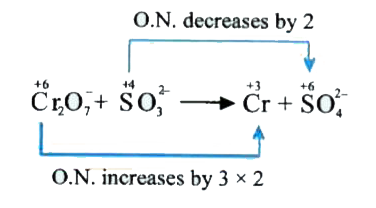
Skeleton equation is `Cr_(2)O_(7)^(-) +SO_(3)^(2-) to Cr^(3+) +SO_(4)^(2-)`

`Cr_(2)O_(7)^(2-)+ 3SO_(3)^(2-) to 2Cr^(3+)+3SO_(4)^(2-)`
`Cr_(2)O_(7)^(2-)+3SO_(3)^(2-) to 2Cr^(3+)+3SO_(4)^(2-)+4H_(2)O`
`Cr_(2)O_(7)^(2-)+3SO_(3)^(2-) to 8H^(+) to 3SO_(4)^(2-)+4H_(2)O`
Promotional Banner

Topper's Solved these Questions

  • REDOX REACTION

    NARAYNA|Exercise Evaluate Yourself -1|3 Videos
  • REDOX REACTION

    NARAYNA|Exercise Evaluate Yourself -2|3 Videos
  • PERIODIC TABLE

    NARAYNA|Exercise All Questions|568 Videos
  • S-BLOCK ELEMENTS

    NARAYNA|Exercise LEVEL-4|15 Videos

Similar Questions

Explore conceptually related problems

Balance the following equation is alkaline medium Zn(s) = N_(3)^(-) (aq) rarr Zn^(2+) (aq.) + NH_(4)^(+) (aq) . Strategy : Follow the seven-step procedure, one step at a time.

Write balanced redox reactions for each of the following reactions: (a) Potassium dichromate (K_(2)Cr_(2)O_(7)) reacts with hydroiodic acid (HI) to produce potassium iodide, chromium (III) iodide, and solid iodine, I_(2)(s) . (b) A purple solution of aqueous potassium permanganate (KMnO_(4)) reacts with aqueous sodium sulphite (Na_(2)SO_(3)) in basic solution to yield the green magnanate ion (MnO_(4)^(2-)) and sulphate ion (SO_(4)^(2-)) . (c ) Sn^(2+) (aq) reduce I_(4)^(Ө)(aq) to I^(Ө)(aq) and is oxidised to Sn^(4+) . (d) H_(2)O_(2)(aq) oxidises Mn^(2+)(aq) to MnO_(2) in basic medium. (e) H_(2)O_(2)(aq) reduces Cr_(2)O_(7)^(2-) (aq) to green coloured Cr^(3+)(aq) in acidic medium.

Acidified K_(2)Cr_(2)O_(7) , solution turns green when Na_(2)SO_(3) is added to it. Thus is due to the formation of

Acidified K_(2)Cr_(2)O_(7) solution turns green when Na_(2)SO_(3) is added to it. This is due to the formation of

Write the equations for the reaction of phenol with the following: (i) Br_(2) water (ii) CHCl_(3)+NaOH (iii) Na_(2)Cr_(2)O_(7)+Conc. H_(2)SO_(4) .

In a redox reaction, dichromate ion (Cr_(2)O_(7)^(2-)) is reduced to Cr^(3+) ion, the equivalent mass of K_(2)Cr_(2)O_(7) in this reaction is :

NARAYNA-REDOX REACTION-Exercise -4
  1. Balance the net equtation fro th reaction of potassium dichromate (VI)...

    Text Solution

    |

  2. Which of the following represents a redox reaction?

    Text Solution

    |

  3. In the reaction SO(2)+2H(2)Srarr3S+2H(2)O the substance oxidised i...

    Text Solution

    |

  4. In the reaction 3Cl(2)+6NaOHrarrNaClO(3)+5NaCl+3H(2)O the element ...

    Text Solution

    |

  5. The oxidation number of oxygen in OF(2) is

    Text Solution

    |

  6. An oxidation process involves

    Text Solution

    |

  7. Which of the following is the strongest reducing agent in aqueous medi...

    Text Solution

    |

  8. Which of the following is the strongest oxidising agent?

    Text Solution

    |

  9. The oxidation number of phosphorus in Ba(H(2)PO(2))(2) is:-

    Text Solution

    |

  10. Which of the following reactions do not involve oxidation reduction ? ...

    Text Solution

    |

  11. For the redox reaction MnO(4)^(ө)+C(2)O(4)^(2-)+H^(o+)rarrMn^(2+)+CO...

    Text Solution

    |

  12. The oxidation state of nitrogen is correctly given for

    Text Solution

    |

  13. The oxidation state of chromium in Cr(CO)(6) is

    Text Solution

    |

  14. Which of the following is not a redox reaction?

    Text Solution

    |

  15. In the chemical reaction, K(2)Cr(2)O(7)+xH(2)SO(4)+ySO(2)rarrK(2)SO(...

    Text Solution

    |

  16. One mole of N(2)H(4) loses ten moles of electrons of form a new compou...

    Text Solution

    |

  17. When copper is treated with a certain concentration of nitric acid, ni...

    Text Solution

    |

  18. In which of the following pairs is there the greatest difference in th...

    Text Solution

    |

  19. In the reaction 3Br(2) + 6CO(3)^(2-) + 3H(2)O to 5Br^(-) + 2BrO(3)^(...

    Text Solution

    |

  20. In the reaction 2FeCl(3)+H(2)Srarr2FeCl(2)+2HCl+S

    Text Solution

    |

  21. The oxidation number of cobalt in K[Co(CO)(4)] is:

    Text Solution

    |

