A
B
C
D
Text Solution
Verified by Experts



Topper's Solved these Questions
Similar Questions
Explore conceptually related problems
NARAYNA-REDOX REACTION-Exercise -4
- The equivalent mass of oxidising agent in the following reaction is ...
Text Solution
|
- In alkaline medium, ClO(2) oxidises H(2)O(2) "to" O(2) and is itself r...
Text Solution
|
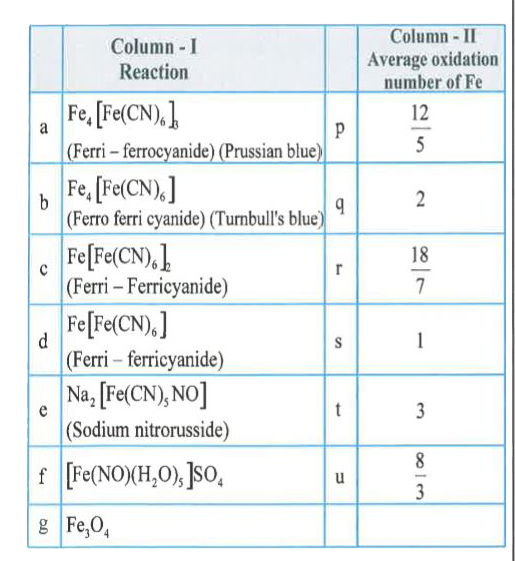
- Match the reaction in column I with average number given in column II.
Text Solution
|
- Assertion (A): H(2)O(2) acts only as an oxidising agnet. H(2)O(2)rar...
Text Solution
|
- Assertion (A): KMnO(4) is a stronger oxidising agent than K(2)Cr(2)O(7...
Text Solution
|
- Assertion (A): SO(2) and Cl(2) are both bleaching agents. Reason (R ...
Text Solution
|
- Assertion (A): F(2) undergoes disproportionation reaction. Reason (R...
Text Solution
|
- Assertion (A): Sn reacts with HCl to produce H(2) gas. Reason (R ): ...
Text Solution
|
- Assertion (A): In aqueous solution, SO(2) reacts with H(2)S liberating...
Text Solution
|
- Assertion (A): PbCl(2) is more stable than PbCl(4). Reason (R ): P...
Text Solution
|
- Assertion (A):F(2) is stronger reducing agent than O(2) Reason (R ):...
Text Solution
|
- Assertion (A): The two Fe atoms in Fe(3)O(4) have different oxidation ...
Text Solution
|
- Assertion (A): HNO(3) acts only as an oxidising agent, while HNO(2) ac...
Text Solution
|
- Assertion (A): O(3) can act as an oxidising agent as wll as a reducing...
Text Solution
|
- Assertion (A): Sodium perxenate (Na(4)XeO(6)) reacts with NaF in acidi...
Text Solution
|
- Assertion (A): In the process of drying dishes with a towel, the wetti...
Text Solution
|
- Assertion (A): A reaction between Fe and I(2) occurs, but a reaction b...
Text Solution
|
- Assertion: (A): The reactions between NH(3) and MnO(4)^(ө) occurs in a...
Text Solution
|
- Oxidation number of nickel in Ni(CI)(4)
Text Solution
|
- Assertion :- H(2)S+Cl(2)rarr2HCl+S In the above reaction, Cl has bee...
Text Solution
|