Home
Class 12
CHEMISTRY
A homogenous catalytic reaction takes pl...

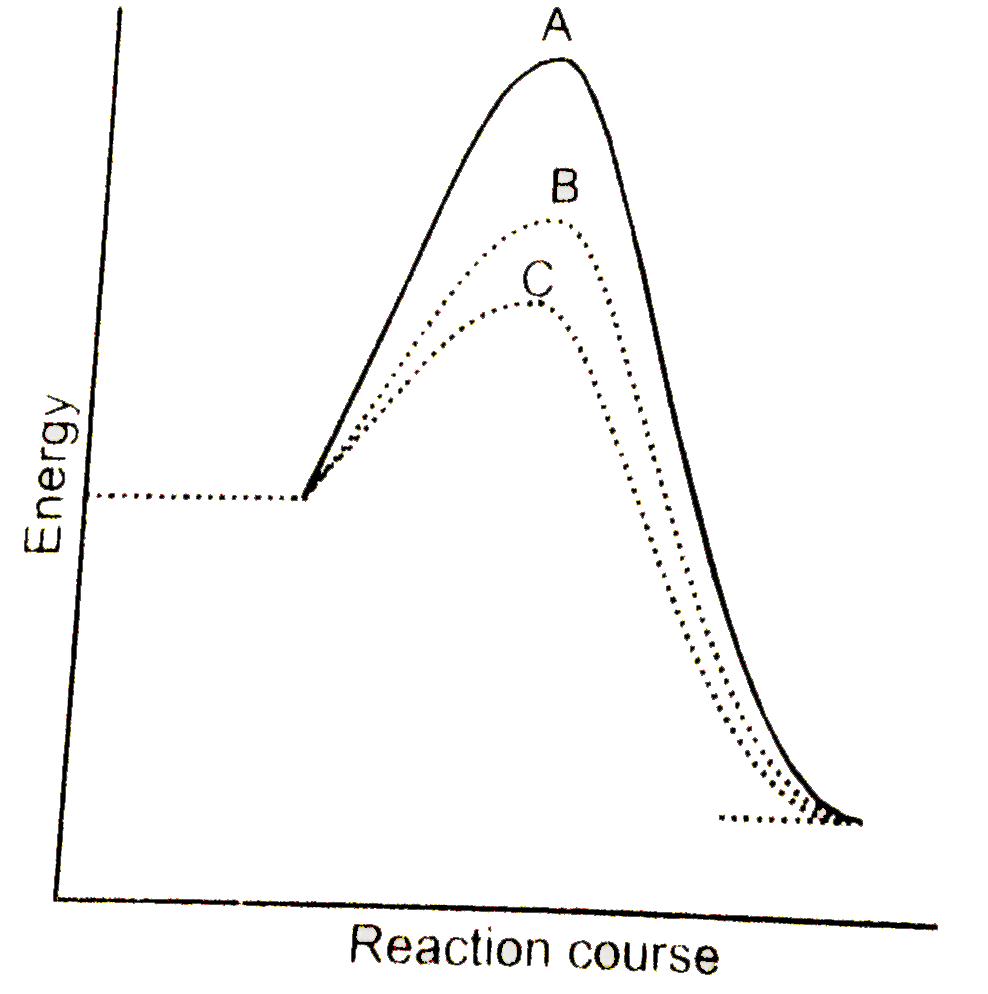
A homogenous catalytic reaction takes place through the three alternative plots A, B, and C shown in the given figure. Which one of the following indicates the relative ease with which the reaction cant take place?

A

`A gt B gt C `

B

`C gt B gt A `

C

`B gt C gt A `

D

A = B =C

Text Solution

Verified by Experts

The correct Answer is:

A

Lesser is the activation energy greater is the ease with which the reaction can take place
Promotional Banner

Topper's Solved these Questions

  • SURFACE CHEMISTRY

    NARAYNA|Exercise EXERCISE -2 (C.W. ) COLLOIDS|29 Videos
  • SURFACE CHEMISTRY

    NARAYNA|Exercise EXERCISE -2 (H.W. ) ADSORPTION|5 Videos
  • SURFACE CHEMISTRY

    NARAYNA|Exercise EXERCISE -2 (C.W. ) CATALYSIS|1 Videos
  • SOLUTIONS & COLLIGATIVE PROPERTIES

    NARAYNA|Exercise EXERCISE : 4|26 Videos

Similar Questions

Explore conceptually related problems

Substances which alter the velocity of a reaction by mere presence, without undergoing any change in mass and compossition are termed catalyst and the phenomenon is known as catalysis In homogenous catalytic reactions, there are three alternative paths A, B, and C (shown in figure). Which one of the following indicates the relative ease with which the reaction can take place?

If a homogeneous catalytic reaction follows three alternative paths A, B and C, then which of the following indicates the relative ease with which the reaction moves?

Which reaction take place at the fastest rate?

Which of the following reaction does not take place ?

Which out of the following reactions does not take place ?

Which of the following reaction does not take place?

If a homogeneous catalytic reaction can take place through three alternative paths as depicted below, the catalytic efficiency of P,Q R representing the relative case would be

NARAYNA-SURFACE CHEMISTRY -EXERCISE -2 (C.W. ) ADSORPTION
  1. Chromatography is a technique based on

    Text Solution

    |

  2. The volume of gases H(2), CH(4), CO(2) and NH(3) adsorbed by 1 g of ch...

    Text Solution

    |

  3. Which of the following processes of metallurgy involves adsorption ?

    Text Solution

    |

  4. According to langmuir adsorption isotherm amount of gas adsorbed at ve...

    Text Solution

    |

  5. Which of the following relations is /are correct? (i) x//m= constant...

    Text Solution

    |

  6. A catalyst :

    Text Solution

    |

  7. In a reversible reaction a catalyst :-

    Text Solution

    |

  8. Which of the following is not an example of homogeneous catalysis?

    Text Solution

    |

  9. The decomposition of hydrogen peroxide can be slowed by the addition o...

    Text Solution

    |

  10. Freundlich adsorption isotherm is given by the expression (x)/(m) = kP...

    Text Solution

    |

  11. In which of the following process, a catalyst is not used ?

    Text Solution

    |

  12. Adsorption is a surface phenomenon and it differs feom adsorption whic...

    Text Solution

    |

  13. Organic catalysts differ from inorganic catalysts

    Text Solution

    |

  14. Which one of the following is not a homogeneous catalytic reaction ?

    Text Solution

    |

  15. Decomposition of urea into NH(3) and CO(2) is followed by the action o...

    Text Solution

    |

  16. Which of the following enzyme is used in the conversion of proteins to...

    Text Solution

    |

  17. Zeolites are microporous catalyst. General formula of Zeolite may be g...

    Text Solution

    |

  18. CH(3)COCI+H(2)overset(Pd)(rarr)CH(3)CH(2)OH overset(Pd//BaSO(4))und...

    Text Solution

    |

  19. An example of auto - catalytic reaction is

    Text Solution

    |

  20. A homogenous catalytic reaction takes place through the three alternat...

    Text Solution

    |
