Home
Class 12
CHEMISTRY
Assertion: [CoF(6)]^(3-) is a paramagnet...

Assertion: `[CoF_(6)]^(3-)` is a paramagnetic.
Reason: `Co^(3+)" has 3d"^(6)` outer electronic configuration. The unpaired electrons do not pair up because of weak field provided by `F^(-)`.

A

Both Assertion and Reason are true and Reason is the correct explanation of Assertion

B

Both Assertion and Reason are true but Reason is not the correct explanation of Assertion

C

Assertion is true but Reason is false

D

Both Assertion and Reason are false

Text Solution

Verified by Experts

The correct Answer is:

A

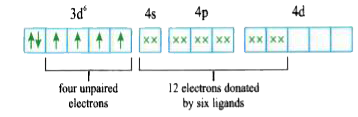
In complex `[CoF_(6)]^(3-)`
Oxidation number of Co =+3
Electronic configuration of `Co^(3+)=1s^(2), 2s^(2), 2p^(6), 3s^(2), 3p^(6), 3d^(6)`
In `Co^(3+)`

In `Co^(3+)` number of unpaired electrons is four, and `F^(-)` is the ligand of weak field, hence, it does not paired up electrons of d-orbital. So, `In[CoF_(6)]^(3-)`

So, `[CoF_(6)]^(3-)` is paramagnetic.
`Co^(3+)" has "3d^(6)` outer electronic configuration, but four unpaired electrons do not pair up because of weak field provided by `F^(-)`.
Promotional Banner

Topper's Solved these Questions

  • CO-ORDINATE COMPOUNDS

    NARAYNA|Exercise Exercise-4|60 Videos
  • CO-ORDINATE COMPOUNDS

    NARAYNA|Exercise Exercise -2 (H.W.)|20 Videos
  • CHEMISTRY OF HEAVY METALS

    NARAYNA|Exercise Passage 13|1 Videos
  • COORDINATION COMPLEXES

    NARAYNA|Exercise Compreshession type question|12 Videos

Similar Questions

Explore conceptually related problems

Assertion : O_(2) is paramagnetic. Reason : It has one unpaired electron.

Chromium has the electronic configuration 4s^1 3d^5 rather than 4s^2 3d^4 because

Assertion : Fe^(2+) has 3de electronic configuration. Reason : Electrons are lost from 4s-orbital to form Fe^(2+) ion.

[FeF_(6)]^(3-) is paramagnetic due to presence of unpaired electrons in the complex . The five electrons remain unpaired because

Assertion NH_(3) is an electron precise hydride. Reason : NH_(3) has one loone pair of electrons on N atom.

Number of unpaired electrons increases in 3d series up to

Assertion : [Fe(H_(2)O)_(6)]^(2+) is sp^(3) d^(2) hybridised and paramagnetic complex ion . Reason : [Fe(H_(2)O)_(6)]^(2+) has four unpaired electrons as H_(2)O is a weak field ligand .

NARAYNA-CO-ORDINATE COMPOUNDS -Exercise-3
  1. Which of the following complexes exhibits the highest paramagnetic beh...

    Text Solution

    |

  2. In which of the following coordination entities the magnitude of Delta...

    Text Solution

    |

  3. Assertion: [CoF(6)]^(3-) is a paramagnetic. Reason: Co^(3+)" has 3d"...

    Text Solution

    |

  4. Which of the following does not show optical isomerism ?

    Text Solution

    |

  5. Which of the following complex ions is expected to absorb visible ligh...

    Text Solution

    |

  6. Which of the following coordination entities should be expected to abs...

    Text Solution

    |

  7. Assertion : CO and CN^(-) are referred as p acid L ligands. Reason :...

    Text Solution

    |

  8. Assertion : If beta(4)" for "[Cu(NH3)(4)]^(2+)" is "2.1 xx 10^(13) its...

    Text Solution

    |

  9. Assertion: K(4)[Fe(CN(6)] is diamagnetic and [Fe(H(2)O)(6)]Cl(3) is pa...

    Text Solution

    |

  10. What is (are) number (s) of unpaired electron(s) in the square planar ...

    Text Solution

    |

  11. IUPAC name of [Fe(CN)(6)]^(3-) ion is

    Text Solution

    |

  12. Crystal field stabilization energy for high spin d^4 octahedral comple...

    Text Solution

    |

  13. The existence of two different coloured comlexes with the composition ...

    Text Solution

    |

  14. Which of the following complex ion is not expected to absorb visible l...

    Text Solution

    |

  15. AgCl dissolved in excess of NH(3), KCN and Na(2)S(2)O(3) solutions the...

    Text Solution

    |

  16. The most stable complex among the following

    Text Solution

    |

  17. Choose the correct statement

    Text Solution

    |

  18. In the complex ion [CoNH(3))(6)]^(3+) , the NH(3) molecules are li...

    Text Solution

    |

  19. The d-electron configurations of Cr^(2+), Mn^(2+), Fe^(2+) and Co^(2+)...

    Text Solution

    |

  20. Of the following complex ions, which is diamagnetic in natures?

    Text Solution

    |