

Home
Class 11
PHYSICS
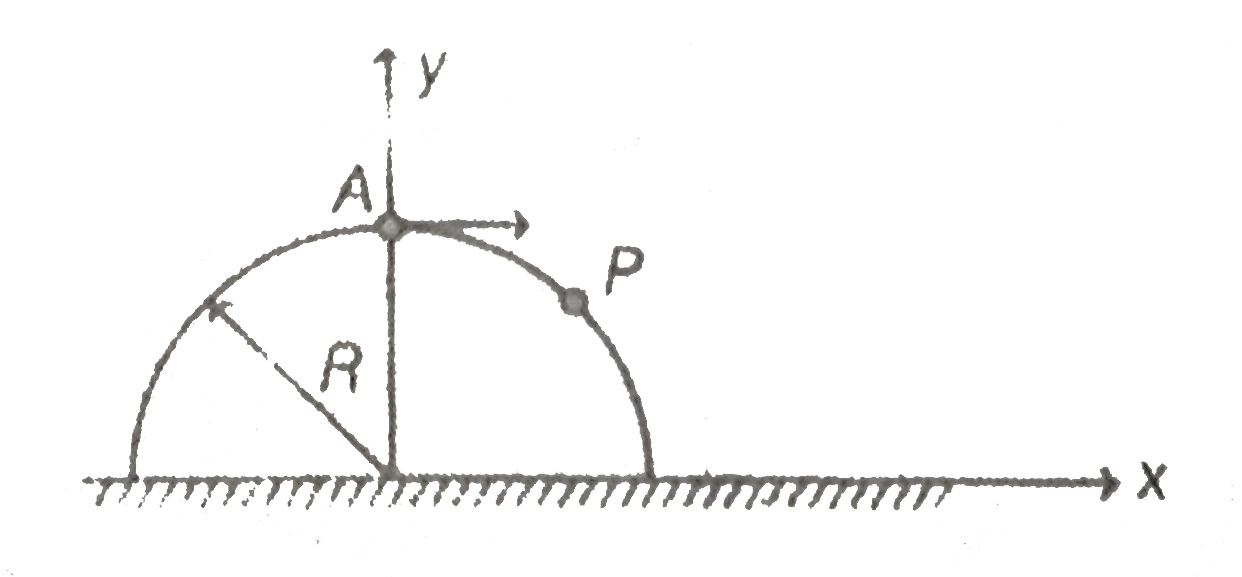
A small particle is placed at the top po...

A small particle is placed at the top point A of a fixed smooth hemisphere of radius R. Particle is given small displacement towards right and it starts slipping. Calculate velocity of the particle after hitting horizontal perfectly inelastic surface.

Promotional Banner

Similar Questions

Explore conceptually related problems

A small ball is placed at the top of a smooth hemispherical wedge of radius R. If the wedge is accelerated with an acceleration a, find the velocity of the ball relative to wedge as a function of theta .

A small ball is placed at the top of a smooth hemispherical wedge of radius R. If the wedge is accelerated with an acceleration a, find the velocity of the ball relative to wedge as a function of theta .

A particle at angular position theta_(0) inside a fixed smooth hemispherical bowl of radius r is projected horizontally with velocity v_(0) . Calculate its value so that the particle may rise to the top.

A particle of mass m is released from the top of a smooth hemisphere of radius R with the horizontal speed mu . Calculate the angle with verticle where it loses contact with the hemisphere.

A particle of mass m is kept on the top of a smooth sphere of radius R. It is given a sharp impulse which imparts it a horizontal speed v. a. find the normal force between the sphere and the particle just after the impulse. B. What should be the minimum value of v for which the particle does not slip on the sphere? c. Assuming the velocity v to be half the minimum calculated in part, d. find the angle made by the radius through the particle with the vertical when it leaves the sphere.

A small particle rest on the top of a hemisphere of radius 20 cm .The smallest horizontal velocity os given to it , if it is to leave the hemisphere without sliding down to its surface ,is

A small particle rests on the top of a hemisphere of radius 20 cm. The smallest horizontal velocity given to it, if it is to leave the hemisphere without sliding down along its surface, is