

Home
Class 11
PHYSICS
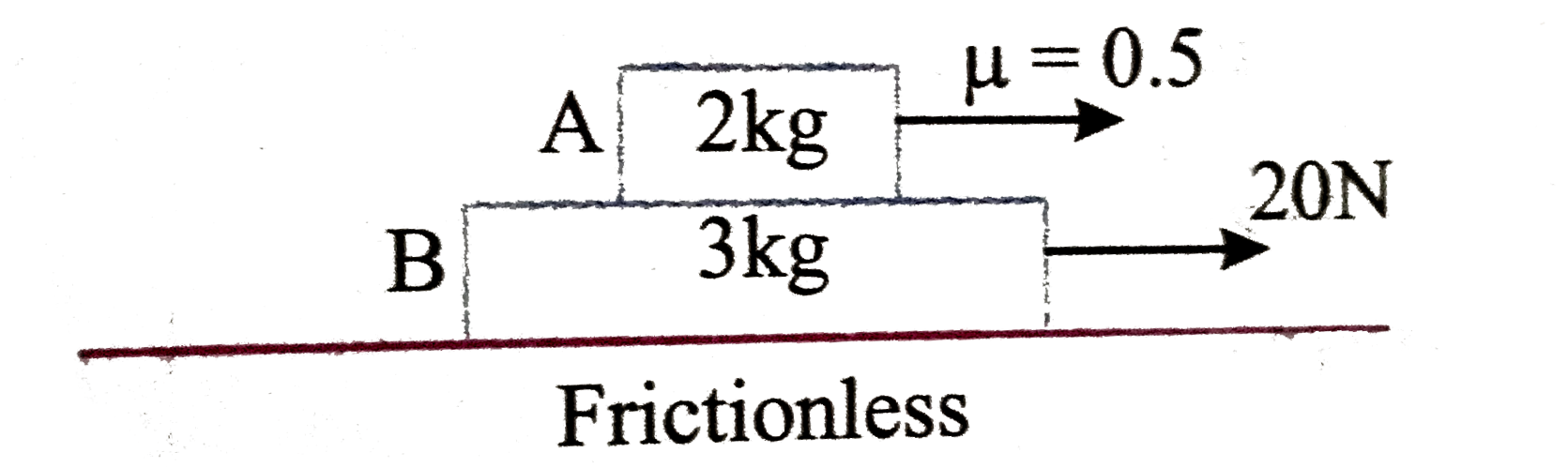
Two block A and B are placed one over ot...

Two block `A` and `B` are placed one over other. Blocks `B` is acted upon by a force of `20 N` which displaces it through `5 m`. Find work done by frictional force on block `A`.
.

Promotional Banner

Similar Questions

Explore conceptually related problems

Friction force acting on the block is?

A block of mass 5kg is resting on a rough surface as shown in the figure. It is acted upon by a force of F towards right. Find frictional force acting on block when 25N.

If block displaces right and work done by both forces is equal find F_A/F_B

A small block of mass 20kg rests on a bigger block of mass 30kg , which lies on a smooth horizontal plane. Initially the whole system is at rest. The coefficient of friction between the blocks is 0.5 . The horizontal force F=50N is applied on the lower block. a. Find the work done by fricitonal force on upper block and on the lower block in t=2s . b. Is the magnitude of work done by the frictional force on upper and lower blocks same? c. Is the work done by the frictional force on the upper block converted to heat or mechanical energy or both?

A small block of mass 20kg rests on a bigger block of mass 30kg , which lies on a smooth horizontal plane. Initially the whole system is at rest. The coefficient of friction between the blocks is 0.5 . The horizontal force F=50N is applied on the lower block. a. Find the work done by fricitonal force on upper block and on the lower block in t=2s . b. Is the magnitude of work done by the frictional force on upper and lower blocks same? c. Is the work done by the frictional force on the upper block converted to heat or mechanical energy or both?

A block is pushed by a force F = 10 N. A frictional force of 2 N acts between the block and the surface. Find the work done by the friction when the block moves 10 m.

A block of mass m is kept over another block of mass M and the system rests on a horizontal surface. A constant horizontal force F acting on the lower block produces an acceleration (F)/(2(m+M)) in the sytem. The two blocks always move together. Consider displacement d of the system. a. Find the work done by friction on bigger block. b. Find the coefficient of kinetic friction between the bigger block and the horizontal surface. c. Find the frictional acting on the smaller block. d. Find the work done by the force of friction on the smaller block by the bigger block. e. Find the work done by static friction on bigger block.

A block of mass m is kept over another block of mass M and the system rests on a horizontal surface. A constant horizontal force F acting on the lower block produces an acceleration (F)/(2(m+M)) in the sytem. The two blocks always move together. Consider displacement d of the system. a. Find the work done by friction on bigger block. b. Find the coefficient of kinetic friction between the bigger block and the horizontal surface. c. Find the frictional acting on the smaller block. d. Find the work done by the force of friction on the smaller block by the bigger block. e. Find the work done by static friction on bigger block.

A block of mass m is kept on a horizontal table. If the static friction coefficient is mu ., find the frictional force acting on the block.

A block of mass m is kept on a horizontal table. If the static friction coefficient is mu ., find the frictional force acting on the block.