

Home
Class 12
PHYSICS
A charged particle initially at rest at ...

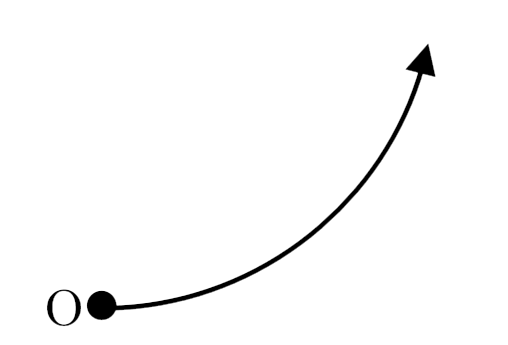
A charged particle initially at rest at O, when released follows a trajectory as shown. Such a trajectory is possible in the presence of

Promotional Banner

Similar Questions

Explore conceptually related problems

A charged particle, initially at rest O, when released follows a trajectory as shown. Such a trajectory is possible in the presence of

When A Particle follow A Projectile?|Equation Of Trajectory |OMR

A charged particle enters at 90^@ to a unifrm magnetic field. The locus of its trajectory will be

A particle initially at rest is released from A as shown in figures. The approximate variation of direction of resultant acceleration as particle moves from A to B is :

A charged particle q is moving in the presence of a magnetic field B which is inclined to an angle 30° with the direction of the motion of the particle. Draw the trajectory followed by the particle in the presence of the field and explain how the particle describes this path.

When a positively charged particle enters into a uniform magnetic field with uniform velocity its trajectory can be i) a straight line ii) a circle iii) a helix

Path traced by a moving particle in space is called trajectory of the particle. Shape of trajectiry is decided by the forces acting on the particle. When a coordinate system is associated with a particle motion, the curve equation in which the particle moves [y=f(x)] is called equation of trajectory. It is just giving us the relation among x and y coordinates of the particle i.e. the locus of particle. To find equation of trajectory of a particle, find first x and y coordinates of the particle as a function of time eliminate the time factor. In above question initial acceleration (i.e. (d^(2)vec(r))/(dt^(2))) of particle is :-

Path traced by a moving particle in space is called trajectory of the particle. Shape of trajectiry is decided by the forces acting on the particle. When a coordinate system is associated with a particle motion, the curve equation in which the particle moves [y=f(x)] is called equation of trajectory. It is just giving us the relation among x and y coordinates of the particle i.e. the locus of particle. To find equation of trajectory of a particle, find first x and y coordinates of the particle as a function of time eliminate the time factor. In above question initial acceleration (i.e. (d^(2)vec(r))/(dt^(2))) of particle is, if r =at i ^ −bt 2 j ^:-

Path traced by a moving particle in space is called trajectory of the particle. Shape of trajectiry is decided by the forces acting on the particle. When a coordinate system is associated with a particle motion, the curve equation in which the particle moves [y=f(x)] is called equation of trajectory. It is just giving us the relation among x and y coordinates of the particle i.e. the locus of particle. To find equation of trajectory of a particle, find first x and y coordinates of the particle as a function of time eliminate the time factor. In above question initial acceleration (i.e. (d^(2)vec(r))/(dt^(2))) of particle is :-