

Home
Class 11
PHYSICS
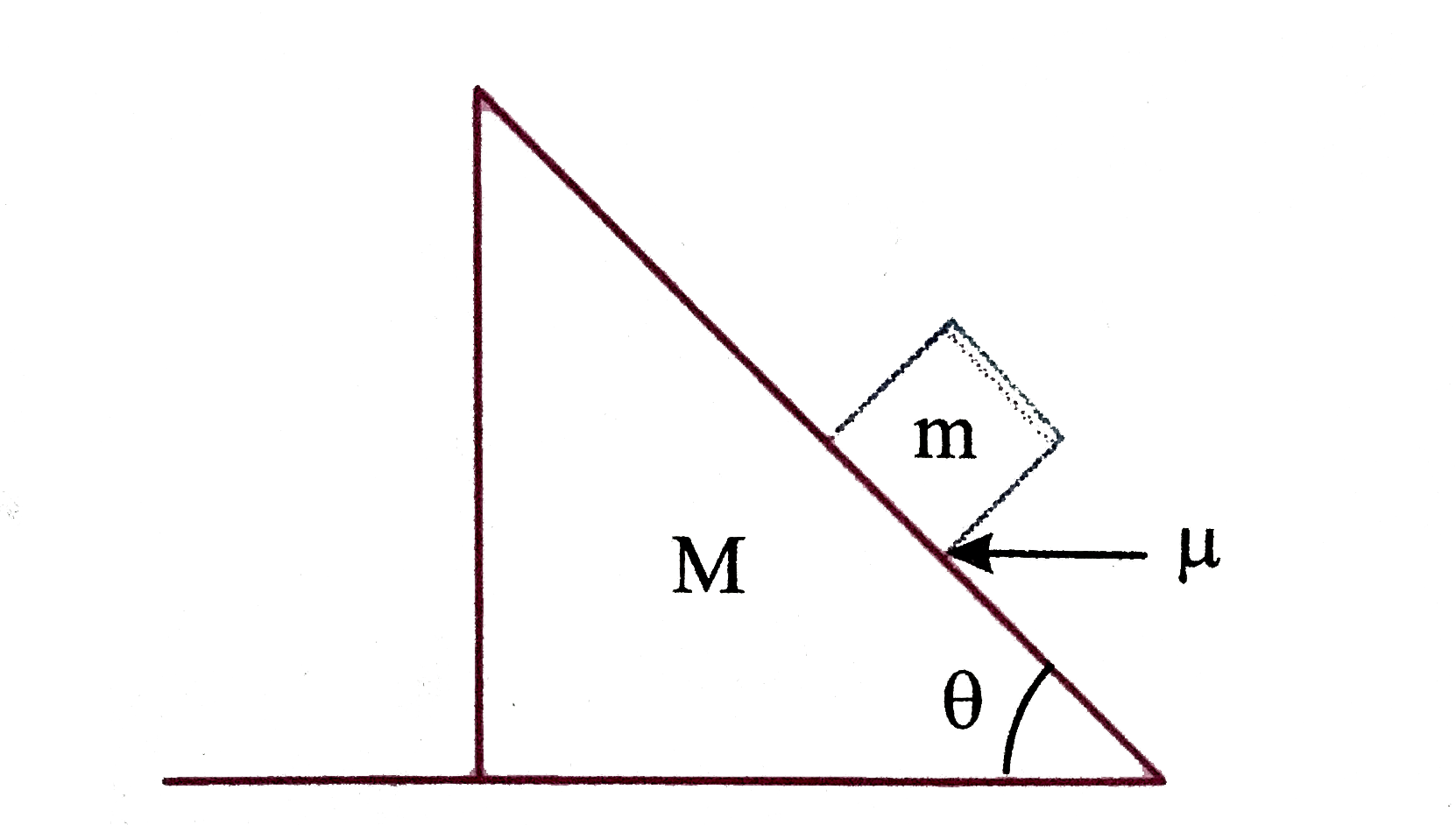
Calculate angle of friction between wedg...

Calculate angle of friction between wedge and block system is at rest `M` coefficient of friction between wedge and block.

Promotional Banner

Similar Questions

Explore conceptually related problems

Wedge is fixed on horizontal surface. Block A is pulled upward by applying a force F as shown in figure and there is no friction between the wedge and the block A while coefficient of friction between A and B is mu . If there is no relative motion between the block A and B then frictional force developed between A and B is

a Block of mass m is placed on a wedge of mass M there is no friction between the block and the wedge .The minmum coefficient of friction between the wedge and the gound so that wedge does not move is,

a Block of mass m is placed on a wedge of mass M there is no friction between the block and the wedge .The minmum coefficient of friction between the wedge and the gound so that wedge does not move is,

Two small blcok m=2kg each kept on wedge of mass 12kg. There is no friction between blocks and wedge coefficient of friction between wedge and ground in μ=0.3. Calculate frictional force by ground on wedge.

Two small blcok m=2kg each kept on wedge of mass 12 kg . There is no friction between blocks and wedge coefficient of friction between wedge and ground in mu=0.3 . Calculate frictional force by ground on wedge.

In the above question 66, if the same acceleration is twoards right the frictinal force exerted by wedge on the block will be: (Coefficient of friction between wedge & block = sqrt3//2 )

A block of mass m slides down a wedge of mass M as shown . The whole system is at rest , when the height of the block is h above the ground. The wedge surface is smooth and gradually flattens. There is no friction between wedge and ground. If there would have been friction wedge and block , which of the following quantities would still remains conserved ?

A block of mass m slides down a wedge of mass M as shown . The whole system is at rest , when the height of the block is h above the ground. The wedge surface is smooth and gradually flattens. There is no friction between wedge and ground. If there would have been friction wedge and block , which of the following quantities would still remains conserved ?

A block of mass 1 kg is placed on a wedge shown in figure. Find out minimum coefficient of friction between wedge and block to stop the block on it.

A block of mass 5 kg is kept against an accelerating wedge with a wedge angle of 45^(@) to the horizontal. The coefficient of friction between the block and the wedge is mu = 0.4 . What is the minimum absolute value of the acceleration of the wedge to keep the block steady? [Assume, g = 10 m/s^(2) ]