Home
Class 12
MATHS
If the tangents at z(1), z(2) on the cir...

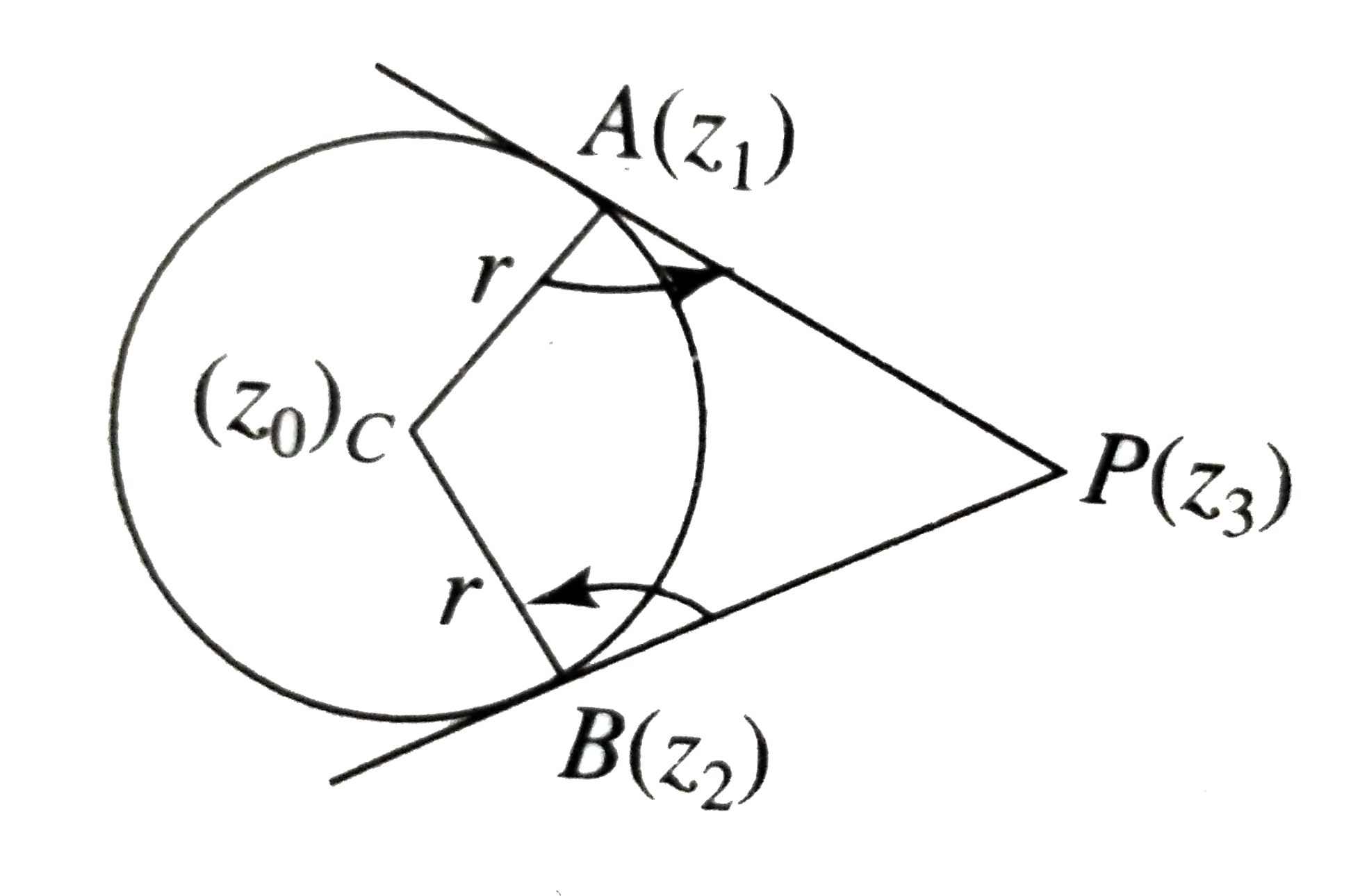
If the tangents at `z_(1)`, `z_(2)` on the circle `|z-z_(0)|=r` intersect at `z_(3)`, then `((z_(3)-z_(1))(z_(0)-z_(2)))/((z_(0)-z_(1))(z_(3)-z_(2)))` equals

A

`1`

B

`-1`

C

`i`

D

`-i`

Text Solution

Verified by Experts

The correct Answer is:
B

`(b)`
`(z_(3)-z_(1))/(z_(0)-z_(1))=((PA)/(AC))i` and `(z_(0)-z_(2))/(z_(3)-z_(2))=((BC)/(BP))i`
`:. ((z_(3)-z_(1))(z_(0)-z_(2)))/((z_(0)-z_(1))(z_(3)-z_(2)))=((PA)/(AC)xx(BC)/(PB))(-1)=-1`
Promotional Banner

Topper's Solved these Questions

  • COMPLEX NUMBERS

    CENGAGE|Exercise Matching Column|1 Videos
  • COMPLEX NUMBERS

    CENGAGE|Exercise Comprehension|11 Videos
  • COMPLEX NUMBERS

    CENGAGE|Exercise Question Bank|30 Videos
  • CIRCLES

    CENGAGE|Exercise Question Bank|32 Videos
  • CONIC SECTIONS

    CENGAGE|Exercise Solved Examples And Exercises|91 Videos

Similar Questions

Explore conceptually related problems

If the circle |z-1|=3 and |z-z_(0)|=4 intersect orthogonally,then

Circles |z-1|=3,|z-z_(0)|=4 intersect orthogonally,then

If z_(1);z_(2) and z_(3) are the vertices of an equilateral triangle; then (1)/(z_(1)-z_(2))+(1)/(z_(2)-z_(3))+(1)/(z_(3)-z_(1))=0

Given z_(1)+3z_(2)-4z_(3)=0 then z_(1),z_(2),z_(3) are

If z_(1),z_(2),z_(3) are the vertices of an equilateral triangle,then value of (z_(2)-z_(3))^(2)+(z_(3)-z_(1))^(2)+(z_(1)-z_(2))^(2)

If z_(1),z_(2),z_(3) are three distinct non-zero complex numbers and a,b,c in R^(+) such that (a)/(|z_(1)-z_(3)|)=(b)/(|z_(2)-z_(3)|)=(c)/(|z_(3)-z_(1)|),quad then (a^(2))/(z_(1)-z_(2))+(b^(2))/(z_(2)-z_(3))+(c^(2))/(z_(2)-z_(1)) is equal to Re(z_(1)+z_(2)+z_(3))( b) Im g(z_(1)+z_(2)+z_(3))0(d) None of these

If z_(1),z_(2),z_(3) are complex numbers such that |z_(1)|=|z_(2)|=|z_(3)|=|(1)/(z_(1))+(1)/(z_(2))+(1)/(z_(3))|=1 then |z_(1)+z_(2)+z_(3)| is equal to

The centre of a square ABCD is at z_(0). If A is z_(1) ,then the centroid of the ABC is 2z_(0)-(z_(1)-z_(0))(b)(z_(0)+i((z_(1)-z_(0))/(3))(z_(0)+iz_(1))/(3) (d) (2)/(3)(z_(1)-z_(0))

CENGAGE-COMPLEX NUMBERS-Single correct Answer
  1. Let I, omega and omega^(2) be the cube roots of unity. The least po...

    Text Solution

    |

  2. Number of imaginary complex numbers satisfying the equation, z^2=bar(z...

    Text Solution

    |

  3. Least positive argument ofthe 4th root ofthe complex number 2-isqrt(12...

    Text Solution

    |

  4. A root of unity is a complex number that is a solution to the equation...

    Text Solution

    |

  5. If z is a complex number satisfying the equation z^6 +z^3 + 1 = 0. If ...

    Text Solution

    |

  6. Suppose A is a complex number and n in N , such that A^n=(A+1)^n=1, t...

    Text Solution

    |

  7. If z(1),z(2),z(3)………….z(n) are in G.P with first term as unity such th...

    Text Solution

    |

  8. If |z-1-i|=1, then the locus of a point represented by the complex num...

    Text Solution

    |

  9. Let z in C and if A={z:"arg"(z)=pi/4}and B={z:"arg"(z-3-3i)=(2pi)/3}. ...

    Text Solution

    |

  10. theta in [0,2pi] and z(1), z(2), z(3) are three complex numbers such t...

    Text Solution

    |

  11. Let 'z' be a comlex number and 'a' be a real parameter such that z^(2)...

    Text Solution

    |

  12. Let z=x+iy then locus of moving point P(z) (1+barz)/z in R, is

    Text Solution

    |

  13. Let A(z(1)) and B(z(2)) are two distinct non-real complex numbers in t...

    Text Solution

    |

  14. Complex numbers z(1) and z(2) satisfy |z(1)|=2 and |z(2)|=3. If the in...

    Text Solution

    |

  15. Let A(2,0) and B(z) are two points on the circle |z|=2. M(z') is the p...

    Text Solution

    |

  16. If A(z(1)), B(z(2)), C(z(3)) are vertices of a triangle such that z(3)...

    Text Solution

    |

  17. Let O, A, B be three collinear points such that OA.OB=1. If O and B re...

    Text Solution

    |

  18. If the tangents at z(1), z(2) on the circle |z-z(0)|=r intersect at z(...

    Text Solution

    |

  19. If z(1), z(2) and z(3) are the vertices of DeltaABC, which is not righ...

    Text Solution

    |

  20. Let P denotes a complex number z=r(costheta+isintheta) on the Argand's...

    Text Solution

    |

