

Home
Class 12
PHYSICS
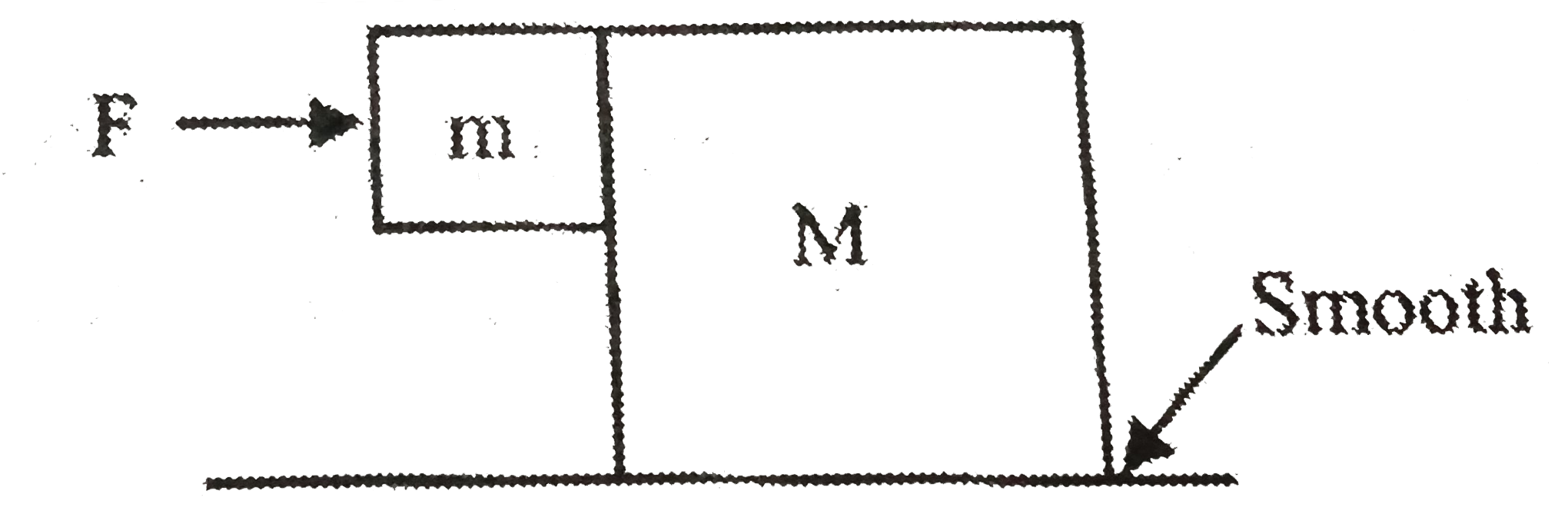
The two blocks, m= 10 kg and M = 50 kg a...

The two blocks, m= 10 kg and M = 50 kg are free to move as shown. The coefficient of static friction between the blocks is 0.5 and there is no friction between M and the ground. A minimum horizontal force F is applied to hold m against M that is equal to -

Promotional Banner

Similar Questions

Explore conceptually related problems

The coefficient of static friction between the two blocks shown in figure is mu and the table is smooth. What maximum horizontal forced F can be applied to he block of mass M so that the block move together?

The coefficient of static friction between the two blocks shown in figure is mu and the table is smooth. What maximum horizontal forced F can be applied to he block of mass M so that the block move together?

The coefficient of static friction between the two blocks shown in figure is mu and the table is smooth. What maximum horizontal forced F can be applied to he block of mass M so that the block move together?

The coefficient of static friction between the two blocks shown in figure is mu and the table is smooth. What maximum horizontal forced F can be applied to he block of mass M so that the block move together?

Two blocks of Masses M and 2M are connected by a spring of stiffness k .The coefficient of friction between the blocks and the surface is mu Find the minimum constant force F to be applied to 2m in order to slide the mass M .

The coefficient of static friction between a block of mass 0.25 kg is 0.4. Calculate the force applied to it. (g = 9.8m//s^2)

Consider the shown arrangement. The coefficient of friction between the two blocks is 0.5 . There is no friction between the 4 kg block and of 12 N is applied on the 2 kg block as shown in the figure, the acceleration of the 4 kg block would be

Two blocks of masses m and 2 m are placed one over the other as shown in figure.The coefficient of friction between m and 2m is mu and between 2m and ground is (mu)/(3) . If a horizontal force F is applied on upper block and T is tension developed in string, then choose the incorrect alternative.

Two blocks of masses m and 2 m are placed one over the other as shown in figure.The coefficient of friction between m and 2m is mu and between 2m and ground is (mu)/(3) . If a horizontal force F is applied on upper block and T is tension developed in string, then choose the incorrect alternative.

In Fig. 6-37, a block of mass m = 5.0 kg is at rest on a ramp. The coefficient of static friction between the block and ramp is not known. Find the magnitude of the net force exerted by the ramp on the block.