

Home
Class 12
PHYSICS
An insulated container is filled with a ...

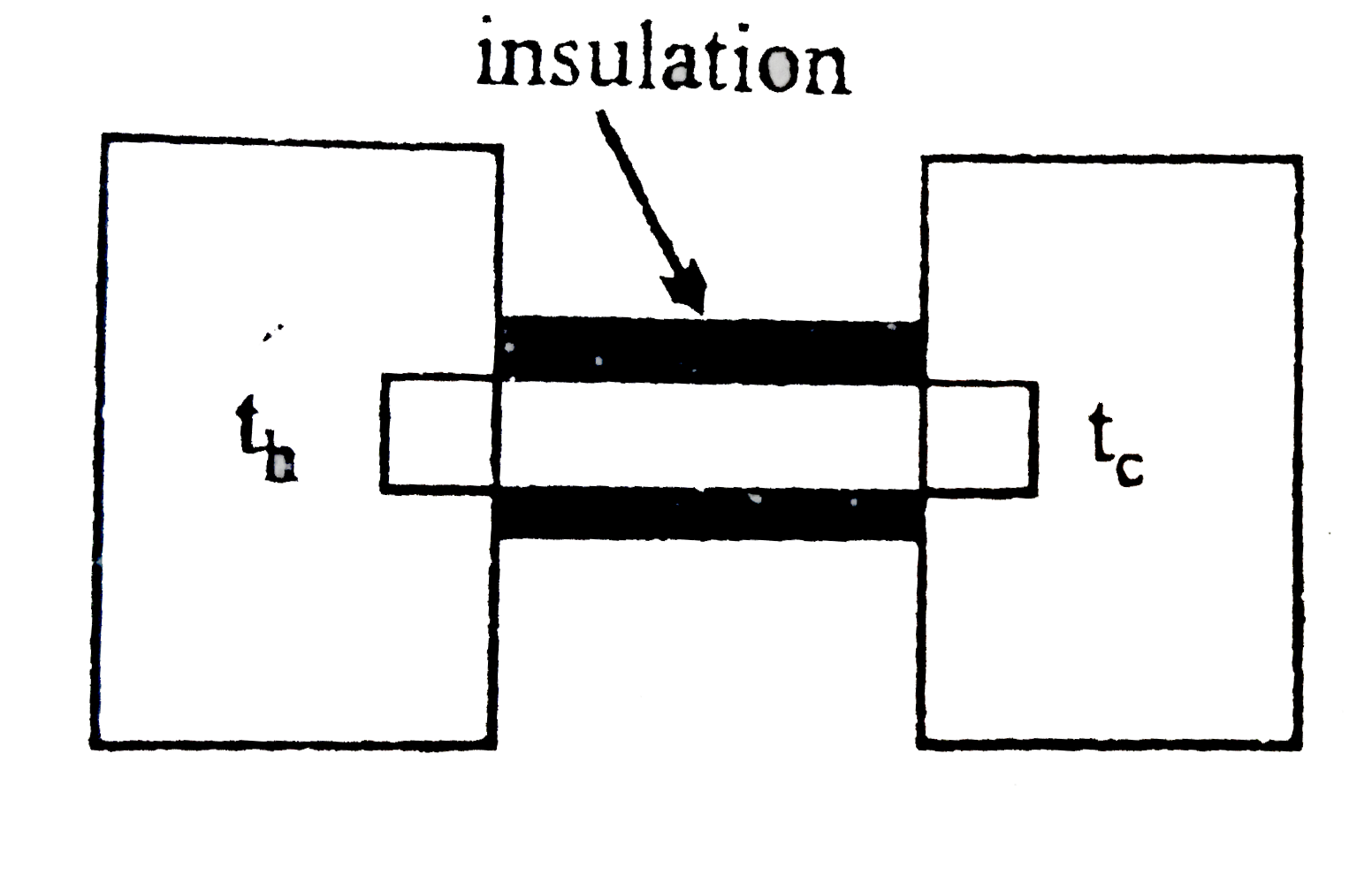
An insulated container is filled with a mixture of water and ice at `t_c = 0^@C`. Another container is filled with water that is continuously boiling at `t_h = 100^@C`. In a series of experiments, the containers are connected by various thick rods that pass through the walls of the containers (see the diagram). The rod is insulated in such a way that there is no heat loss to surroundings. In experiment 1, a copper rod is used, and the ice melts in `T_1 = 2` min. In experiment 2, a steel rod of the same cross section is used, and the ice melts in `T_2 = 6` min. How long ( in min) would it take to melt the ice if the two rods are used "in series"?

Promotional Banner

Similar Questions

Explore conceptually related problems

An insulated container is filled with ice at 0^(@)C, and another container is filled with water that is continuously boiling at 100^(@)C. In series of experiments, the container connected by various, thick metal rods that pass through the walls of container as shown in the figure-4.46. In the experiment- I: A copper rod is used and all ice melts is 20 minutes. In the experiment - II: A steel rod of identical dimensions is used and all melts in 80 minutes. In the experiment-III: Both the are used in parallel all ice melts in t_(10) minutes. In the cxperiment-IV: Both rods are used in parallel all ice melts in t_(20)

A container is filled with water at 4^@C . The water will overflow if the temperature of water is :

Two equal containers are filled with a mixture of water and alcohol .One of them contains three times as much alcohol as in the other .the mixtures in the two containers are then mixed and it is 3:2 .Find the ratio of water to alcohol in each of the original containers .

A container contains 100 gm water at 4^@C . If this container is filled with mercury, then what will be its mass (sp. Gravity of mercury =13.6)

A piece of ice at 0^@C is added to a vessel containing water at 0^@C , then

An insulated cylinderical vessel filled with an insulated piston of negligible weight and negligible thickness at the mid point of the vessel . The cylinder contains a gas at 0^@C .When the gas is heated to 100^@C , the piston moves through a length of 5 cm . Length of the cylindrical vessel in cm is