

Home
Class 12
PHYSICS
Given system is in equilibrium. All surf...


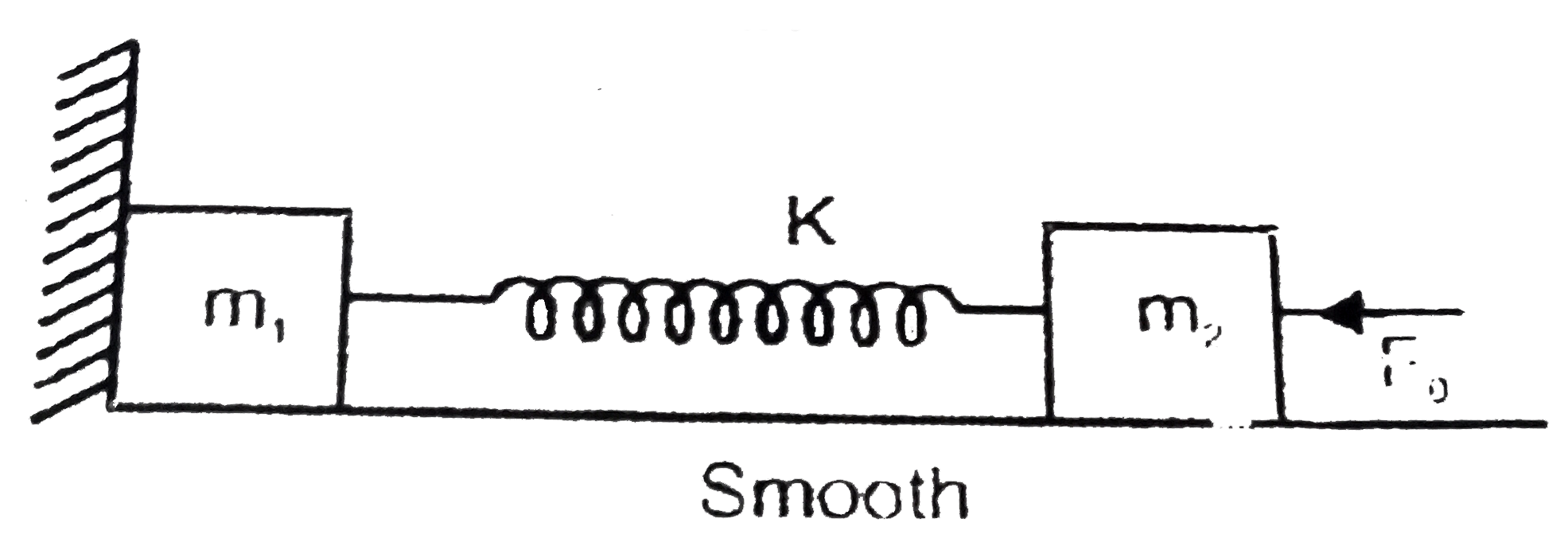
Given system is in equilibrium. All surfaces are smooth. Spring is ideal and blocks are sticked at the ends of spring Now `F_(0)` is removed Average normal contact force between wall and mass `m_(1)` upto the time spring attains its natural length for the first time in newton is (given that `F_(0)=2pi` Newton)

Promotional Banner

Similar Questions

Explore conceptually related problems

The two blocks A and B of same mass connected to a spring and placed on a smooth surface. They are given velocities (as shown in the figure) when the spring is in its natural length :

Two blocks of masses m and 2m compress a spring of spring constant k by x_(0) and blocks are a connected by a thread and placed on a smooth surface as shown. Now , thread is burned. Find the speed of each block when the spring attains its normal length L .

A spring having a spring constant k is fixed to a vertical wall as shown in Fig. A block of mass m moves with velocity v torards the spring from a parallel wall opposite to this wall. The mass hits the free end of the spring compressing it and is decelerated by the spring force and comes to rest and then turns the spring is decelerated by the spring force and comes to rest and then turns back till the spring acquires its natural length and contact with the spring is broken. In this process, it regains its angular speed in the opposite direction and makes a perfect elastice collision on the opposite left wall and starts moving with same speed as before towards right. The above processes are repeated and there is periodic oscillation. Q. What is the time period of oscillation ?

A spring having a spring constant k is fixed to a vertical wall as shown in Fig. A block of mass m moves with velocity v torards the spring from a parallel wall opposite to this wall. The mass hits the free end of the spring compressing it and is decelerated by the spring force and comes to rest and then turns the spring is decelerated by the spring force and comes to rest and then turns back till the spring acquires its natural length and contact with the spring is broken. In this process, it regains its angular speed in the opposite direction and makes a perfect elastice collision on the opposite left wall and starts moving with same speed as before towards right. The above processes are repeated and there is periodic oscillation. Q. What is the time period of oscillation ?

Block of mass 2 m is given v_(0) towards the right. If L is the natural length of spring constant k , find the maximum elongation of the spring.

A block of mass m connected to a spring of stiffness k is placed on horizontal smooth surface. When block is at x=0 , spring is in natural length. The block is also subjected to a force F=(k|x|)/(@) then

A particle of mass 'm' attached with one end of a light spring of stiffness (k) is pushed with a speed (v) on a smooth horizontal plane. If l_(0)= natural length of the spring and x_(0) = elongation of the spring at the given instant.

The system is in equilibrium and at rest. Now mass m_(1) is removed from m_(2) . Find the time period and amplituded of resultant motion. Spring constant is K .

The system is in equilibrium and at rest. Now mass m_(1) is removed from m_(2) . Find the time period and amplituded of resultant motion. Spring constant is K .

A block of mass m is attached to a spring of force constant k whose other end is fixed to a horizontal surface. Initially the spring is in its natural length and the block is released from rest. The average force acting on the surface by the spring till the instant when the block has zero acceleration for the first time is