

Home
Class 11
PHYSICS
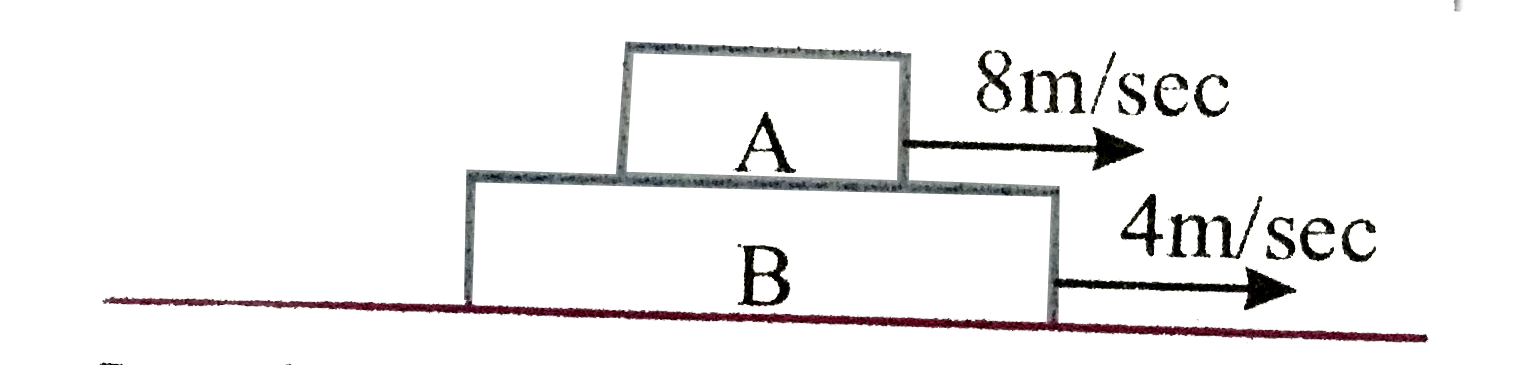
Block A of mass 1 kg is placed on the ro...

Block `A` of mass `1 kg` is placed on the rough surface of block `B` of mass `3 kg`. Block `B` is placed on smooth horizontal surface. Blocks are given the velocities as shown. Find net work done by the frictional force. [in `(-) ve J`].
.

Promotional Banner

Similar Questions

Explore conceptually related problems

A block of mass 1 kg is placed on a horizontal surface . The reaction force to the weight of the block is

A block of mass 1 kg is placed on a horizontal surface . The reaction force to the weight of the block is

Block A of mass 3 kg is placed on another block B of mass 5 kg placed on the smooth surface. If coefficient of friction between two blocks is 1/2 and 32 N force is applied on block B as shown in the figure, then the work done by the frictional force on block A in first two second will be (initial velocity of the system is zero and g = 10 m/s^2 )

Block A of mass 3 kg is placed on another block B of mass 5 kg placed on the smooth surface. If coefficient of friction between two blocks is 1/2 and 32 N force is applied on block B as shown in the figure, then the work done by the frictional force on block A in first two second will be (initial velocity of the system is zero and g = 10 m/s^2 )

A block of mass m is placed on a rough horizontal surface. If minimum force to pull the block is (mg)/(2) then coefficient of friction is :

Two block of mass 1 kg and 2 kg are connected by a string AB of mass 1 kg . The blocks are placed on a smooth horizontal surface. Block of mass 1 kg is pulled by a horizontal force F of magnitude 8 N . Find the tension in the string at points A and B

A block A of mass 2 kg is placed over smooth block B of mass 4 kg which is placed over a smooth horizontal floor The coefficient of friction between A and B is 0.4 when a horizontal forces of magnitude 10 N is applied on A the acceleration of block of A and B are

A block A of mass 2 kg is placed over smooth block B of mass 4 kg which is placed over a smooth horizontal floor The coefficient of friction between A and B is 0.4 when a horizontal forces of magnitude 10 N is applied on A the acceleration of block of A and B are

A block A of mass 4 kg is placed on another block B of mass 5 kg and the block rests on a smooth horizontal table. For sliding the block A on B, a horizontal force of 12 N is required to be applied on it. The maximum horizontal force that can be applied on B so that both A and B move together and the acceleration produced by this force is

A block of mass 10kg is placed on a rough surface inclined plane of inclination 37^@ with horizontal. Now the block is released . The work done by the gravitational force and friction force, when the block moves from A to B(sin37^@=0.6 , cos37^@=0.8)