

Home
Class 11
PHYSICS
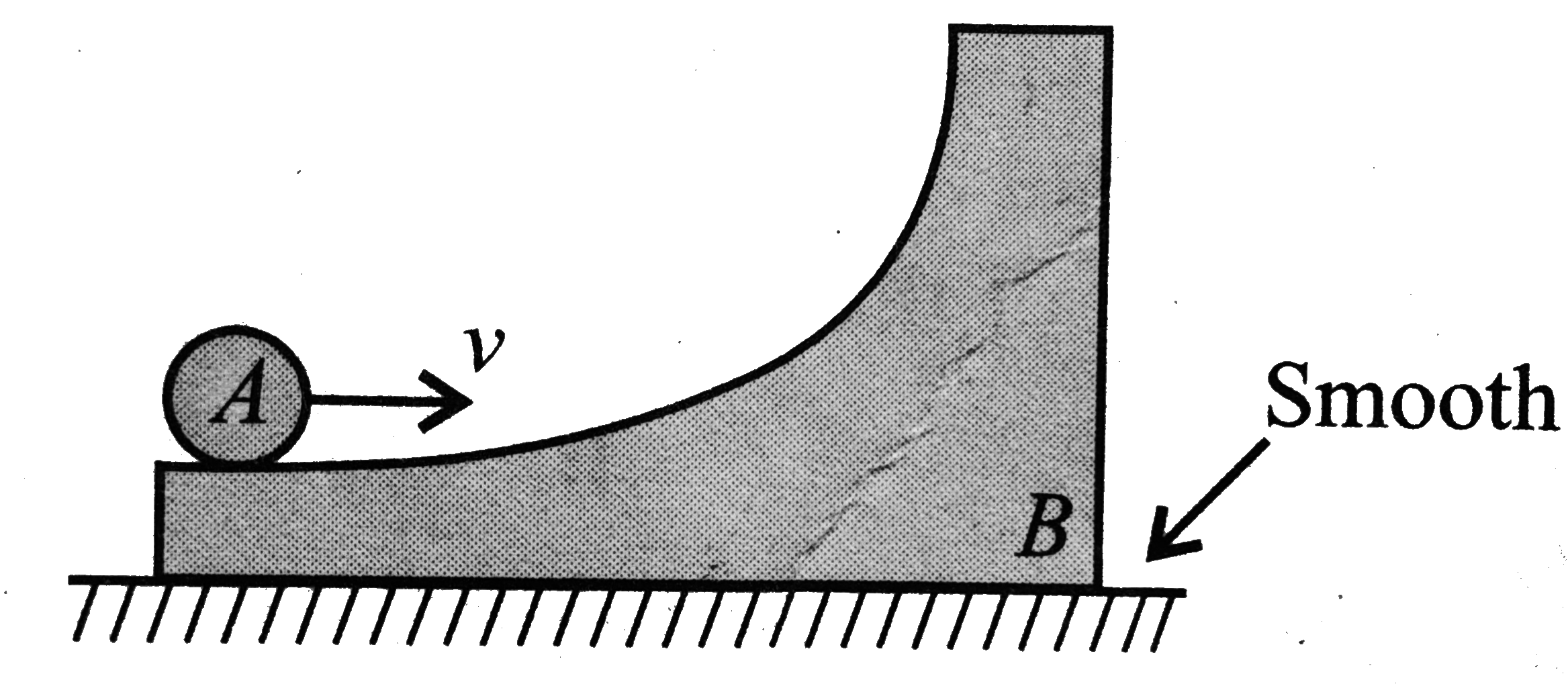
In the figure shown, a ring A is initial...

In the figure shown, a ring `A` is initially rolling without sliding with a velocity `1`, on the horizontal surface of the body `B` (of same mass as `A`). All surfaces arc smooth. `B` has no initial velocity. What will be the maximum height reached by `A` on `B`?

Promotional Banner

Similar Questions

Explore conceptually related problems

In the figure shown, a cylinder A is initially rolling with velocity v on the horizontal surface of the wedge B (of same mass as A ). All surfaces are smooth and B has no initial velocity. Then maximum height reached by cylinder on the wedge will be. .

A smooth wedge of mass M rests on a smooth horizontal surface. A block of mass m is projected from its lowermost point with velocity v_(0) . What is the maximum height reached by the block?

A smooth wedge of mass M rests on a smooth horizontal surface. A block of mass m is projected from its lowermost point with velocity v_(0) . What is the maximum height reached by the block?

A smooth wedge of mass M rests on a smooth horizontal surface. A block of mass m is projected from its lowermost point with velocity v_(0) . What is the maximum height reached by the block?

A body thrown up with a velocity reaches a maximum height of 50 m. Another body with double the mass thrown up with double the initial velocity will reach the maximum height of

A body thrown up with a velocity reaches a maximum height of 50 m. Another body with double the mass thrown up with double the initial velocity will reach the maximum height of

A uniform disc of mass m and radius r rolls without slipping along a horizontal surface and ramp, as shown above. The disk has an initial velocity of upsilon . What is the maximum height h to which the center of mass of the disc rises ?

A uniform disc of mass m and radius r rolls without slipping along a horizontal surface and ramp, as shown above. The disk has an initial velocity of upsilon . What is the maximum height h to which the center of mass of the disc rises ?