

Home
Class 12
PHYSICS
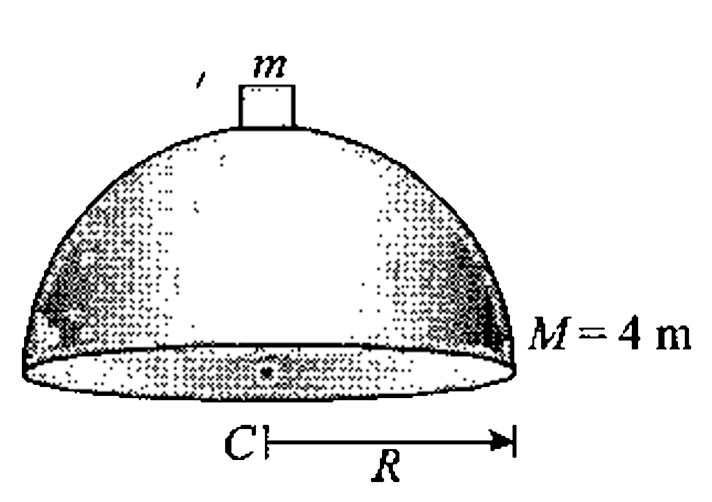
A small block of mass m starts sliding d...

A small block of mass m starts sliding down from rest along the smooth surface of a fixed hollow hemisphere of same mass m. Find the distance of centre of mass of block and hemishere from centre of hemisphere C when block m separates from the surface of hemisphere.

Promotional Banner

Similar Questions

Explore conceptually related problems

Find distance of centre of mass of solid hemisphere of radius 8cm from centre

The distance of the centre of mass of a hemispherical shell of radius R from its centre is

A block of mass m is at rest over the rough surface of the fixed wedge.

A small body of mass m slides down from the top of a hemisphere of radius r . The surface of block and hemisphere are frictionless. The height at which the body lose contact with the surface of the sphere is

A block of mass m slides down on inclined wedge of same mass m as shown in figure . Friction is absent everywhere . Acceleration of centre of mass of the block and wedge is

A particle of mass m initially at rest starts moving from point A on the surface of a fixed smooth hemisphere of radius r as shown. The particle looses its contact with hemisphere at point B.C is centre of the hemisphere. The equation relating theta and theta' is .

A small body of mass m slides without friction from the top of a hemisphere of radius r. At what hight will the body be detached from the centre of hemisphere?

A block of mass as shown is released from rest from top of a fixed smooth hemisphere. Find angle made by this particle with vertical at the instant when it looses contact with hemisphere.

A small block of mass m slides along a smooth frictional track as shown in the figure. If it starts from rest at P, what is the resultant force acting on it at Q?