

Home
Class 11
PHYSICS
A long block A is at rest on a smooth ho...

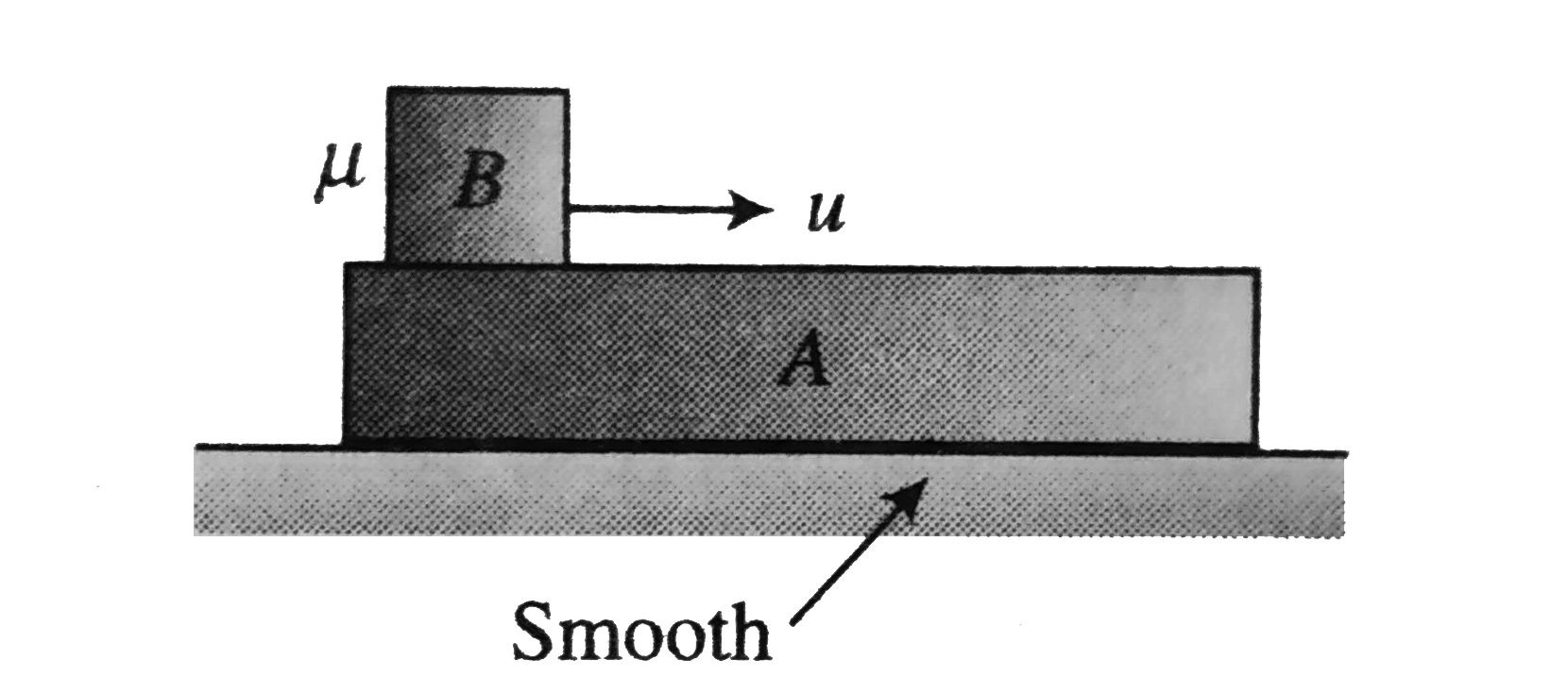
A long block A is at rest on a smooth horizontal surface. A small block B whose mass is half of mass of A is placed on A at one end and is given an initial velocity u as shown in figure. The coefficient of friction between the blocks is `mu`.

Promotional Banner

Similar Questions

Explore conceptually related problems

A long block A is at rest on a smooth horizontal surface. A small block B, whose mass is half of A, is placed on A at one end and projected along A with some velocity u. The coefficient of friction between the blocks is mu :

A long block A of mass M is at rest on a smooth horizontal surface.A small block B of mass M//2 is placed on A at one end and projected along A with some veklocity v.The coefficient of friction between the block is mu then , the accelerations of blocks A and B before reaching a common velocity will be respectively

A block of mass 1 kg is placed on a wedge shown in figure. Find out minimum coefficient of friction between wedge and block to stop the block on it.

A sufficiently long plane of mass 4kg is placed on a smooth horizontal surfaces A small block of mass 2kg is placed over the plank and is beging acted upon by a time verying horizontal force F = (0.5t) where F is in newton and t is in second as shown in figure. The coefficient of friction slipping the plank and the block is given is mu_(s) = mu_(k) = mu time t = 12s the relative slipping between the plank and the block is just likely to accor The coefficient of friction mu is equal to

A block of mass m is moving with a speed v on a horizontal rought surface and collides with a horizontal monted spring of spring constant k as shown in the figure .The coefficient of friction between the block and the floor is mu The maximum cobnpression of the spring is

A block of mass m = 2kg is accelerating by a force F = 20N applied on a smooth light pulley as shown in the figure. If the coefficient of kinetic friction between the block and the surface is mu=0.3 , find its acceleration.

A wedge B of mass 2 m is placed on a rough horizontal suface. The coefficient of friction between wedge and the horizontal surface is mu_(1) . A block of mass m is placed on wedge as shown in the figure. The coefficient of friction between block and wedge is mu_(2) . The block and wedge are released from rest. Q. Suppose the inclined surface of the wedge is at theta=37^(@) from angle from horizontal and mu_(2)=0 are wedge will remain in equilibrium if

A rectangular block is kept on a rough horizontal surface and given some initial velocity. The coefficient of friction between the block and the surface is constant. The block will topple

In the arrangement shown in figure, a block A of mass m has been placed on a smooth wedge B of mass M. The wedge lies on a horizontal smooth surface. Another block C of mass (M)/(4) has been placed in contact with the wedge B as shown. The coefficient of friction between the block C and the vertical wedge wall is mu= (3)/(4) . Find the ratio (m)/(M) for which the block C will not slide with respect to the wedge after the system is released?

A small block of mass 'm' is placed on a plank of mass 'M'. The block is connected to plank with the help of a light string passing over a light smooth pulley as shown in figure. The co-efficient of static friction between the block and plank is mu . The co-efficient of friction between the plank and the horizontal surface is zero. What maximum horizontal force F applied on the block of mass m can make the block and plank not to slide relatively?