

Home
Class 11
PHYSICS
A small asteroid is approaching a planet...


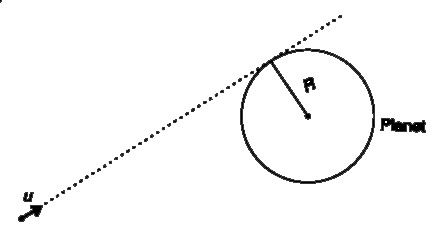
A small asteroid is approaching a planet of mass M and radius R from a large distance. Initially its velocity (u) is along a tangent to the surface of the planet. It fall on the surface making an angle of `30^(2)` with the vertical. Calculate u.

Promotional Banner

Similar Questions

Explore conceptually related problems

If v_(e) is the escape velocity of a body from a planet of mass 'M' and radius 'R . Then the velocity of the satellite revolving at height 'h' from the surface of the planet will be

Mass and radius of a planet are two times the value of earth. What is the value of escape velocity from the surface of this planet?

The angular velocity of rotation of a planet of mass M and radius R, at which the matter start to escape from its equator is

The earth is a homogeneous sphere of mass M and radius R. There is another spherical planet of mass M and radius R whose density changes with distance r from the centre as p=p_(0)r. (a) Find the ratio of acceleration due to gravity on the surface of the earth and that on the surface of the planet. (b) Find p_(0).

At satellite of mass m is launched from the surface of a planet of mass M and radius R in a circular orbit at an altitude of 3R. K.E. of satellite at the time of launching is

A small asteroid is at a large distance from a planet and its velocity makes an angle phi(cancel(=)0) with line joining the asteroid to the centre of the planet. Prove that such an asteroid can never fall normally on the surface of the planet.

Two planets of mass M and 16M of radius a and 2a respectively, are at distance 10a . Find minimum speed of a particle of mass m at surface of smaller planet so that it can reached from smaller planet to larger planet.

A solid spherical planet of mass 2m and radius 'R' has a very small tunnel along its diameter. A small cosmic particle of mass m is at a distance 2R from the centre of the planet as shown. Both are initially at rest, and due to gravitational attraction, both start moving toward each other. After some time, the cosmic particle passes through the centre of the planet. (Assume the planet and the cosmic particle are isolated from other planets)

A spaceship is sent to investigate a planet of mass M and radius R . While hanging motionless in space at a distance 5R from the centre of the planet, the spaceship fires an instrument package of mass m , which is much smaller than the mass of the spaceship. For what angle theta will the package just graze the surface of the planet?

If the radius of a planet is R and its density is rho , the escape velocity from its surface will be