Text Solution
Verified by Experts
The correct Answer is:



Topper's Solved these Questions
Similar Questions
Explore conceptually related problems
FULL MARKS-TRIGONOMETRY -ASSIGNMENT II (ANSWER THE FOLLOWING QUESTIONS):
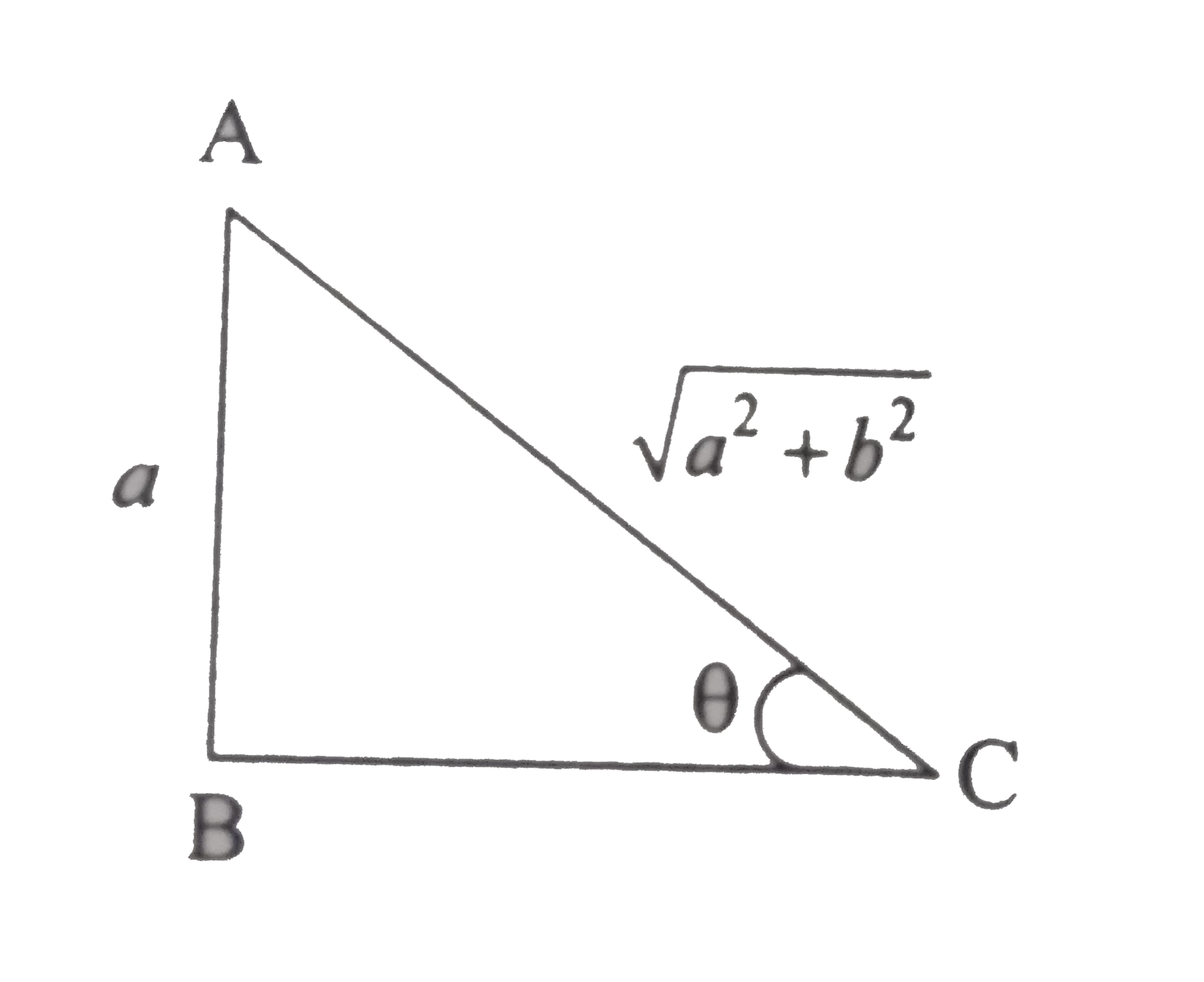
- If sintheta=(a)/(sqrt(a^(2)+b^(2))) then show that b sin theta = a cos...
Text Solution
|
- Find the other trigonometric ratios of secA=(17)/(8)
Text Solution
|
- If sectheta=(13)/5 , show that (2sintheta-3costheta)/(4sintheta-9co...
Text Solution
|
- Evaluate (12cos^(2)30^(@)-2tan^(2)60^(@))/(4sec^(2)45^(@))
Text Solution
|
- Find the value of 3(tan67^(@))/(cot23^(@))+(sin42^(@))/(2cos48^(@))+(5...
Text Solution
|
- Simplify (sin35^(@))/(cos55^(@))+(cos55^(@))/(sin35^(@))-2cos^(2)60^(@...
Text Solution
|
- A ladder makes an angles 30^(@) with the floor and its lower end is 12...
Text Solution
|
- In an isosceles triangle with base alpha, vertical angle 20^(@) and la...
Text Solution
|