

Home
Class 11
PHYSICS
A block A of mass 3kg and another block ...

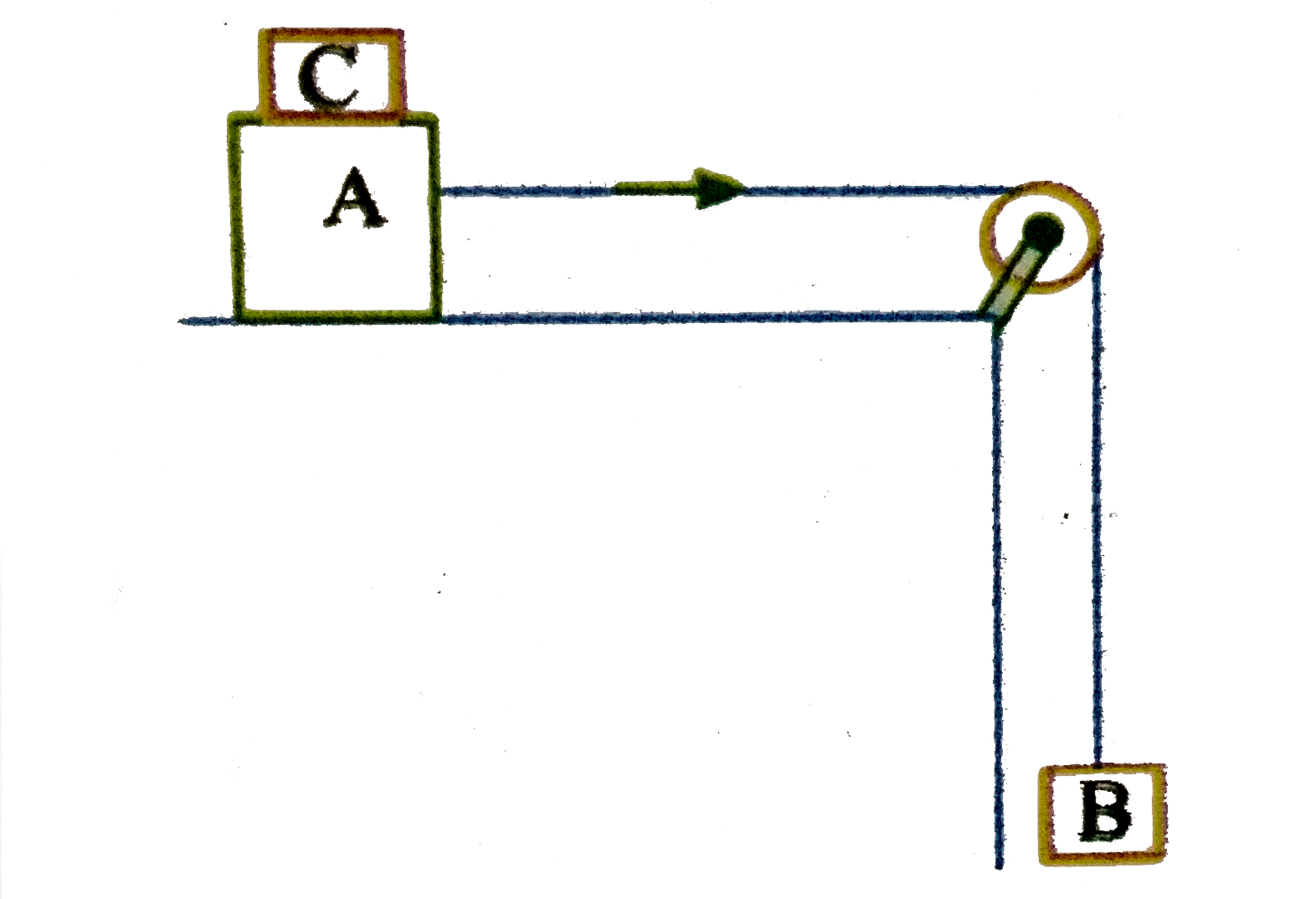
A block A of mass 3kg and another block `B` of mass `2kg` are connected by a light inextensible string as shown in figure. If the coefficient of friction between the surface of the table and A is 0.5 What maximum mass `C` is to be placed on A so that the system is to be in equlibrium
.

Promotional Banner

Similar Questions

Explore conceptually related problems

A block A of mass 3kg and another block B of mass 2 kg are connected by a light inextensible string as shown in figure. If the coefficient of friction between the surface of the table and A is 0.5. What maximum mass C is to be placed on A so that the system is to be in equilibrium? (g = 10 m//s^2)

The block A in the given figure is of mass 10sqrt(3) kg The coefficient of friction between the block and the surface on which it rests is 0.5. Find maximum mass of block B possible such that the system will be in equilibrium is.

The block A in the given figure is of mass 10sqrt(3) kg The coefficient of friction between the block and the surface on which it rests is 0.5. Find maximum mass of block B possible such that the system will be in equilibrium is.

In the shown ,two blocks one of mass 5kg and the other of mass 2kg are connected by light and inextensible string Pulleys are light an d frictionless Choose the correct statement .

Two blocks A and B are connected by a light inextensible string passing over a fixed smooth pulley as shown in figureThe coefficient of friction between the block A and B the horizontal table is mu = 0.5 . If the block A is just , find ratio of the masses of the blocks

On a smooth table two blocks of masses 2.5kg and 1.5kg are placed one over the other as shown in figure. If the coefficient of static friction between two blocks is 0.2, the maximum horizontal force to be applied on the lower block so that the two blocks move together is (g = ms^(-2) )

Two blocks of masses 3 kg and 6 kg are connected by a string as shown in the figure over a frictionless pulley. The acceleration of the system is