Home
Class 11
CHEMISTRY
Explain the bond formation in ethylene a...

Explain the bond formation in ethylene and acetylene.

Text Solution

Verified by Experts
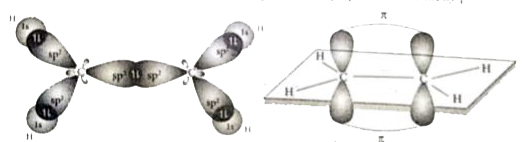
Bonding in Ethylene. `C_(2)H_(4)`:
(i) onding in ethylene can be explained by hybridisation concept.
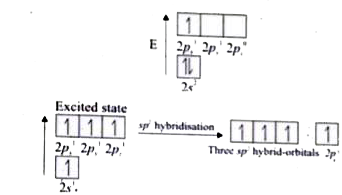
(ii) The valency of carbon is 4. The electronic configuration of carbon is `ls^(2)" "2s^(2)" "2p_(x)^(1)" "2p_(y)^(1)" "2p_(z)^(0).` One electron from 2s orbital is promoted to `2p_(z)` orbital in the excited state to satisfy the valency of carbon.

(iii) In ethylene both the carbon atoms undergo `sp^(2)` hybridisation involving `2s, 2p_(x) and 2p_(y)` orbitals resulting in 3 equivalent `sp^(2)` hybridised orbitals lying in the XY plane at an angle of `120^(@)` other. The unhybridised `2p_(z)` orbital lies perpendicular to the xy plane.

(iv) One of the `sp^(2)` hybridised orbitals of each carbon atoms lying along the X-axis linearly overlaps with each other resulting in the formation of C- C sigma bond. The other two `sp^(2)` hybridised orbitals of both carbon atom linearly overlap with the four Is orbitals of four hydrogen atoms leading to the formation of two C-H sigma bonds on each carbon atom.
(v) The unhybridised `2p_(z)` orbital of both carbon atoms can overlap only sideways as they are not in the molecular axis. This lateral overlap results in the formation of a pi bond between the two carbon atoms.
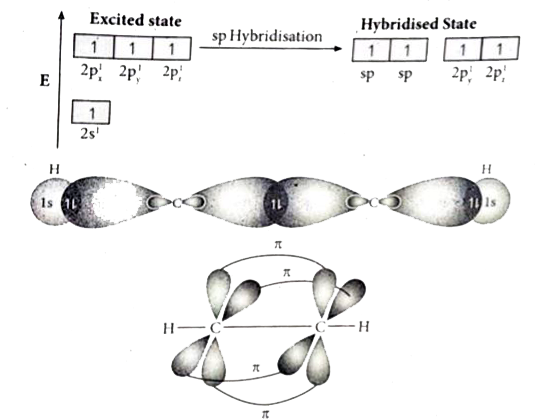
Bonding in acetylene `(C_(2)H_(2))`:
(i) The electronic configuration of valence shell of carbon atom in the ground state is `[He]2s^(2)" "2p_(x)^(1)" "2p_(z)^(0).` One electron from 2s orbital is promoted to `2p_(z)` orbital in the excited state to satisfy the valency of carbon.
(ii) n acetylene molecule, both the carbon atoms are in sp hybridised state. I he 2s and `2p_(x)` Orbilals resulting in two equivalent sp hybridised orbitals are formed lying in a straigh: line along the X-axis. The unhybridised `2p_(y) and 2p_(z)` orbitals lie perpendicular to the X-axis.

(iii) One of the two sp hybridised orbitals of each carbon atom linearly overlaps with each other resulting in the formation of a C-C sigma bond. The other sp hybridised orbital of both carbon atoms linearly overlap with the two Is orbitals of two hydrogen atoms leading to the formation of one C-H sigma bond on each carbon atom.
(iv) The unhybridised `2p_(y) and 2p_(z)` orbitals of each carbon atom overlap sideways. This lateral overlap results in the formation of two pi bonds. `(p_(y) - p_(y)) and (p_(z) - p_(z))` between the two carbon atoms.
Promotional Banner

Topper's Solved these Questions

  • CHEMICAL BONDING

    FULL MARKS|Exercise IN TEXT QUESTION-EVALUATE YOURSELF|10 Videos
  • CHEMICAL BONDING

    FULL MARKS|Exercise ADDITIONAL QUESTIONS SOLVED (CHOOSE THE CORRECT ANSWER.)|50 Videos
  • CHEMICAL BONDING

    FULL MARKS|Exercise ADDITIONAL QUESTIONS SOLVED (5-MARK QUESTIONS)|14 Videos
  • BASIC CONCEPTS OF ORGANIC REACTIONS

    FULL MARKS|Exercise Additional Questions Solved (5-Marks Question)|10 Videos
  • ENVIRONMENTAL CHEMISTRY

    FULL MARKS|Exercise ADDITIONAL QUESTIONS SOLVED ( 5-Mark Questions )|8 Videos

Similar Questions

Explore conceptually related problems

Explain the bond formation in BeCl_(2) .

What is meant by electrovalent bond. Explain the bond formation in AlBr_(3) and CaO.

Explain the bond formation in sucrose molecule.

Explain the bond formation of hydrogen molecule.

Explain the bond formation in BeCl_(2) and MgCl_(2).

FULL MARKS-CHEMICAL BONDING -TEXTUAL EVALUATION SOLVED (SHORT ANSWER QUESTIONS.)
  1. Draw MO diagram of CO and calculate its bond order .

    Text Solution

    |

  2. What do you understand by interphase ?

    Text Solution

    |

  3. Discuss the formation of N2, molecule using MO Theory.

    Text Solution

    |

  4. What is dipole moment ?

    Text Solution

    |

  5. Linear form of carbondioxide molecule has two polar bonds. Yet the mol...

    Text Solution

    |

  6. Draw the Lewis structures for the following species. HNO(3)

    Text Solution

    |

  7. Explain the bond formation in BeCl(2) and MgCl(2).

    Text Solution

    |

  8. Which bond is stronger sigma or pi? Why ?

    Text Solution

    |

  9. Define bond energy.

    Text Solution

    |

  10. Hydrogen gas is diatomic where as inert gases are monoatomic - explain...

    Text Solution

    |

  11. What is polar covalent bond? Explain with example.

    Text Solution

    |

  12. Considering x-axis as molecular axis, which out of the following will ...

    Text Solution

    |

  13. Explain resonance with reference to carbonate ion. Lewis structur...

    Text Solution

    |

  14. Explain the bond formation in ethylene and acetylene.

    Text Solution

    |

  15. What type of hybridisations are possible in the following geometeries ...

    Text Solution

    |

  16. Explain VSEPR theory . Applying this theory to predict the shapes of I...

    Text Solution

    |

  17. CO(2) and H(2)O both are triatomic molecules but their dipole moment ...

    Text Solution

    |

  18. Which one of the following has highest bond order? N(2), N(2)^(+) or N...

    Text Solution

    |

  19. Explain the covalent character in ionic bond.

    Text Solution

    |

  20. Describe fajan's rule.

    Text Solution

    |