Home
Class 6
PHYSICS
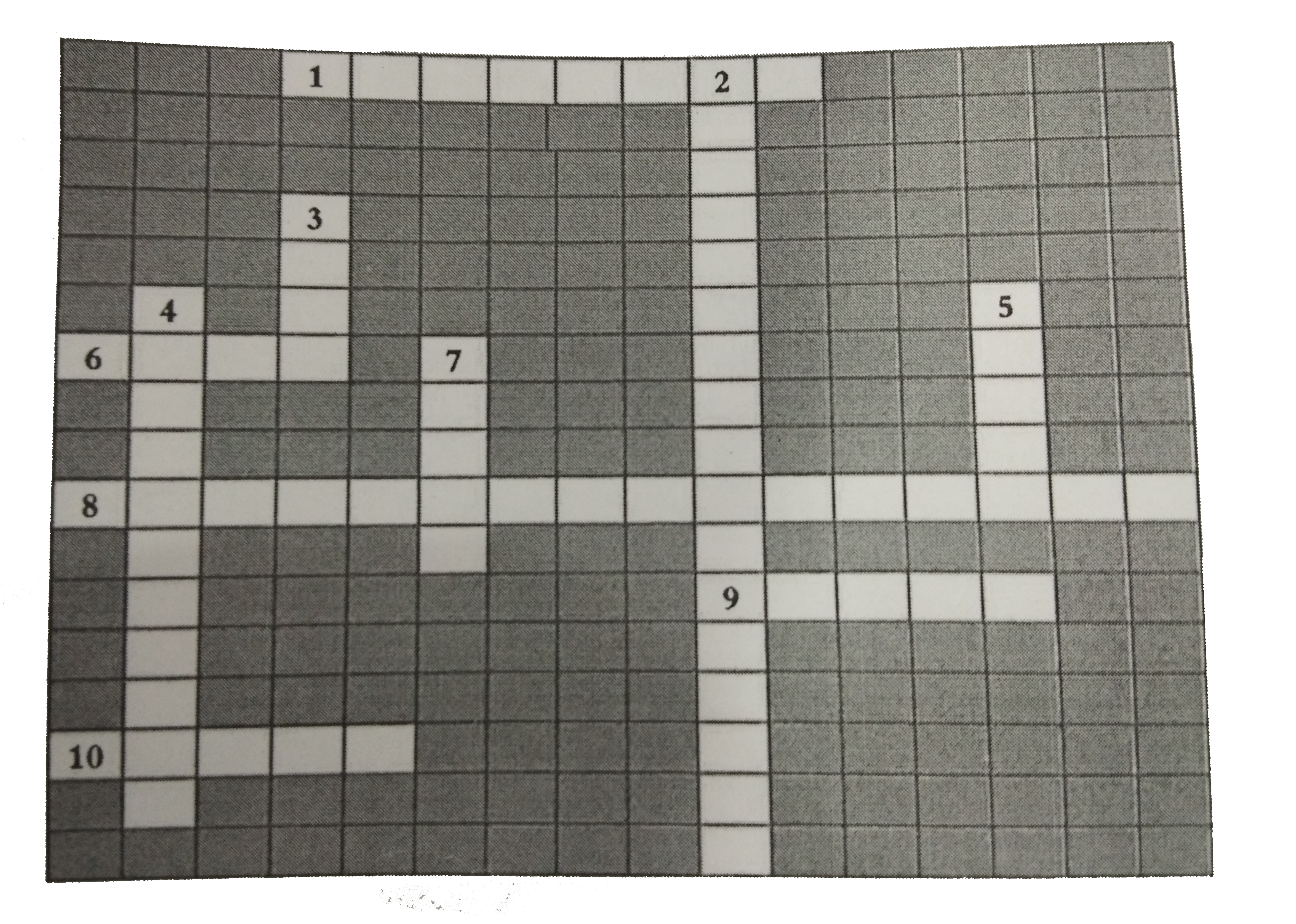
{:("Across","Down"),("1. Prefix used ins...


`{:("Across","Down"),("1. Prefix used instead of a 10 power positive number.","2. Only these quantities can be measured."),("6. A body does not change its position.","3. Standard reference of a physical quantity."),("8. The quantity that depends on other quantities.","4. Kelvin is the unit of"),("9. Unit of electric current","5. Prefix used to represent "10^(-2) " is"),("10. Paper used to measure the area of irregular lamina.","7. Distance covered by the body in unit time."):}`

Text Solution

Verified by Experts

The correct Answer is:

`{:("Across","Down"),("1. Multiple","2. Physical"),("6. Rest","3. Unit"),("8. Derived quantity","4. Temperature"),("9. Ampere","5. Centi"),("10. Graph","7. Speed"):}`
Promotional Banner

Similar Questions

Explore conceptually related problems

Statement-1: The numerical value (n)of a physical quantity is inversely proportional to size of unit (u) being used to measure it. Statement-2:The magnitude of physical quantity does not change by changing the units.

The process of measurement is basically a process of comparison. The chosen standard of measurement of a quantity, which has essentially the same nature as that of the quantity is called unit of the quantity. Magnitude of a quantity (Q) = size of its unit (u)xx number of times (n) this unit is contained in the quantity. i.e. Q = nu As magnitude of a quantity remains the same, whatever be its units of measurement, therefore, Q = n_1u_1 = n_2 u_2 Read the above passage and answer the following questions : (i) The value of acceleration due to gravity (g) = 9.8 m//s^2 How do you express it in km//hr^2 ? (ii) Our world is a game of numbers. Do you agree ? Justify.

Given below are two quantities named I and II. Based on the given information, you have to determine the relation between the two quantities. You should use the given data and your knowledge of Mathematics to choose among the possible answers. Quantity I: A 63 litres mixture of wine and water contains wine and water in the ratio 5: 4 respectively. A lady added another 49 litres mixture of wine and water which contains wine and water in the ratio 4: 3 respectively. Another lady added 12 litres of wine and 1 litres of water into the mixture. The final mixture is divided into three containers in the ratio 2: 2: 1 respectively. Find the difference between quantities of water in the first and third container. Quantity II: Ratio of milk and water in a mixture is 13: 7 respectively. The milkman added 5 litres of milk and 15 litres of water to the mixture and hence the ratio becomes 7: 5 respectively. The milkman sold 50% of the new mixture and added 10 litres of milk and 8 litres of water to the remaining mixture. Find the difference between the quantities of milk and water in the final mixture.

The density of Cu is 8.94 g cm^(-3) . The quantity of electricity neede to plate an area 10 cm xx 10 cm to a thickenss of 10^(-2) cm using CuSO_4 solution qould be .

A unit of area, often used in measuring land areas, is the hectare defined as 10^4 m^2 An open-pit coal mine consumes 75 hectares of land, down to a depth of 26 m, each year. What volume of earth, in a cubic kilometre, is removed in this time?

Graphs are very useful to represent a physical situation. Various quantities can be easily represented on graphs and other quantites can be determined from the graph. For example the slope of velocity-time graph represents instantaneous acceleration. For a motion with constant acceleration slope of velocity-time graph is constant. If acceleration is changing with time, slope with change and thus velocity-time graph will be a non-linear curve. Further the area of velocity-time graph gives displacement. For the above situation let t_(1) be the time of accelerated motion and t_(2) be the time or retarded motion, then the correct relation is
