Home
Class 12
BIOLOGY
Study the given figure which shows the d...

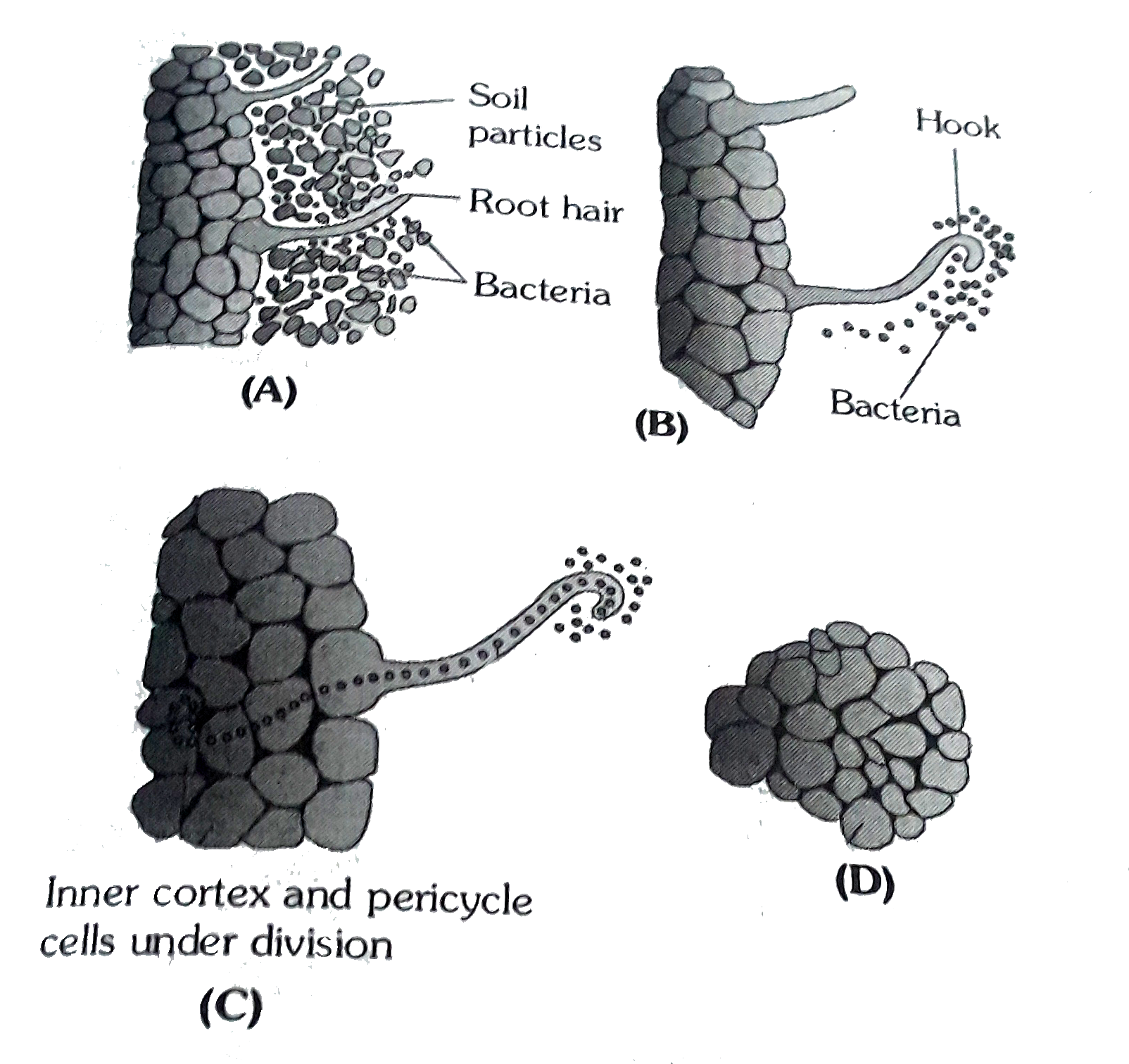
Study the given figure which shows the development of root nodules in soyabean. Match the correct explanation and find the correct sequence for labelled diagrams.

(I) Rhizobium bacteria contacting a susceptible root hair.
(II) A mature nodule having vascular connection with roots.
(III). Infection thread carrying bacteria to the inner cortex.
(IV). Curling of root hair due to successful infection.

Text Solution

Verified by Experts

The correct Answer is:

`A-I to B-IV to C-III to D-II`
Promotional Banner

Similar Questions

Explore conceptually related problems

Study the given figures carefully showing the development of root nodules and arrange them in a correct sequence.

Choose the correct sequence of step w.r.t nodule formation in legumes. (a) Root nodule formation (b) Infection thread formation (c ) Curling of root hair (d) Division of cortical cells

Sequential stage for nodule formation are I. Rhizobia multiply and colonize the surrounding roots. II. Rhizobia get attached to epidermal and root hair cells. III. Root hair curl and bacteria invade root hair. IV. Initiation of nodule formation in cortex. V. Infection thread is produced carrying bacteria to cortex. VI. Bacteria released from thread into cells and cause their differentiation in specialized nitrogen fixing cells. VII. Nodule formed establishes a direct vascular connection with the host for exchange of nutrient.

Consider the following steps involved in nodule formation in the root of a legume. (i). Bacteria release chemicals and enzymes. (ii). Bacteria stop dividing and form bacteroides. (iii). Roots secrete chemical atractants. (iv). Formation of infection thread. (v). Formation of nodules. (v). Formation of nodulues. (vi). Division of infected cortical cells. (vii) Curlinig of root hair and degradation of their cell wall. (viii). Infection thread grows along with multiplication of bacteria. Arrange the steps in the right sequence and mark the correct option

During nodule formation in leguminous plants, an infection thread is produced carrying the (i) into the (ii) of the root, where they initiate the nodule formation in the (iii) of the root. Fill up the blanks by choosing the correct option.

Four statements regarding root hairs are given below. Choose the correct one from them I) They are unbranched tubular extensions II) They are fine, delicate thread like structures III) They are present on tap root and absent in all adventitious roots IV) They are uniformly distributed in all regions of root

Go through the following matches with reference to the elements and their deficiency symptoms in plants: (i) Sulphur - Reduced nodulation in legumes (ii) Boron - Whiptail disease (iii) Sulphur - Blossom end root of tomato (iv) Nitrogen - Wrinkling of cereal grains Which of these are correct

Go through the following matches with reference to the elements and their deficiency symptoms in plants: (i) Sulphur - Reduced nodulation in legumes (ii) Boron - Whiptail disease (iii) Sulphur - Blossom end root of tomato (iv) Nitrogen - Wrinkling of cereal grains Which of these are correct

Go through the following statements (i) The most widely used compound as source of ethylene is ethephon. (ii) Ethylene helps the plants to increa their absorption surface by promotin root growth and root hair formation. (iii) 2, 4 - D is mainly used to kill mature monocotyledonous plants. (iv) Spraying juvenile conifers with GAs has- tens the maturity period, thus leading to early seed production. Which of these are correct
