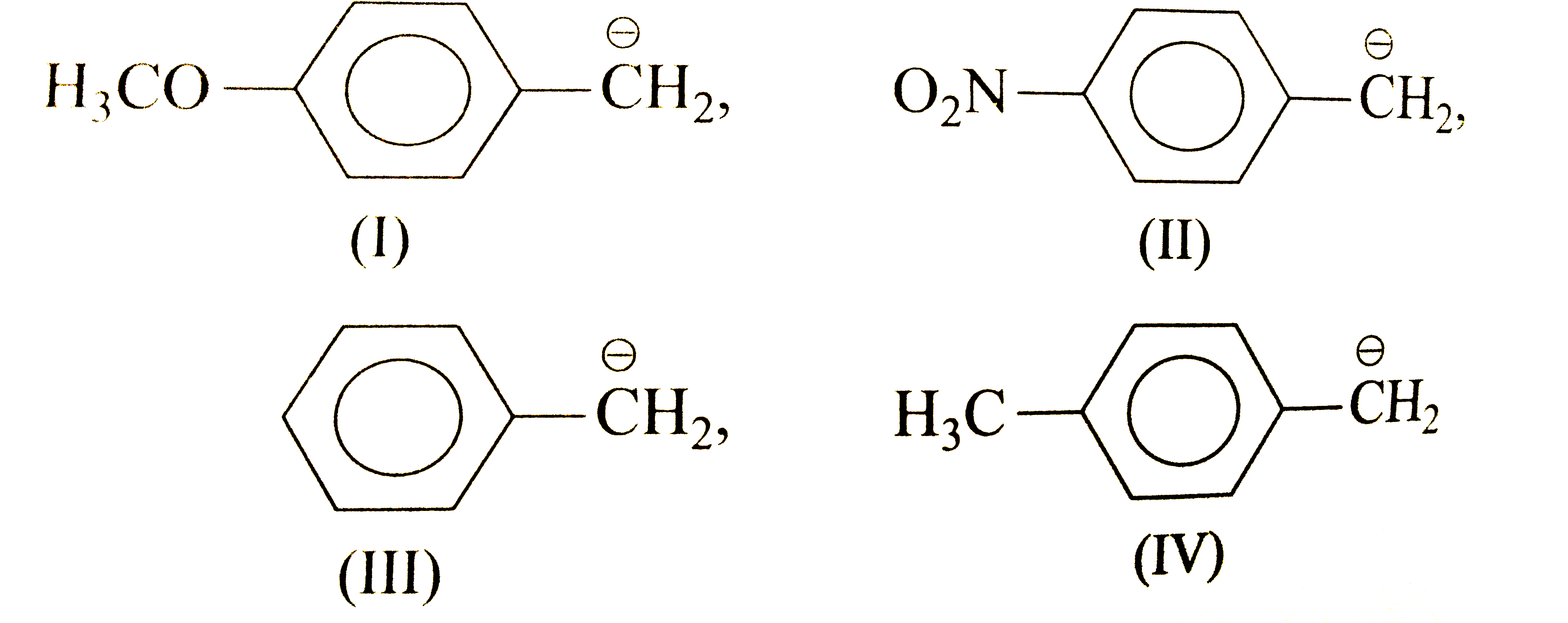
A
B
C
D
Text Solution
Verified by Experts
The correct Answer is:



Topper's Solved these Questions
BASIC PRINCIPLES OF ORGANIC COMPOUNDS (MECHANISM OF ORGANIC REACTIONS)
OP TANDON|Exercise PROBLEMS FOR PRACTICE|17 VideosBASIC PRINCIPLES OF ORGANIC COMPOUNDS (MECHANISM OF ORGANIC REACTIONS)
OP TANDON|Exercise BRAIN STORMING PROBLEMS|14 VideosBASIC PRINCIPLES OF ORGANIC COMPOUNDS (MECHANISM OF ORGANIC REACTIONS)
OP TANDON|Exercise SINGLE INTEGER ANSWER TYPE QUESTIONS|4 VideosBASIC PRINCIPLES
OP TANDON|Exercise SECTION V INTEGER ANSWER TYPE QUESTION|3 VideosCARBOXYLIC ACIDS AND THEIR DERIVATIVES
OP TANDON|Exercise Integer|4 Videos
Similar Questions
Explore conceptually related problems
OP TANDON-BASIC PRINCIPLES OF ORGANIC COMPOUNDS (MECHANISM OF ORGANIC REACTIONS)-ILLUSTRATIONS OF OBJECTIVE QUESTIONS
- Among the following which acid is strongest?
Text Solution
|
- Which of the following acid is strongest?
Text Solution
|
- Which of the following alkyl groups has the maximum +I effect?
Text Solution
|
- Considering the following alkene: The correct decreasing order of ...
Text Solution
|
- The decreasing order of basic strength in {:(C(6)H(5)NH(2)",",(C(6)H...
Text Solution
|
- Benzyne is:
Text Solution
|
- Which of the following is true about the cycloheptatrienyl free radica...
Text Solution
|
- Heterolysis of propane gives:
Text Solution
|
- Which of the following pairs of ions is more stable? (a) CH(3)CH(2)O...
Text Solution
|
- Which among the following compounds behave both as an electrophile as ...
Text Solution
|
- Which of the following species is an ambident nucleophile?
Text Solution
|
- Consider the following carbanions: Correct decreasing order of st...
Text Solution
|
- Which one of the following carbocations are most stable?
Text Solution
|
- Which of the following is not a nucleophile ?
Text Solution
|
- Nucleophilicity of which species is least?
Text Solution
|
- The nitration of benzene is :
Text Solution
|
- Classify the following as electrophiles and nucleophiles: (a) CN^(-)...
Text Solution
|
- Which of the following most readily undergoes E(2) elimination with a ...
Text Solution
|
- In the reaction: the product formed will be:
Text Solution
|
- Which of the following alkene is most statble?
Text Solution
|