

Home
Class 12
PHYSICS
In the arrangement shown in figure the m...

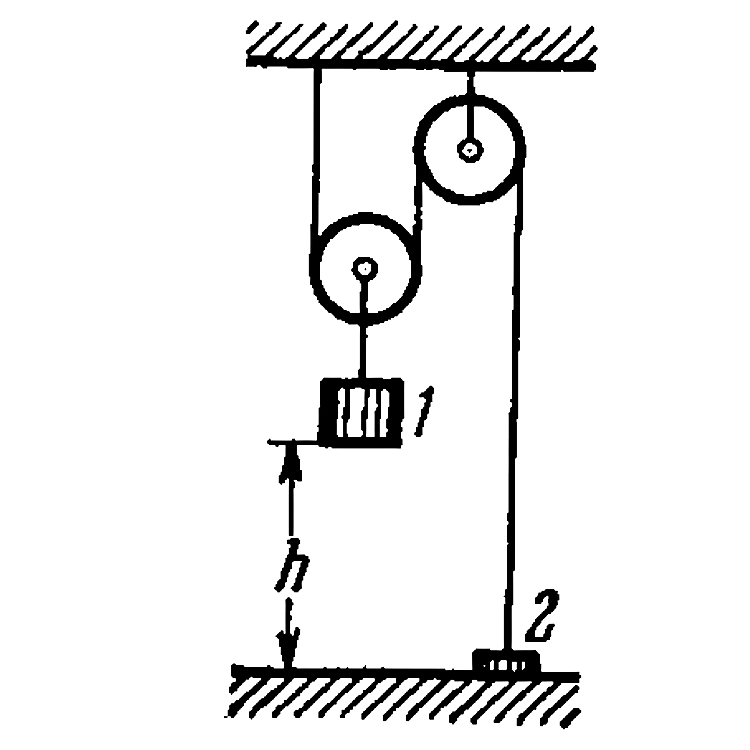
In the arrangement shown in figure the mass of body 1 is `eta=4.0` times as great as that of body 2. The height `h=20cm`. The masses of the pulleys and the threads, as well as the friction, are negligible. At a certain moment body 2 is released and the arrangement set in motion. What is the maximum height that body 2 will go up to?

Promotional Banner

Similar Questions

Explore conceptually related problems

In the arrangement shown in figure the mass of the ball is eta times as that of the rod. The length of the rod is L the masses of the pulleys and the threads as well as the friction, are negligible. The ball is set on the same level as the lower end of the rod and then released. How soon will the ball be opposite the upper end of the rod?

In the arrangement shown in figure the mass of the ball is eta times as that of the rod. The length of the rod is L the masses of the pulleys and the threats as well as the friction, are negligible. The ball is set on the same level as the lower and of the rod and then released. How soon will the ball be opposite the upper and of the rod?

Find the acceleration of the block of mass m in the arrangement shown in the following figures. The masses of the pulleys and the threads, as well as the friction are assumed to be negligible.

In the arrangement shown in figure the masses m of the bar and M of the wedge, as well as the wedge angle alpha , are known. The masses of the pulley and the thread are negligible. The friction is absent. Find the acceleration of the wedge M.

In the arrangement shown in the figure, the blocks have masses 3m,m and 2m , the friction is absent, the masses of the pulleys and the threads are negligible. Find the acceleration of mass 3m .

In the arrangement shown in figure , the mass of the body A is 4 m and that of body B is m . The height h = 0*2 m . If the body B is released , then till what maximum height the body B will go up ? (g = 10 m//s^(2))

In the arrangment shown in figure , the mass of the body A is 4 m and that of body B is m . The height h = 0*2 m . If the body B is released , then till what maximum height the body B will go up ? (g = 10 m//s^(2))

In the arrangement shown in figure the bodies have masses m_0 , m_1 , m_2 , the friction is absent, the masses of the pulleys and the threads are negligible. Find the acceleration of the body m_1 . Look into possible cases.

In the arrangement shown in fig the bodies have masses m_(0), m_(1) and m_(2) the friction is absent the masses of pulleys and the threads are negligible find the acceleration of the body m_(1)