

Home
Class 11
PHYSICS
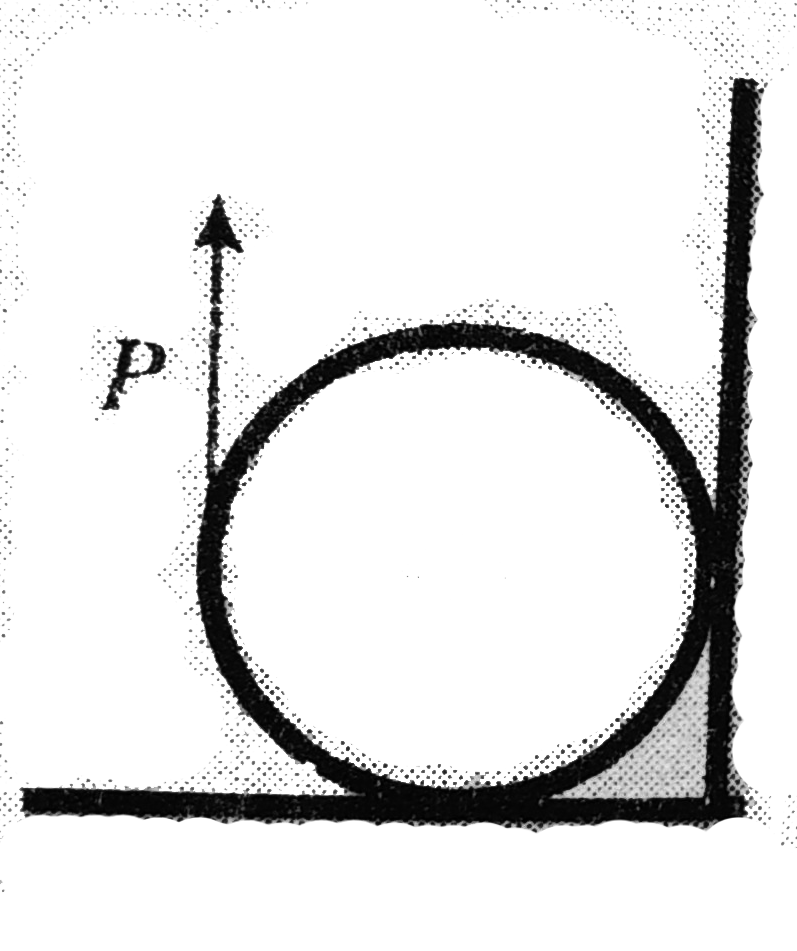
Figure shows a vertical force applied ta...

Figure shows a vertical force applied tangentially to a uniform cylinder of weight `F_(g)`. The coefficient of static friction between the cylinder and all surfaces is `0.500`. In terms of `F_(g)` , find the maximum force `P` that can be applied that does not cause the cylinder to rotate.

Promotional Banner

Similar Questions

Explore conceptually related problems

Figure shows a vertical force applied tangentially to a uniform cylinder of weight F_(g) . The coefficient static friction between the cylinder and both surface is 0.500 . In terms of F_(g) , find the maximum force P that can be applied that does not cause the cylinder to rotate. .

The coefficient of static friction between a block of mass 0.25 kg and a horizontal surface is 0.4. Find the horizontal force applied to it.

The coefficient of static friction between a block of mass 0.25 kg and a horizontal surface is 0.4. Find the horizontal force applied to it.

The coefficient of static friction between two blocks is 0.5 and the table is smooth. The maximum horizontal force that can be applied to move the blocks together is N. (take g = 10 ms^(-2) )

A uniform cylinder rests on a cart as shown. The coefficient of static friction between the cylinder and the cart is 0.5 If the cylinder is 4 cm in diameter and 10 cm in height, which of the following is the minimum acceleration of the cart needed to cause the cylinder to tip over ? .

A uniform cylinder rests on a cart as shown. The coefficient of static friction between the cylinder and the cart is 0.5 If the cylinder is 4 cm in diameter and 10 cm in height, which of the following is the minimum acceleration of the cart needed to cause the cylinder to tip over ? .

The coefficient of static friction between the two blocks shown in figure is mu and the table is smooth. What maximum horizontal forced F can be applied to he block of mass M so that the block move together?

The coefficient of static friction between the two blocks shown in figure is mu and the table is smooth. What maximum horizontal forced F can be applied to he block of mass M so that the block move together?

The coefficient of static friction between the two blocks shown in figure is mu and the table is smooth. What maximum horizontal forced F can be applied to he block of mass M so that the block move together?