Home
Class 12
CHEMISTRY
For a reaction : A to B to Products , ...

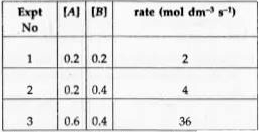
For a reaction : ` A to B to ` Products , the rate of the reaction at various concentrations are given below :

The rate law for the above reaction is

A

A) `r = k [A]^(2) [B]`

B

B) `r = k [A] [B]^(2)`

C

C) `r = k [A]^(3) [B]`

D

D) `r = k [A]^(2) [B]^(2)`

Text Solution

Verified by Experts

The correct Answer is:

A

`A to B to ` Products
Rate = `k [A]^(alpha) [B]^(beta)`
From expt. No. 1
`2 = k[0.2]^(alpha) [0.2]^(beta) " " … (1)`
From expt. No. 2
`4 = k [0.2]^(alpha) [0.4]^(beta) " " …. (2)`
dividing eq. (1) and (2) we get `(2)/(4) = (k[0.2]^(alpha) [0.2]^(beta))/(k[0.2]^(alpha) [0.4]^(beta)) or (1)/(2) = [(1)/(2)]^(beta) implies beta = 1`
From expt. No. 3
`36 k = [0.6]^(alpha) [0.4]^(beta) " " ... (3)`
dividing eqn. (2) and (3) we get
`(4)/(36) = (k[0.2]^(alpha) [0.4]^(beta))/(k[0.6]^(alpha) [0.4]^(beta)) or (1)/(9) = [(1)/(3)]^(alpha) implies alpha = 2 `
`implies` Rate law for the given reaction is `r = k [A]^(2) [B]^(1)`
Promotional Banner

Topper's Solved these Questions

  • KARNATAKA CET 2010

    KCET PREVIOUS YEAR PAPERS|Exercise Chemistry|60 Videos
  • KARNATAKA CET 2013

    KCET PREVIOUS YEAR PAPERS|Exercise Chemistry|58 Videos

Similar Questions

Explore conceptually related problems

Product (B) of the above reaction is :

Product (B) in the above reaction is :

For a reaction : A+B rarr Products the rate of the reaction of various concentrations are given below : {:("Expt No.",[A], [B]," ""Rate (mol dm"^(-3)s^(-1)),(1,0.2,0.2," "2),(2,0.2,0.4," "4),(3,0.6,0.4," "36):} The rate law for the above reaction is :

Product (B) in the above reactions is:

Product (B) of above reaction is :

Product (B) of the given reaction is :

For a reaction the graph of the rate of the reaction against molar concentration of the reactant is as shown : What is the order of the reaction ?

Product (A) & (B) ofthe above reaction is

Product (B) of given reaction is :

KCET PREVIOUS YEAR PAPERS-KARNATAKA CET 2012-CHEMISTRY
  1. Oil of winter green is

    Text Solution

    |

  2. An organic compound 'A' burns with a sooty flame . It is negative towa...

    Text Solution

    |

  3. For a reaction : A to B to Products , the rate of the reaction at va...

    Text Solution

    |

  4. Which one of the following has no unpaired electrons ?

    Text Solution

    |

  5. The atomic number of cobalt is 27 . The EAN of cobalt in Na(3)[Co(NO(2...

    Text Solution

    |

  6. The "spin only" magnetic moment of Ni^(2+) in aqueous solution would b...

    Text Solution

    |

  7. Impossible orbital among the following is

    Text Solution

    |

  8. The total number of electrons in 18 mL of water (density = 1 g mL^(-1)...

    Text Solution

    |

  9. The number of moles of hydrogen that can be added to 1 mole of an oil ...

    Text Solution

    |

  10. The reaction between sodium and water can be made less vigorous by

    Text Solution

    |

  11. All colloidal dispersions have

    Text Solution

    |

  12. Silver iodide is used for producing artificial rain because AgI

    Text Solution

    |

  13. The equilibrium constant of a reaction is 0.008 at 298 K. The standard...

    Text Solution

    |

  14. Function of potassium ethylxanthate in froth floatation process is...

    Text Solution

    |

  15. The correct order of electronegativities of N,O,F and P is

    Text Solution

    |

  16. The s-block element used as a catalyst in the manufacture of Buna-S ru...

    Text Solution

    |

  17. Which of the following is not a characteristic of a covalent compound ...

    Text Solution

    |

  18. The volume of 0.1 M oxalic acid that can be completely oxidized by 20 ...

    Text Solution

    |

  19. A ligand is

    Text Solution

    |

  20. The vapour pressures of two liquids A and B in their pure states are i...

    Text Solution

    |
