

Home
Class 12
PHYSICS
A uniformly charged non conducting rod i...

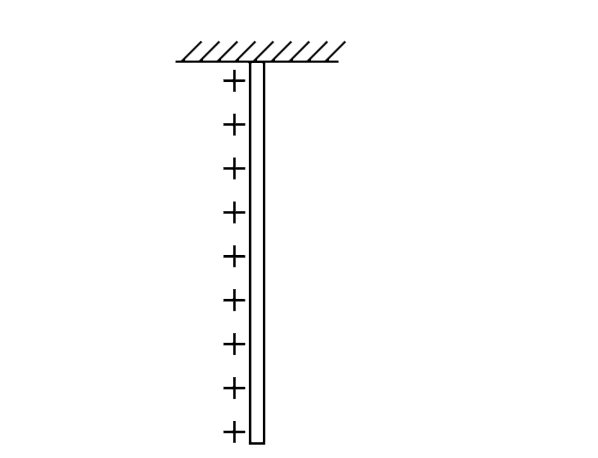
A uniformly charged non conducting rod is suspended vertically at its end. The rod can swing freely in the vertical plane without any friction. The linear charge density on the rod is `lamda C//m` and it has a uniformly distributed mass of M
Length of the rod is L. A uniform horizontal electrif field (E) is switched on in the region.
(a). For what value of electric field (call it `E_(0)`) the rod just manages to make itself horizontal.?
(b). If eletrif field `E_(0)` is switched on, what is the maximum angular speed acquired by the rod during its motion?

Promotional Banner

Similar Questions

Explore conceptually related problems

Calculate the potential due to a thin uniformly charged rod of length L at the poiot P shown in figure. The lioear charge density of the rod is lambda C//m

A uniform rod of mass 20 Kg and length 1.6 m is piovted at its end and swings freely in the vertical plane. Angular acceleration of the rod just after the rod is relased from rest in the horizontal position is

A uniform rod of mass 20 Kg and length 1.6 m is piovted at its end and swings freely in the vertical plane. Angular acceleration of the rod just after the rod is relased from rest in the horizontal position is

An insulating rod of uniform linear charge density A and uniform linear mass density mu lies on a smooth table whose surface is xy -plane. A uniform electric field E is switched on in the space:

A thin rod of length L is vertically straight on horizontal floor. This rod falls freely to one side without slipping of its bottom. The linear velocity of centre of rod when its top end touches floor is

A light rigid rod of mass M, and length L is pivoted at one of its end. The rod can swing freely in the vertical plane through a horizontal axis passing through the pivot. Show that the time period of the rod about the pivot is T = pi sqrt((2L)/(3g))

A glass rod of length l moves with velocity in a uniform magnetic field B. What is the e.m.f. induced in the rod ?

A positive charge Q is uniformly distributed across a rod of length L. The rod is then bent in the form of a semicircle. What will be the electric field intensity at the centre of curvature of the semicircle thus formed?

A positive charge Q is uniformly distributed along the length L of a rod. It is bent in the shape of a square. Calculate electric field intensity at the centre of the square.