Home
Class 11
CHEMISTRY
Discuss the molecular shape of "BrF"(3) ...

Discuss the molecular shape of `"BrF"_(3)` on the basis of VSEPR theory.

Text Solution

Verified by Experts
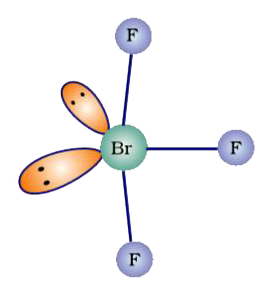
The central atom Br has seven electrons in the valence shell. Three of these will form electronpair bonds with three fluorine atoms leaving behind four electrons. Thus, there are three bond pairs and two lone pairs. According to VSEPR theory, these will occupy the corners of a trigonal bipyramid. The two lone pairs will occupy the equatorial positions to minimise lone pair-lone pair and the bond pairlone pair repulsions which are greater than the bond pair-bond pair repulsions. In addition, the axial fluorine atoms will be bent towards the equatorial fluorine in order to minimise the lone-pair-lone pair repulsions. The shape would be that of a slightly bent .T..
Promotional Banner

Topper's Solved these Questions

  • THE P-BLOCK ELEMENTS

    NCERT TELUGU|Exercise Intext Questions|34 Videos
  • THE P-BLOCK ELEMENTS

    NCERT TELUGU|Exercise Exercises|40 Videos
  • REDOX REACTIONS

    NCERT TELUGU|Exercise EXERCISES|30 Videos
  • THE s-BLOCK ELEMENTS

    NCERT TELUGU|Exercise EXERCISES|32 Videos

Similar Questions

Explore conceptually related problems

The shape of BrF_(3)

Explain the shape of XeF_(4) on the basis of VSEPR theory.

What is the use of VSEPR theory?

Write about VSEPR theory.

Discuss on the shape of XeOF_(4) molecule.

Discuss the structure of glucose on the basis of its chemical properties.

Describe the molecular shape of I_(3)^(-) . (Hint : Central iodine is of sp^(3) d. - linear)

The number of CO ligands that can be attached to Fe(Z=26) on the basis of EAN theory are

How do you predict the shapes of the following molecules making use of VSEPR theory ? BrF_(5)

How do you predict the shapes of the following molecules making use of VSEPR theory ? ClF_(3) and

NCERT TELUGU-THE P-BLOCK ELEMENTS -Exercises
  1. Discuss the molecular shape of "BrF"(3) on the basis of VSEPR theory.

    Text Solution

    |

  2. Discuss the general characteristics of Group - 15 elements with refere...

    Text Solution

    |

  3. Why does the reactivity of nitrogen differ from phosphorus ?

    Text Solution

    |

  4. Discuss the trends in chemical reactivity of group 15 elements

    Text Solution

    |

  5. NH(3) forms hydrogen bonds but PH(3) does not - why ?

    Text Solution

    |

  6. How is nitrogen prepared in the laboratory ? Write the chemical equa...

    Text Solution

    |

  7. How is ammonia manufactured by Haber's process ? Explain the reactions...

    Text Solution

    |

  8. Illustrate how copper metal can give different products on reaction wi...

    Text Solution

    |

  9. Give the resonating structures of NO(2) and N(2)O(5).

    Text Solution

    |

  10. The HNH angle is higher than HPH, HAsH and HSbH angles - Why ?

    Text Solution

    |

  11. Why does R(3)P=O exist but R(3)B=O does not (R = alkyl group) ?

    Text Solution

    |

  12. Explain why is NH(3) basic while "BiH"(3) is only feebly basic.

    Text Solution

    |

  13. Nitrogen exists as diatomic molecule and phosphorus as P(4) - Why ?

    Text Solution

    |

  14. Write the difference between the properties of white phosphorus and re...

    Text Solution

    |

  15. Why does nitroggen show catenation properties less than phosphorus ?

    Text Solution

    |

  16. Give the disproportionation reaction of H(3)PO(3).

    Text Solution

    |

  17. Can PCl(5) act as an oxidising as well as a reducing agent? Justify.

    Text Solution

    |

  18. Justify the placement of O, S, Se, Te and Po in the same group of the ...

    Text Solution

    |

  19. Why is dioxygen a gas but sulphur a solid ?

    Text Solution

    |

  20. Knowing the electron gain enthalpy values for O to O^(-) and O to O^(2...

    Text Solution

    |

  21. Which aerosols deplete ozone?

    Text Solution

    |

