Text Solution
Verified by Experts



Topper's Solved these Questions
Similar Questions
Explore conceptually related problems
NCERT TELUGU-ORGANIC CHEMISTRY - SOME BASIC PRINCIPLES AND TECHNIQUES -EXERCISES
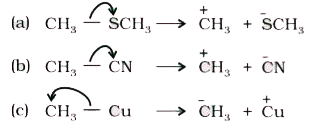
- Using curved-arrow notation, show the formation of reactive intermedi...
Text Solution
|
- What are hybridisation states of each carbon atom in the following com...
Text Solution
|
- Indicate the σ and π bonds in the following molecules : C(6)H(6),C(6...
Text Solution
|
- Write bond line formulas for : Isopropyl alcohol, 2,3-Dimethyl butanal...
Text Solution
|
- Give the IUPAC names of the following compounds : (a) (b) Cl(2)CHCH...
Text Solution
|
- Which of the following represents the correct IUPAC name for the compo...
Text Solution
|
- Draw formulas for the first five members of each homologous series beg...
Text Solution
|
- Give condensed and bond line structural formulas and identify the func...
Text Solution
|
- Identify the functional groups in the following compounds
Text Solution
|
- Which of the two: O(2)NCH(2)CH(2)O^(–) or CH(3)CH(2)O^(–) is expected ...
Text Solution
|
- Explain why alkyl groups act as electron donors when attached to a π s...
Text Solution
|
- Draw the resonance structures for the following compounds. Show the el...
Text Solution
|
- What are electrophiles and nucleophiles ? Explain with examples.
Text Solution
|
- Identify the reagents shown in bold in the following equations as nucl...
Text Solution
|
- Classify the following reactions in one of the reaction type studied i...
Text Solution
|
- For the following bond cleavages, use curved-arrows to show the electr...
Text Solution
|
- Explain the terms Inductive and Electromeric effects. Which electron d...
Text Solution
|
- Give a brief description of the principles of the following techniques...
Text Solution
|
- Describe the method, which can be used to separate two compounds with ...
Text Solution
|
- What is the difference between distillation, distillation under reduce...
Text Solution
|
- Discuss Lassigne's test.
Text Solution
|