

Home
Class 11
CHEMISTRY
For the following bond cleavages, use cu...

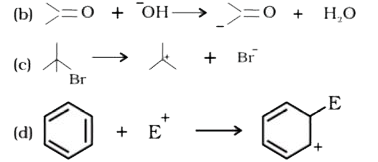
For the following bond cleavages, use curved-arrows to show the electron flow and classify each as homolysis or heterolysis. Identify reactive intermediate produced as free radical, carbocation and carbanion.
(a) `CH_(3)O-OCH_(3)rarrCH_(3)overset(.)O+overset(.)(O)CH_(3)`
(b)

Promotional Banner

Topper's Solved these Questions

  • ORGANIC CHEMISTRY - SOME BASIC PRINCIPLES AND TECHNIQUES

    NCERT TELUGU|Exercise EXERCISES|39 Videos
  • HYDROGEN

    NCERT TELUGU|Exercise EXERCISE|36 Videos
  • ORGANIC HALOGEN COMPOUNDS

    NCERT TELUGU|Exercise Questions|25 Videos

Similar Questions

Explore conceptually related problems

The IUPAC name of CH_(3)CH_(2)OCH_2overset(O)overset(||)C-H is

The IUPAC name of CH_(3)CH_(2)OCH_(2)overset(O)overset("||")("C")-H is

The functional group(s) present in H_(3)C-CH_(2)-O-CH_(2)-overset(O)overset("||")("C")-OCH_(3)

CH_(3)-CH_(2)-CH=CH-CH_(3)+O_(3)underset("Zn")overset(H_(2)O)rarr

H_(3)CNH_(2)overset((CH_(2))_(2)O)to(A) . What is (A)

Write IUPAC name of the structure : CH_(3) - CH_(2) - overset(O)overset(||)(C) - CH_(3)

Give the major products that are formed by heating of the CH_(3)-CH_(2)-overset(CH_(3))overset(|)CH-CH_(2)-O-CH_(2)-CH_(3) ethers with HI.

Identify A and b in the following reaction , CH_(3) CH_(3) overset(B) (larr) CH_(3) COOH overset(Delta)(to) CH_(3) CH_(2) OH

The stability order of alkyl free radicals is: (CH_(3))_(3) overset(.)C gt (CH_(3))_(2) overset(.)CH gt CH_(3) overset(.)CH_(2) gt overset(.)CH_(3)

What are X and Y in the following reactions ? CH_(3)-underset(CH_(3))underset(|)overset(CH_(3))overset(|)(C)-OCH_(3)+HIrarrX+Y

NCERT TELUGU-ORGANIC CHEMISTRY - SOME BASIC PRINCIPLES AND TECHNIQUES -EXERCISES
  1. Identify the reagents shown in bold in the following equations as nucl...

    Text Solution

    |

  2. Classify the following reactions in one of the reaction type studied i...

    Text Solution

    |

  3. For the following bond cleavages, use curved-arrows to show the electr...

    Text Solution

    |

  4. Explain the terms Inductive and Electromeric effects. Which electron d...

    Text Solution

    |

  5. Give a brief description of the principles of the following techniques...

    Text Solution

    |

  6. Describe the method, which can be used to separate two compounds with ...

    Text Solution

    |

  7. What is the difference between distillation, distillation under reduce...

    Text Solution

    |

  8. Discuss Lassigne's test.

    Text Solution

    |

  9. Differentiate between the principal of estimation of nitrogen in an or...

    Text Solution

    |

  10. Explain the estimation of phosphorus and sulphur present in the organi...

    Text Solution

    |

  11. Explain the principle of chromatography.

    Text Solution

    |

  12. Why is nitric acid added to sodium extract before adding silver nitrat...

    Text Solution

    |

  13. Explain the reason for the fusion of an organic compound with metallic...

    Text Solution

    |

  14. Name a suitable technique of separation of the components from a mixtu...

    Text Solution

    |

  15. Explain why an organic liquld vaporizes at a temperature below its bol...

    Text Solution

    |

  16. Will C Cl(4) give white precipitate of AgCl on heating it with silver ...

    Text Solution

    |

  17. Why is a solution of potassium hydroxide used to absorb carbon dioxide...

    Text Solution

    |

  18. Why is it necessary to use acid and not sulphuric acid for acidificati...

    Text Solution

    |

  19. An organic compound contains 69% carbon and 4.8% hydrogen, the remaind...

    Text Solution

    |

  20. A sample of 0.50 g of an organic compound was treated according to Kje...

    Text Solution

    |