

Home
Class 11
PHYSICS
The 10 kg block is resting on the horizo...

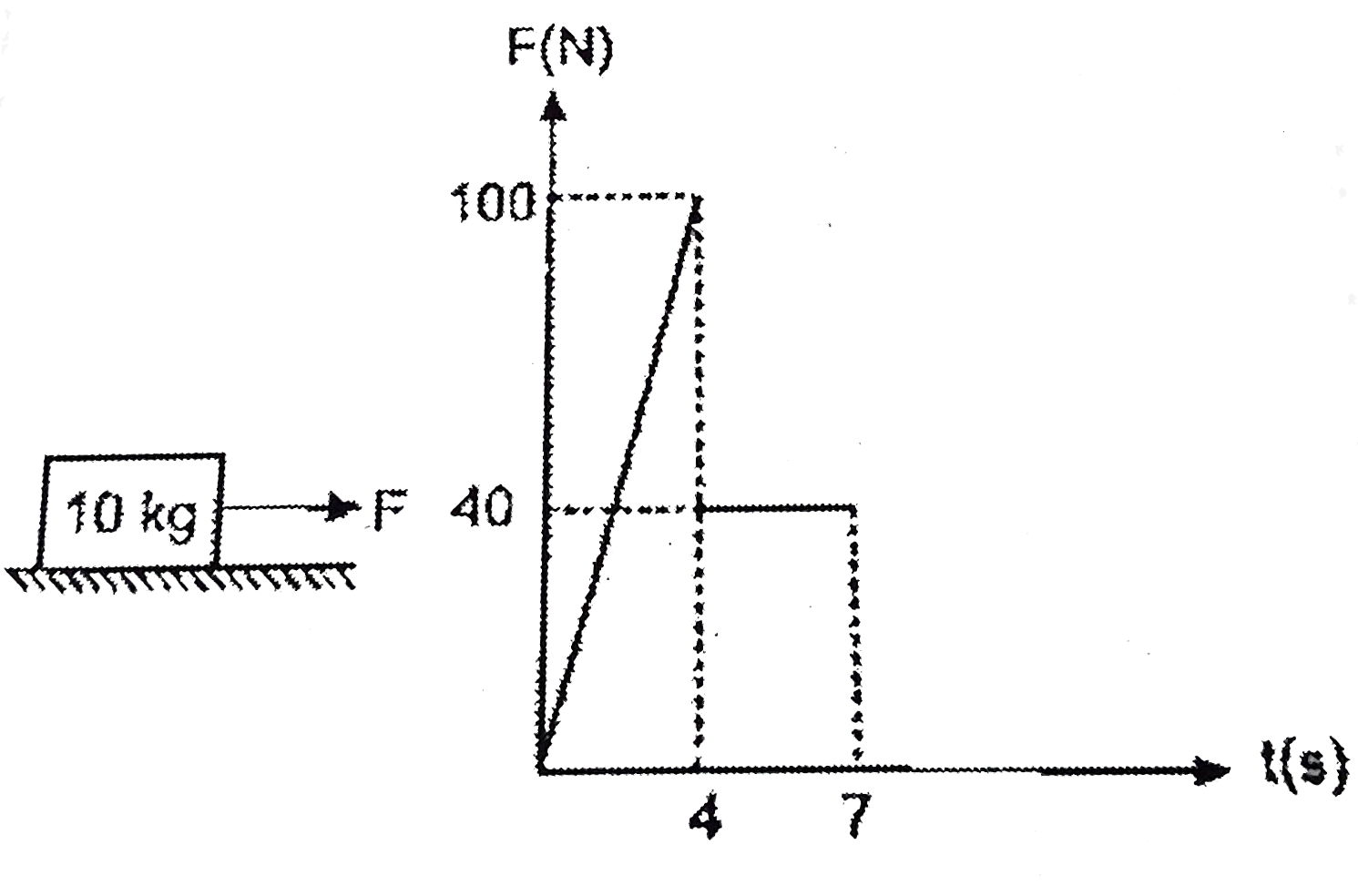
The 10 kg block is resting on the horizontal surface when the force 'F is applied to it for 7 second. The variation of 'F with time is shown. Calculate the maximum velocity reached by the block and the total time 't' during which the block is in motion. The coefficient of static and kinetic friction are both, 0.50.

Promotional Banner

Similar Questions

Explore conceptually related problems

The 10 kg block is resting on the horizontal surface when the force F is applied to it for 7 s . The variation of F with time is shown . Calculate the maximum velocity reached by the block and the total time t during which the block is in motion. The coefficient of static and kinetic friction are both 0.50.(g = 9.8 m//s^(2))

The 10 kg block is resting on the horizontal surface when the force F is applied to it for 7 s . The variation of F with time is shown . Calculate the maximum velocity reached by the block and the total time t during which the block is in motion. The coefficient of static and kinetic friction are both 0.50.(g = 9.8 m//s^(2))

A 10kg block is resting on the horizontal surface. Horizontal force F is applied on it for 7s. The variation of F in N with time in seconds is shown if Fig. The coefficients of static and kinetic friction are both 0.50. Velocity of the block in m/s)as t = 4s is –

A 10 kg block is initially at rest on a rough horizontal surface. A horizontal force of 60 N is required to set the block in motion . After it is in motion , a horizontal force of 50 N is required to keep the block moving with constant velocity . The ratio coefficient of static and kinetic friction is

A block is kept on a rough surface and applied with a horizontal force as shown which is gradually increasing for zero. The coefficient of static and kinetic friction are 1//sqrt3 then

A block is kept on a rough surface and applied with a horizontal force as shown which is gradually increasing for zero. The coefficient of static and kinetic friction are 1//sqrt3 then

A block is kept on a rough surface and applied with a horizontal force as shown which is gradually increasing for zero. The coefficient of static and kinetic friction are 1//sqrt3 then

If the mass of the block A = 10 kg and the coefficient of static and kinetic friction is 0.2, then the mass of block B to start the motion is

A block of mass 2 kg is placed on the floor. The coefficient of static friction is 0.4. A force F of2.5 N is applied on the block as shown. Calculate the force of friction between the block and the floor