Home
Class 12
CHEMISTRY
Assign reason for each of the following ...

Assign reason for each of the following :
(i) Transition elements exhibit paramagnetic behaviour .
(ii) `Co^(2+)` is easily oxidised in the presence of a strong ligand

Text Solution

Verified by Experts
(i) The low ionisation potentials mean that the elements show variable valency states that compounds of the transtion element can be paramnetic .This suggests that the electrons which enter the d orbitals are being used
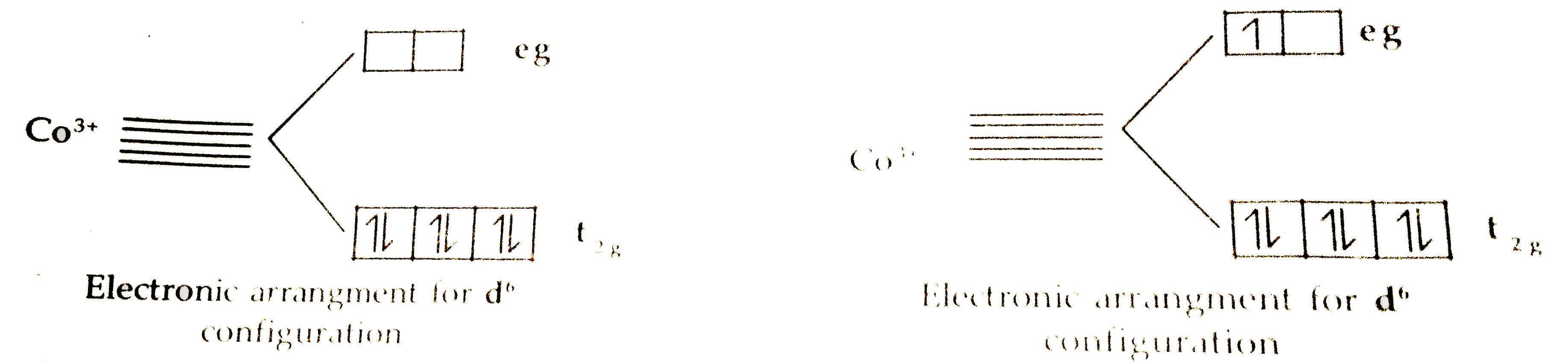
(ii) In presence of strong ligand the pairing of d electrons takes place and the valence shell electorinic configuration of `Co^(2)` and `CO^(3+)` ions can be represented as follow

Since the `l_(g)` level is at higher energy than `t_(2g)` level `Co^(2+)` ion is less stable than `Co^(3+)` ion morevoer the electrons in `l_(g)` level lower crystal field stablistion energy of `Co^(2+)` ion So `Co^(2+)` is easily oxidized to `CO^(3+)` in presence of a strong ligand
Promotional Banner

Topper's Solved these Questions

  • XII BOARDS

    XII BOARDS PREVIOUS YEAR|Exercise Set -I|35 Videos
  • XII BOARDS

    XII BOARDS PREVIOUS YEAR|Exercise Set -II|11 Videos
  • XII BOARDS

    XII BOARDS PREVIOUS YEAR|Exercise C.B.S.E CLASS XII|41 Videos
  • SAMPLE PAPER 2019

    XII BOARDS PREVIOUS YEAR|Exercise SECTION: D|1 Videos

Similar Questions

Explore conceptually related problems

Assign reason for the following, B_(2) is paramagnetic while C_(2) is not.

Which one of the following molecules is expected to exhibit diamagnetic behaviour? (i) N_2 (ii) O_2 (iii) S_2 (iv) C_2

Explain the following given appropriate reason: i) Nickel does not form low spin octahedral complexes. ii) The pi -complexes are known for the transition metals only. iii) Co^(2+) is easily oxidised to Co^(3+) in the presence of a strong ligand.

Assing the reason for the following : (i) Transition metals exhibit enthalpy of atomisation. (ii) Transition metals form interstitial compounds .

Give reasons for the following: (i) Transition metals exhibit a wide range of oxidation states. (ii) Cobalt (II) is very stable in aqueous solutions but gets easily oxidised in the presence of strong ligands. (iii) Actinoids exhibit a greater range of oxidation states than lanthanoids.

Assign reason for the following : (i) Ammonis is soluble in water while phosphine is not (ii) B_(2) is paramagnetic while C_(2) is not.

