Home
Class 12
CHEMISTRY
(i) What is the role of activated charco...

(i) What is the role of activated charcoal in gas mask ?
(ii) A colloidal sol is prepared by the given method in figure. What is the charge on hydrated ferric oxide colloidal particles formed in the test tube ? How is the sol represented?
(iii) How does chemisorption vary with temperature?

Text Solution

Verified by Experts
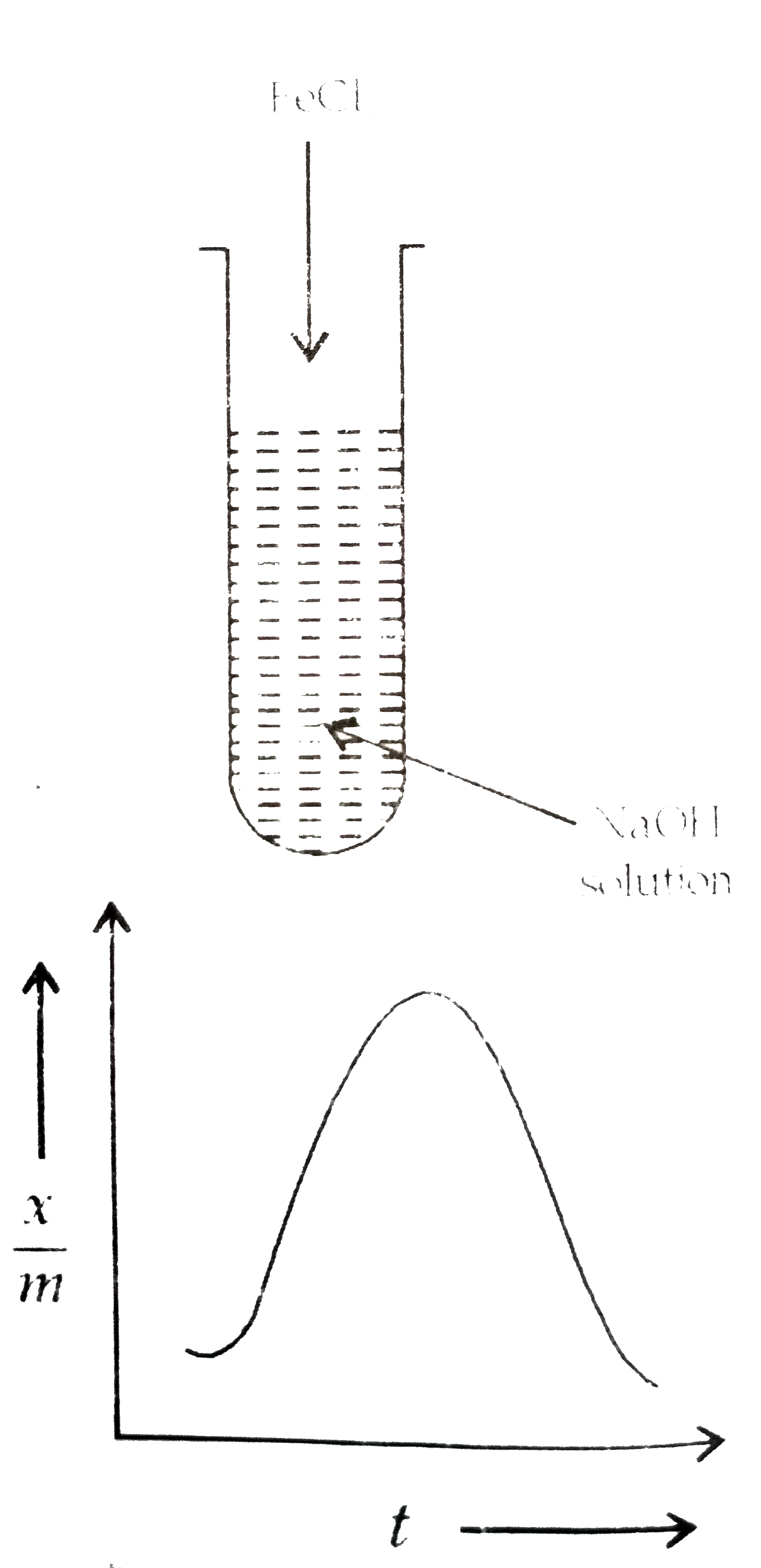
(i) Activated charcoal is a good absorbent. Gas mask is usually used for breathing in coal mines to adsorb poisonous gas.
(ii) A negatively charged sol of hydrated ferric oxide is formed when ferric chloride is added to NaOH solution as follows:
`FeCl_(3)+2NaOHtoFe(OH)_(3)+3NaCl`
The negatively charged sol is obtained because of the preferential absorption of `OH^(-)` ions which form an electrical double layer.
(iii) The adsorption isobar of chemical adsorption shows that the extent of adsorption first increases and then decreases with the increase in temperature.
Promotional Banner

Topper's Solved these Questions

  • XII BOARDS

    XII BOARDS PREVIOUS YEAR|Exercise SECTION-D|12 Videos
  • XII BOARDS

    XII BOARDS PREVIOUS YEAR|Exercise CHEMISTRY (Theory) [SET - I]|34 Videos
  • XII BOARDS

    XII BOARDS PREVIOUS YEAR|Exercise SECTION-B|22 Videos
  • SAMPLE PAPER 2019

    XII BOARDS PREVIOUS YEAR|Exercise SECTION: D|1 Videos

Similar Questions

Explore conceptually related problems

(a) A colloidal sol is prepared by the given method in figure. What is the charge of AgI colloidal particles in the test tube ? How is the sol formed, represented? (b) Explain how the phenomenon of adsorption finds application in Heterogeneous catalysis. (c) Which of the following electroytes is the most effective for the coagulation of Fe(OH)_(3) sol which is a positively charged sol? NaCI, Na_(2)SO_(4), Na_(3)PO_(4)

A colloidal solution of Agl is prepared by two different methods as shown in the figure below: What is the charge of Agl colloidal particles in the two test tubes (A) and (B) ? b. Given reasons for the origin of charge.

The colloidal particles are electrically charged as a indicated by their migration towards cathode or anode under the applied electric field. In a particular colloidal system, all particles carry either positive charge or negative charge. The electric charge on colloidal particles orginate in several ways. According to preferential adsorption theory, the freshly obtained precipitate particles adsorb ions from the dispersion medium, which are common to their lattice and acquire the charge of adsorbed ions. For example, For example, freshly obtained Fe(OH)_(3) precipitated is dispersed, by a little FeCl_(3) , into colloidal solution owing to the adsorption of Fe^(3+) ions in preference. Thus sol particles will be positively charged. In some cases the colloidal particles are aggregates of cations or anions having ampiphilic character. When the ions posses hydrophobic part (hydrocarbon end) as well as hydrophilic part (polar end group), they undergo association in aqueous solution to form particles having colloidal size. The formation of such particles, called micelles plays a very important role in the solubilization of water insoluble substances, (hydrocarbon, oils, fats, grease etc.). In micelles, the polar end groups are directed towards water and the hydrocarbon ends into the centre. The charge on sol particles of proteins depends on the pH. At low pH, the basic group of protein molecule is ionized (protonated) and at higher pH (alkaline medium), the acidic group is ionized. At isoelectric pH, characteristic to the protein, both basix and acidic groups are equally ionized. The stability of colloidal solution is attributed largely to the electric charge of the dispersed particles. This charge causes them to be coagulated or precipitated. On addition of small amount of electrolytes, the ions carrying oppiste charge are adsorbed by sol particles resulting in the neutralization of their charge. When the sol particles either with no charge or reduced charge, come closer due to Brownian movement, they coalesce to form bigger particles resulting in their separation from the dispersion medium. This is what is called coagulating or precipitation of the colloidal solution. The coagulating power of the effective ion, which depend on its charge, is expressed in terms of its coagulating value, defined as its minimum concentration (m mol/L) needed to precipitate a given sol. Under the influence of an electric field, the particles in a sol migrate towards cathode. The coagulation of the same sol is studied using NaCl, Na_(2)SO_(4) and Na_(3)PO_(4) solutions. Their coagulating values will be in the order :

The colloidal particles are electrically charged as a indicated by their migration towards cathode or anode under the applied electric field. In a particular colloidal system, all particles carry either positive charge or negative charge. The electric charge on colloidal particles orginate in several ways. According to preferential adsorption theory, the freshly obtained precipitate particles adsorb ions from the dispersion medium, which are common to their lattice and acquire the charge of adsorbed ions. For example, For example, freshly obtained Fe(OH)_(3) precipitated is dispersed, by a little FeCl_(3) , into colloidal solution owing to the adsorption of Fe^(3+) ions in preference. Thus sol particles will be positively charged. In some cases the colloidal particles are aggregates of cations or anions having ampiphilic character. When the ions posses hydrophobic part (hydrocarbon end) as well as hydrophilic part (polar end group), they undergo association in aqueous solution to form particles having colloidal size. The formation of such particles, called micelles plays a very important role in the solubilization of water insoluble substances, (hydrocarbon, oils, fats, grease etc.). In micelles, the polar end groups are directed towards water and the hydrocarbon ends into the centre. The charge on sol particles of proteins depends on the pH. At low pH, the basic group of protein molecule is ionized (protonated) and at higher pH (alkaline medium), the acidic group is ionized. At isoelectric pH, characteristic to the protein, both basix and acidic groups are equally ionized. The stability of colloidal solution is attributed largely to the electric charge of the dispersed particles. This charge causes them to be coagulated or precipitated. On addition of small amount of electrolytes, the ions carrying oppiste charge are adsorbed by sol particles resulting in the neutralization of their charge. When the sol particles either with no charge or reduced charge, come closer due to Brownian movement, they coalesce to form bigger particles resulting in their separation from the dispersion medium. This is what is called coagulating or precipitation of the colloidal solution. The coagulating power of the effective ion, which depend on its charge, is expressed in terms of its coagulating value, defined as its minimum concentration (m mol/L) needed to precipitate a given sol. A gelatin sol at pH less than the isoelectric value is subjected to an electric field. The sol particles migrate toward :

The colloidal particles are electrically charged as a indicated by their migration towards cathode or anode under the applied electric field. In a particular colloidal system, all particles carry either positive charge or negative charge. The electric charge on colloidal particles orginate in several ways. According to preferential adsorption theory, the freshly obtained precipitate particles adsorb ions from the dispersion medium, which are common to their lattice and acquire the charge of adsorbed ions. For example, For example, freshly obtained Fe(OH)_(3) precipitated is dispersed, by a little FeCl_(3) , into colloidal solution owing to the adsorption of Fe^(3+) ions in preference. Thus sol particles will be positively charged. In some cases the colloidal particles are aggregates of cations or anions having ampiphilic character. When the ions posses hydrophobic part (hydrocarbon end) as well as hydrophilic part (polar end group), they undergo association in aqueous solution to form particles having colloidal size. The formation of such particles, called micelles plays a very important role in the solubilization of water insoluble substances, (hydrocarbon, oils, fats, grease etc.). In micelles, the polar end groups are directed towards water and the hydrocarbon ends into the centre. The charge on sol particles of proteins depends on the pH. At low pH, the basic group of protein molecule is ionized (protonated) and at higher pH (alkaline medium), the acidic group is ionized. At isoelectric pH, characteristic to the protein, both basix and acidic groups are equally ionized. The stability of colloidal solution is attributed largely to the electric charge of the dispersed particles. This charge causes them to be coagulated or precipitated. On addition of small amount of electrolytes, the ions carrying oppiste charge are adsorbed by sol particles resulting in the neutralization of their charge. When the sol particles either with no charge or reduced charge, come closer due to Brownian movement, they coalesce to form bigger particles resulting in their separation from the dispersion medium. This is what is called coagulating or precipitation of the colloidal solution. The coagulating power of the effective ion, which depend on its charge, is expressed in terms of its coagulating value, defined as its minimum concentration (m mol/L) needed to precipitate a given sol. How would you obtain a sol of AgI, the particles of which migrate towards cathode under the electric field?

The colloidal particles are electrically charged as a indicated by their migration towards cathode or anode under the applied electric field. In a particular colloidal system, all particles carry either positive charge or negative charge. The electric charge on colloidal particles orginate in several ways. According to preferential adsorption theory, the freshly obtained precipitate particles adsorb ions from the dispersion medium, which are common to their lattice and acquire the charge of adsorbed ions. For example, For example, freshly obtained Fe(OH)_(3) precipitated is dispersed, by a little FeCl_(3) , into colloidal solution owing to the adsorption of Fe^(3+) ions in preference. Thus sol particles will be positively charged. In some cases the colloidal particles are aggregates of cations or anions having ampiphilic character. When the ions posses hydrophobic part (hydrocarbon end) as well as hydrophilic part (polar end group), they undergo association in aqueous solution to form particles having colloidal size. The formation of such particles, called micelles plays a very important role in the solubilization of water insoluble substances, (hydrocarbon, oils, fats, grease etc.). In micelles, the polar end groups are directed towards water and the hydrocarbon ends into the centre. The charge on sol particles of proteins depends on the pH. At low pH, the basic group of protein molecule is ionized (protonated) and at higher pH (alkaline medium), the acidic group is ionized. At isoelectric pH, characteristic to the protein, both basix and acidic groups are equally ionized. The stability of colloidal solution is attributed largely to the electric charge of the dispersed particles. This charge causes them to be coagulated or precipitated. On addition of small amount of electrolytes, the ions carrying oppiste charge are adsorbed by sol particles resulting in the neutralization of their charge. When the sol particles either with no charge or reduced charge, come closer due to Brownian movement, they coalesce to form bigger particles resulting in their separation from the dispersion medium. This is what is called coagulating or precipitation of the colloidal solution. The coagulating power of the effective ion, which depend on its charge, is expressed in terms of its coagulating value, defined as its minimum concentration (m mol/L) needed to precipitate a given sol. When 9.0 ml of arsenious sulphide sol and 1.0 ml of 1.0 xx 10^(-4) M BaCl_(2) are mixed, turbidity due to precipitation just appears after 2 hours. The effective ion and its coagulating value are respectively :

XII BOARDS PREVIOUS YEAR-XII BOARDS-SECTION-C
  1. The decomposition of NH, on platinum surface is zero order reaction. I...

    Text Solution

    |

  2. (i) What is the role of activated charcoal in gas mask ? (ii) A coll...

    Text Solution

    |

  3. An element crystallizes in fec lattice with a cell edge of 300 pm. The...

    Text Solution

    |

  4. A 4% solution (w/w) of sucrose (M 342 g mol^(-1)) in water has a freez...

    Text Solution

    |

  5. (a) Name the method of refining which is (i) used to obtain semicond...

    Text Solution

    |

  6. Give reasons for the following: (i) Transition elements and their co...

    Text Solution

    |

  7. Write the structures of monomers used for getting the following polyme...

    Text Solution

    |

  8. (i) [-CH(2)-overset(CH(3))overset(|)(C)H-](n) a homopolymer or copoly...

    Text Solution

    |

  9. (i) What type of drug is used in sleeping pills? (ii) What type of d...

    Text Solution

    |

  10. Define the following terms with a suitable example in each: (i) Broa...

    Text Solution

    |

  11. (i) Out of (CH(3))(3), C-Br and (CH(3))(3) C-I, which one is more reac...

    Text Solution

    |

  12. An aromatic compound A on heating with Br, and KOH forms a compound B ...

    Text Solution

    |

  13. Complete the following reactions: (i) (ii) (C(6)H(5)CH(2))(2)Cd+2...

    Text Solution

    |

  14. Write chemical equations for the following reactions: (i) Propanone ...

    Text Solution

    |

  15. Differentiate between the following: (i) Amylose and Amylopectin. ...

    Text Solution

    |

  16. Write chemical reaction to show that open structure of D-glucose conta...

    Text Solution

    |

  17. Chromium metal can be plated out from an acidic solution containing Cr...

    Text Solution

    |

  18. Give reasons for the following : (a) Leather gets hardened after tan...

    Text Solution

    |

  19. What is the role of : ( i) Depressants in froth floatation ? (b) Ca...

    Text Solution

    |

  20. Write chemical reactions taking place in the extraction of Aluminium f...

    Text Solution

    |

