Home
Class 12
CHEMISTRY
(a) (i) Why PCl(5) gives fumes in moistu...

(a) (i) Why `PCl_(5)` gives fumes in moisture ?
(ii) Why Interhalogens are more reactive than pure halogens ?
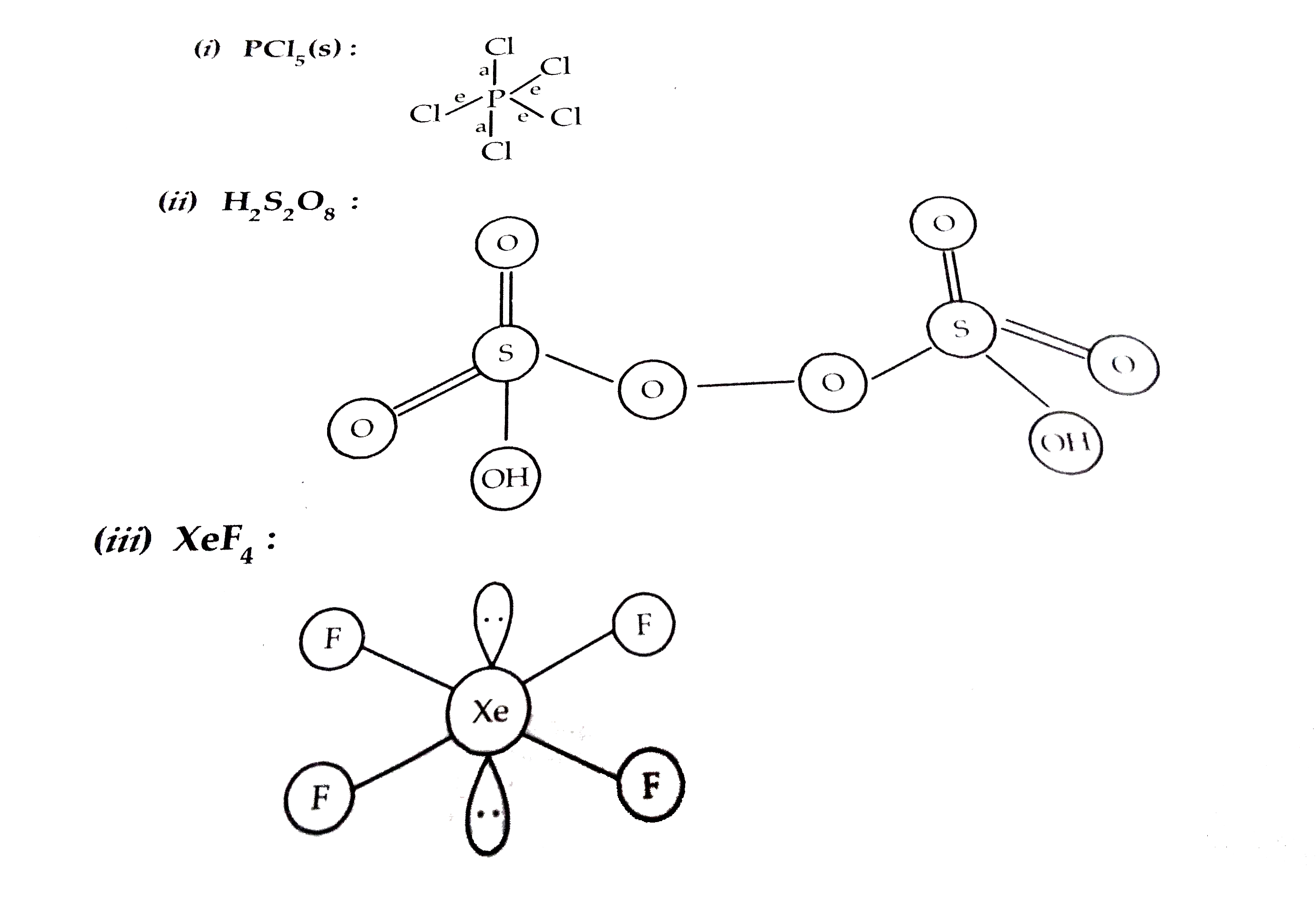
(b) Draw the structures of the following :
`{:((i) PCl_(5), (ii)H_(2)S_(2)O_(8),(iii)XeF_(4)):}`

Text Solution

Verified by Experts
(i) `PCl_(3)+hArrPCl_(3)+Cl_(2)`
`PCl_(3)+H_(2)O("moisture")toPOCl_(3)+2HCl`
Due to the formation of HCl, fumes formed when `PCl_(5)` reacted with moisture.
(ii) Interhalogen compounds are more reactive cecause the bond in interhalogen (X-X) is weakwer than X-X and X' -X bond in halogens. This is due ot less effective overlapping between orbitals of dissmilar atoms than those between similar atoms.
(b) Draw the structures of the follwoing :
Promotional Banner

Topper's Solved these Questions

  • XII BOARDS

    XII BOARDS PREVIOUS YEAR|Exercise [SET-II]|10 Videos
  • XII BOARDS

    XII BOARDS PREVIOUS YEAR|Exercise [SET-III]|10 Videos
  • XII BOARDS

    XII BOARDS PREVIOUS YEAR|Exercise [SET-1]|36 Videos
  • SAMPLE PAPER 2019

    XII BOARDS PREVIOUS YEAR|Exercise SECTION: D|1 Videos

Similar Questions

Explore conceptually related problems

Draw the structures of the following : (i) XeF_(4) (ii) HClO_(4)

Draw the structure of the following : (i) XeF_(2) (ii) BrF_(3)

Draw the structures of the following molecules : (i) XeF_(6) (ii) H_(2)S_(2)O_(7)

Draw the structure of the following : (i) XeF_2 (ii) BrF_5

Draw the structure of the following molecules (i) H_(3)PO_(2) (ii) H_(2)S_(2)O_(7) (iii) XeOF_(4) .

Draw the structure of the following : (i) H_2SO_4 (ii) XeF_2

(a) Draw the structures of the following compounds : (i) XeF_(4) (ii) N_(2)O_(5) .

Draw the structures of the following molecules : (i) SF_(4) (ii) XeF_(4)

XII BOARDS PREVIOUS YEAR-XII BOARDS-[SET-I]
  1. How would you account for the following : (i) Many of the transition...

    Text Solution

    |

  2. Complete the following reaction equations: (i) R-overset(O)over...

    Text Solution

    |

  3. Describe the following substance with one suitable expample of each t...

    Text Solution

    |

  4. (a) Define the following terms: (i) Mole fraction (ii) Van't Hoff fa...

    Text Solution

    |

  5. (a) What is meant by: (i) Colligative properties (ii)Molality of a sol...

    Text Solution

    |

  6. Draw the structures of the following : (i) H(2)S(2)O(8) (ii...

    Text Solution

    |

  7. Draw the structures of the following : (i) H(2)S(2)O(7) (ii) HC...

    Text Solution

    |

  8. (a) Write chemical equations to illustreate the following name beari...

    Text Solution

    |

  9. (a) How will you bring about the following conversions : (i) Et...

    Text Solution

    |

  10. Explain the following with an exampe in each : {:((i)"Kolbe's reacti...

    Text Solution

    |

  11. Write the products A and B in the following :

    Text Solution

    |

  12. Write two uses of each of the following polymers. (i)"Polypropylene....

    Text Solution

    |

  13. What are enzyme ? Describe their functions. Name two diseases which ar...

    Text Solution

    |

  14. Ankit's grandfather is not only obses but he is also a diabetic patien...

    Text Solution

    |

  15. (a) What are the two classifications of batteries ? What is the differ...

    Text Solution

    |

  16. (a) What are fuel cells ? Give an example of a fuel cell. (b) Calcu...

    Text Solution

    |

  17. Draw the structure of : {:((i)BrF(3),(ii)XeOF(4)):} (b) Explain givi...

    Text Solution

    |

  18. (a) (i) Why PCl(5) gives fumes in moisture ? (ii) Why Interhalogens ...

    Text Solution

    |

  19. (a) Complete the following equations : (i) (ii) CH(3)COOHoverset(...

    Text Solution

    |

  20. (a) What is meant by the following terms ? Give an example of the reac...

    Text Solution

    |

