Home
Class 12
CHEMISTRY
(a) Account for the following : (i) ...

(a) Account for the following :
(i) `PCl_(5)` is more covalent than `PCl_(3)`.
(ii) Iron on reaction with HCl forms `FeCl_(2)` and not `FeCl_(3)`.
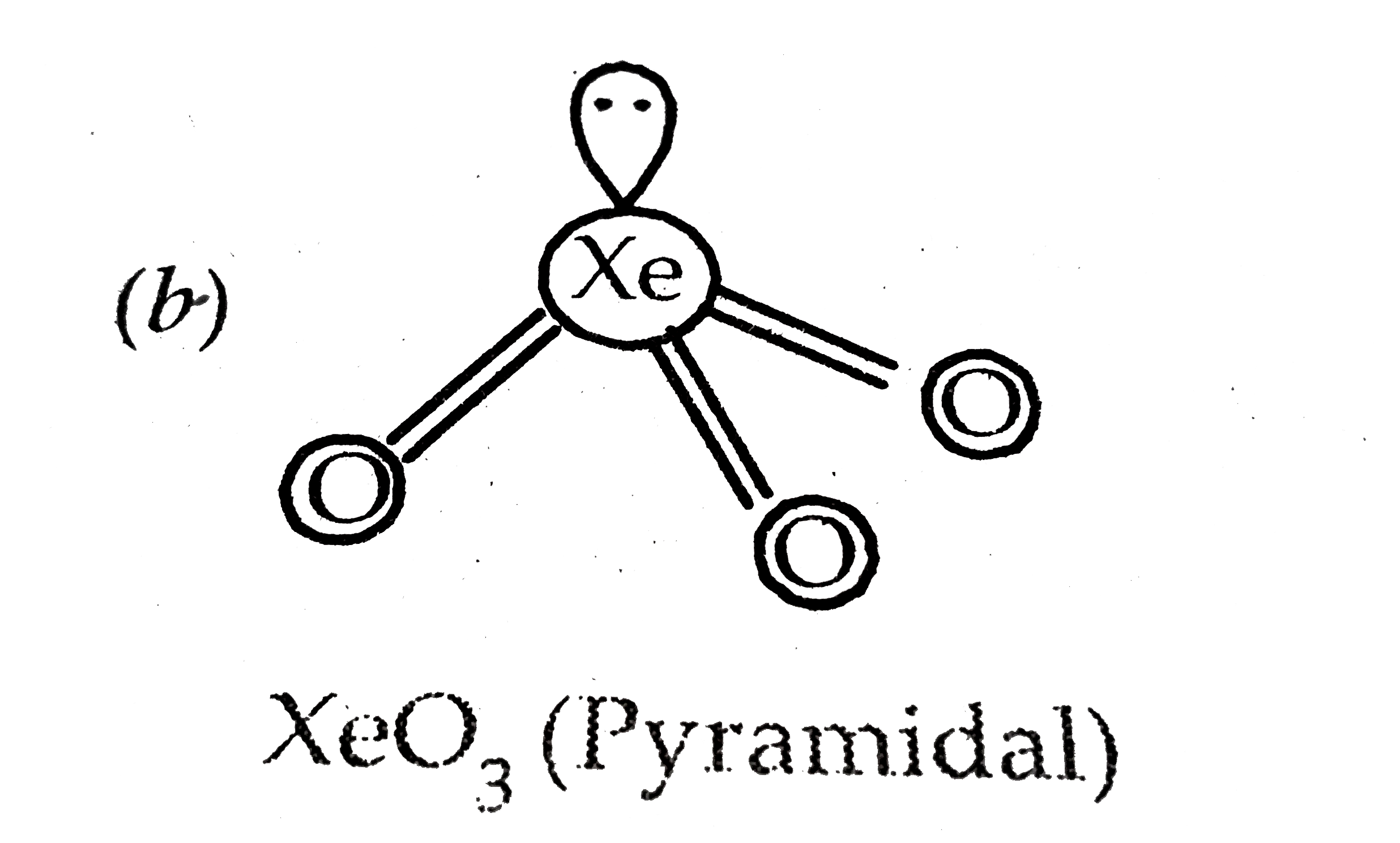
(b) Draw sturcture of `XeO_(3)`.

Text Solution

Verified by Experts
(i) It is difficult to lose all the three electrons to form `p^(3+)` or even more difficult to lose all the five valence electrons to form `p^(5+)` ions. Therefore, higher elements have no tendency to form ionic compounds. Instead they form covalent compounds by sharing of electrons.
Since elements in the +5 oxidation state have less tendency to lose electrons than in the +3 oxidation state. Hence, elements in the +5 oxidation state have more tendency to share electrons than in the +3 oxidation state. Thus, elements in the +5 oxidation state are more covalent than in the +3 oxidation state.
(ii) Fe reacts with HCl to form `FeCl_(2)` and `H_(2)`,
`Fe + 2HCl rarr FeCl_(2) + H_(2)`
`H_(2)` thus liberated prevents the oxidation of `FeCl_(2)` to `FeCl_(3)`.
(b)
Promotional Banner

Similar Questions

Explore conceptually related problems

Why is PCl_(5) more covalent than PCl_(3) ?

Account for the following : (i) PCl_(5) is more covalent than PCl_(3) . (ii) Iron on reaction with HCl forms FeCl_(2) and not FeCl_(3) . (iii) The two O-O bond lengths in the ozone molecule are equal.

Why is PCl_(5) molecule more covalent than PCl_(3) molecule ?

(a) Account for the following : (i) Ozone is thermodynamically unstable. (ii) Solid PCl_(5) is ionic in nature. (iii) Fluorine forms only one oxoacid HOF. (b) Draw the structure of (i) BrF_(5) (ii) XeF_(4)

Complete the following : (i) R-OH + PCl_(5) rarr (ii) R-OH+PCl_(3) rarr

Fecl_(3) solution on reaction with SO_(2) changes to?

The reactions of tolunce with Cl_(2) in pressnce of FeCl_(3) gives :

