(a) DNA replication occurs in S phase of the cell cycle.
(b) Enzymes involved in DNA replication are :
(i) DNA-dependent DNA polymerase : catalyses the polymerisation of polynucleotides in a very short time only in 5' -3' direction with accuracy.
(ii) DNA ligase: Joins the discontinuously synthesised short segment called Okazaki fragments on one of the template strands.
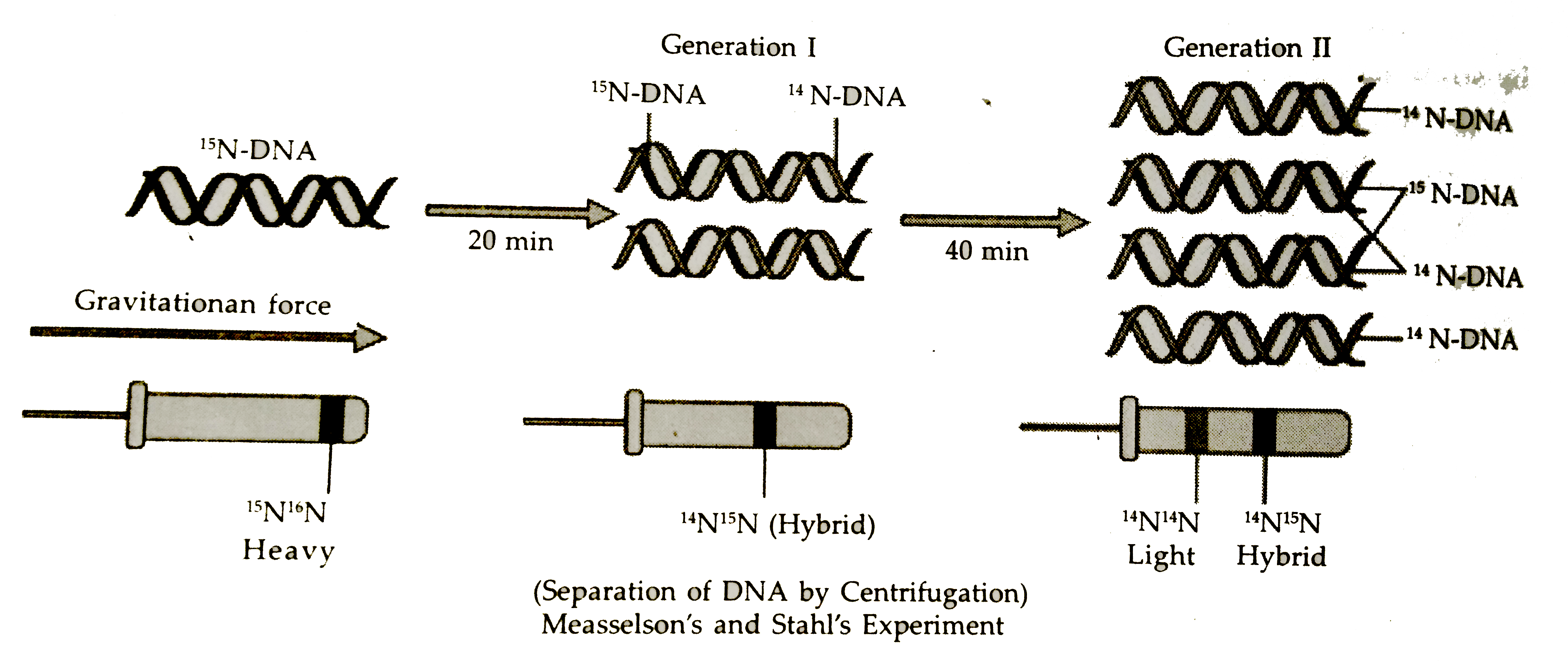
(c) The two strands of DNA separate and act as a template for the synthesis of new comlementary strands. After the completion of replication, each DNA molecule has one parental and one newly sytnthesized strand and this scheme was termed a semiconservative DNA replication.
DNA replication is auto catalytic, it occurs during S-phase of cell cycle. Watson and Crick proposed semi conservative mode of replication for DNA. 1958 Meselson and Stahl's proved the semi-conservative mode of replication. They worked with E. coli using a heavy isotope of Nitrogen, `N^(15)`. E. coli was grown with `N^(15)` for several generation till the bacteria become completely labelled with `N^(15)` They were then shifted to medium with normal `N^(14)` nitrogen. Samples were taken affer every generation and tested for the presence of `N^(15) and N^(14)` using density gradient centrifugation with CsCI. The first generation was found to be hybrid between `N^(15) and N^(14)` second generation contain two types of DNA, 50%, light `(N^(14))` and 50% intermediate. This is only possible if two strands separate during replication and act as a template for synthesis of new comlementary strands, thus proving a semiconservative mode of replication.