

Home
Class 11
PHYSICS
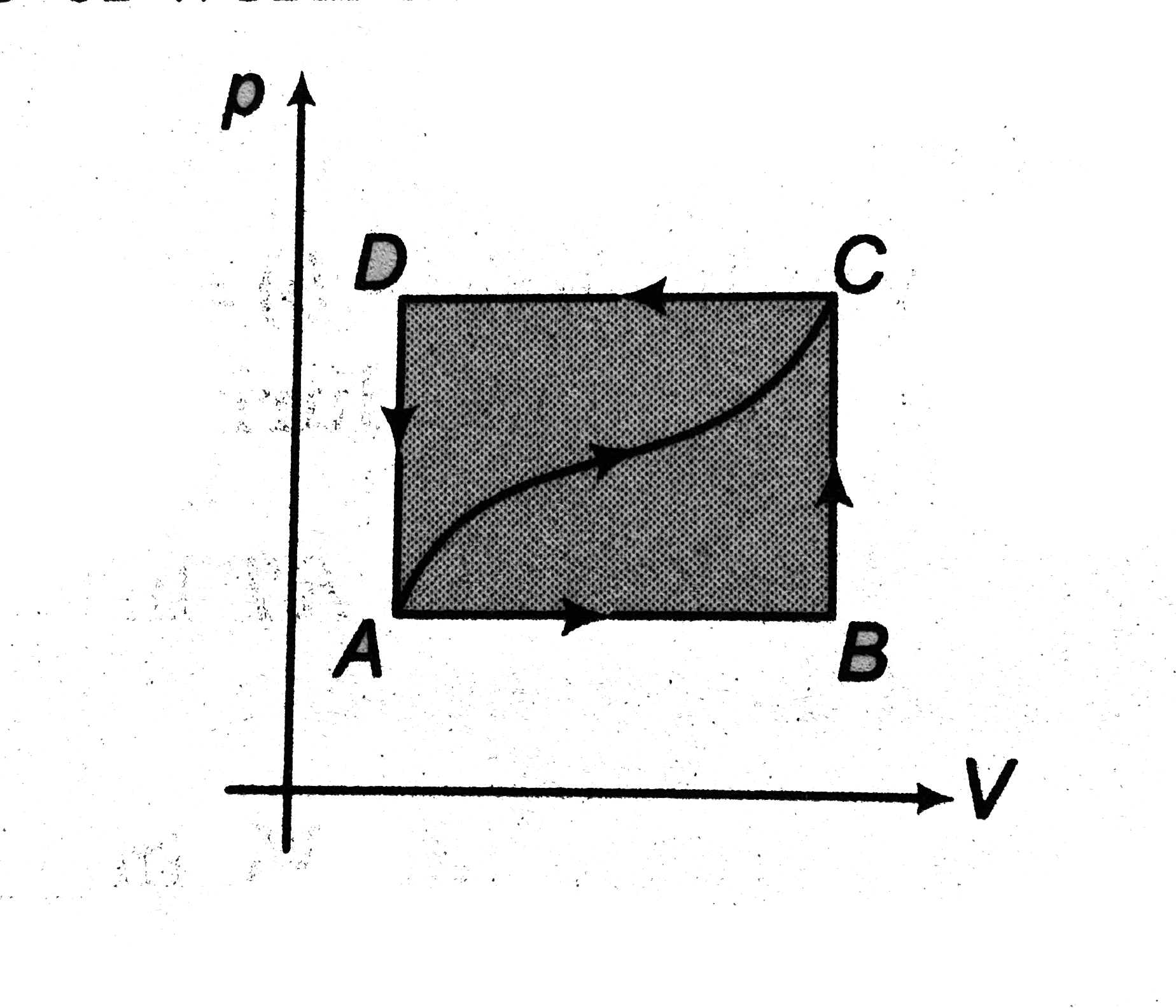
When a gas expands along AB, it does 500...

When a gas expands along AB, it does 500J of work and absorbs 250 J of heat. When the gas expands along AC, it does 700J of work and absorbs 300J of heat.

(a) How much heat does the gas exchange along Bc?
(b) When the gas makes the transition from C to A along CDA, 800J of work are done on it from C to D. How much heat does it exchange along CDA?

Promotional Banner

Similar Questions

Explore conceptually related problems

Find the magnitude of change in internal energy when system does 150J work and absorbs 200J heat

An ideal gas expands isothermally along AB and does 700J of work. How much heat does the gas exchange along AB? The gas then expands adiabarically along BC and does 400J of work. When the gas returns to A along CA, it exhausts 100J of heat to the surroundings. How much work is done on the gas along this path?

A heat engine absorbs 300J of heat at 627^(@)C and rejects a part of it at 27^(@)C . Find the work done by the engine.

A diatomic gas does 100 J of work when it is expanded isobarically. The heat given to the gas during this process is

A diatomic gas does 80 J of work when expanded isobarically. The heat given to the gas during this process is

When a system goes from state A to state B, it is supplied with 400 J of heat and it does 100 J of work. (a) For this transition, what is the system's change in internal energy? (b) If the system moves from B to A, what is the change in internal energy? (c) If in moving from A to B along a different path in which W_(AB)^'=400J of work is done on the system, how much heat does it absorb?

When a system goes from state A to state B, it is supplied with 400 J of heat and it does 100 J of work. (a) For this transition, what is the system's change in internal energy? (b) If the system moves from B to A, what is the change in internal energy? (c) If in moving from A to B along a different path in which W_(AB)^'=400J of work is done on the system, how much heat does it absorb?

In the given cyclic process from c to b 40 J heat is exchanged from b to a 130 J heat is exchanged and work done is 80 J from a to c, 400 J heat is exchanged, then:

When a system is taken from state a to state b, in figure along the path a to c to b , 60J of heat flow into the system, and 30 J of work is done : (i) How much heat flows into the system along the path a to d to b if the work is 10J . (ii) When the system is returned from b to along the curved path, the work done by the system is -20J . Does the system absorb or liberate heat, and how much ? (iii) If , U_(a) = 0 and U_(d)= 22J , find the heat absorbed in the process a to d and d to b .