

Home
Class 11
PHYSICS
In the arrangement shown in fig. m(1)=1k...

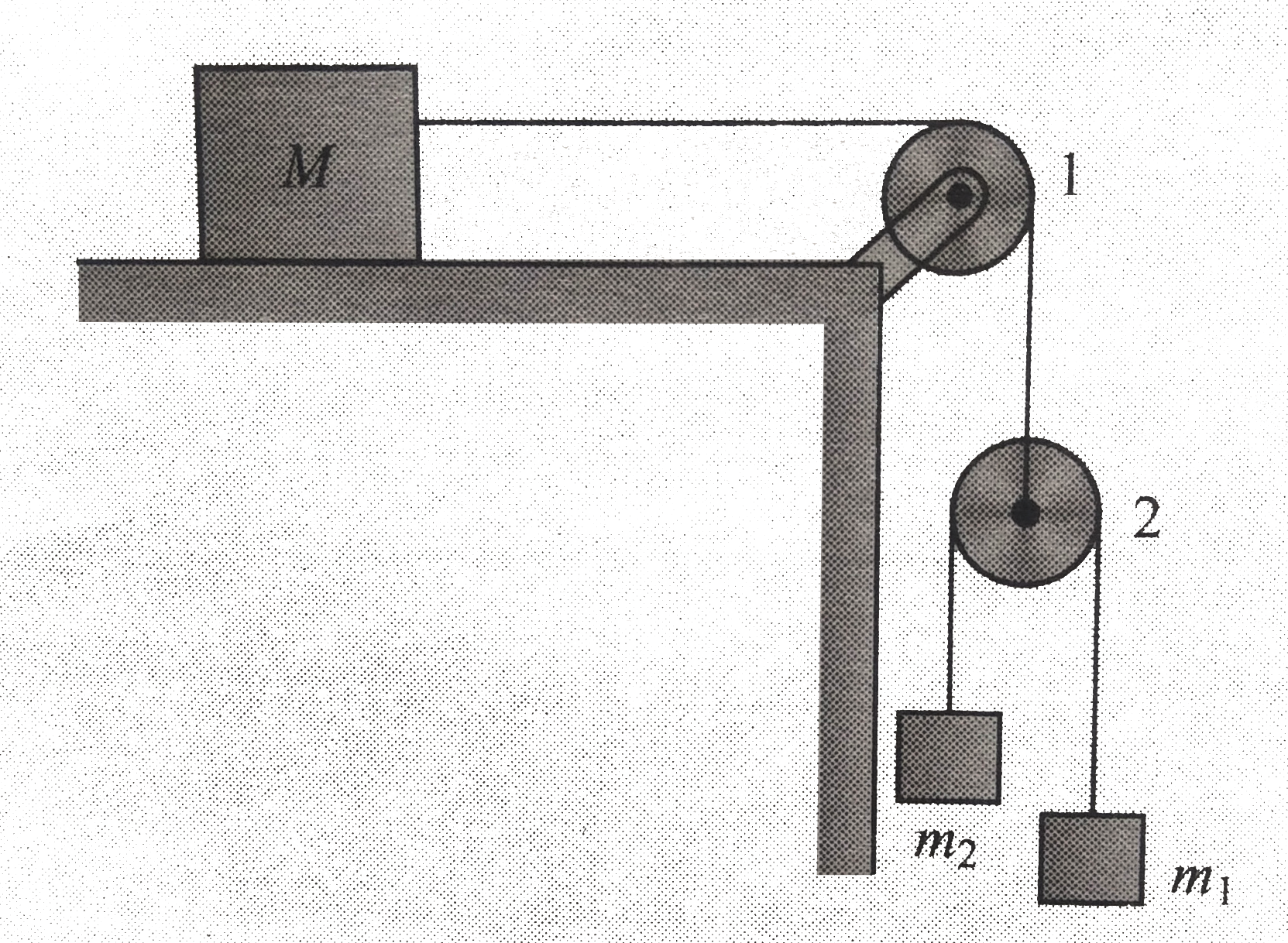
In the arrangement shown in fig. `m_(1)=1kg, m_(2)=2 kg`. Pulleys are massless and strings are light. For what value of M, the mass `m_(1)` moves with constant velocity.

Promotional Banner

Similar Questions

Explore conceptually related problems

In the arrangement shown in fig m_(1)=1kg, m_(2)=2 kg Pulleys are massless and string are light. For what value of M the mass m_(1) moves with constant velocity (neglect friction):

In the arrangement shown in figure m_(1)=1kg, m_(2)=2kg , pullyes are massless and strings are light. For what value of M the mass m_(1) moves with constant velocity? (Neglect friction)

In the arrangment as shown below m_(1) = 1 kg, m_(2) = 2 kg . Pulleys are massless and strings are light . For what value of M the mass m_(1) moves with constant velocity . ( Neglect Friction)

In the arrangment as shown below m_(1) = 1 kg, m_(2) = 2 kg . Pulleys are massless and strings are light . For what value of M the mass m_(1) moves with constant velocity . ( Neglect Friction)

In the arrangement shown in fig. pulleys are smooth and massless. Threads are massless and inextensible. Find acceleration of mass m_(1) .

In the system shown in fig., all pulleys are mass less and the string is inextensible and light. (a) After the system is released, find the acceleration of mass m_(1) (b) If m_(1) = 1 kg, m_(2) = 2 kg "and" m_(3) = 3 kg then what must be value of mass m_(4) so that it accelerates downwards?

In the arrangement shown the fixed pulley is massless and frictionless. If the acceleration of block of mass 1kg is (30)/(x)m//s^(2) . Find the value of x .

In the arrangement shown the fixed pulley is massless and frictionless. If the acceleration of block of mass 1kg is (30)/(x)m//s^(2) . Find the value of x .

In the system shown in fig the pulley is frictionless and the string massless if m_(1)=m_(2) thrust on the pulley will be: