

Home
Class 11
PHYSICS
Two uniformly charged concentric spheric...

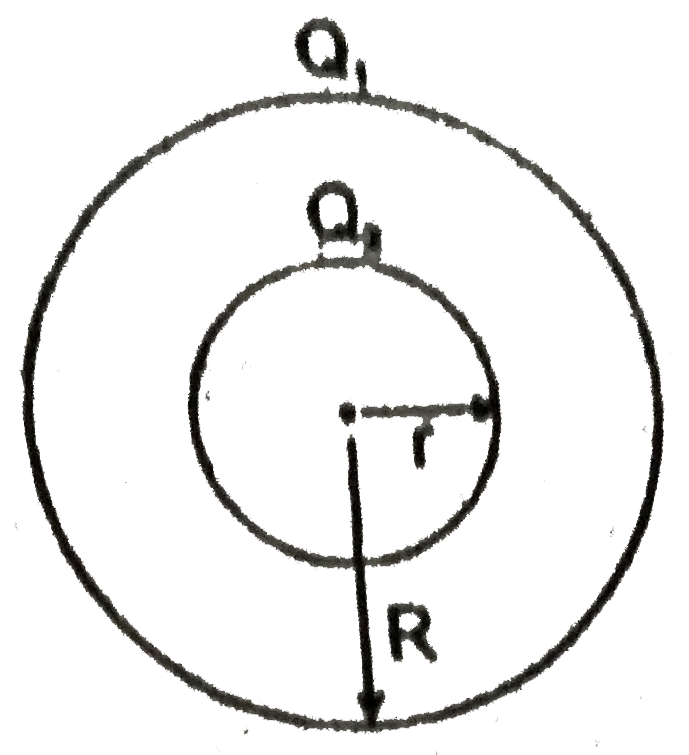
Two uniformly charged concentric spherical shells of radius R and r, are given charges `Q_1` and `Q_2` respectively. If their potential difference is V, then it will not depends upon:

Promotional Banner

Similar Questions

Explore conceptually related problems

Two concentric conducting shells of radii R and 2R are having charges Q and -2Q respectively.In a region r

Three concentric metallic spherical shells of radii R, 2R, 3R, are given charges Q_1 , Q_2 , Q_3 , respectively. It is found that the surface charge denisties on the outer surfaces of the shells are equal. Then, the ratio of the charges given to the shells, Q_1:Q_2:Q_3 , is

Three concentric metallic spherical shells of radii R, 2R, 3R, are given charges Q_1 , Q_2 , Q_3 , respectively. It is found that the surface charge denisties on the outer surfaces of the shells are equal. Then, the ratio of the charges given to the shells, Q_1:Q_2:Q_3 , is

Two concentric spherical shells fo radill R and 2R are given charges Q_(1) and Q_(2) respectively. The surfaces charge densities of the outer surfaces are equal. Determine the ratio Q_(1) : Q_(2) .

Two isolated, concentric, conducting spherical shells have radii R and 2R and uniform charges q and 2q respectively. If V_1 and V_2 are potentials at points located at distances 3R and R/2 , respectively, from the centre of shells. Then the ratio of (V_2/V_1) will be

Three concentric metallic spherical shells of radii R, 2R, 3R are given charges Q_(1) Q_(2) Q_(3) , respectively. It is found that the surface charge densities on the outer surface of the shells are equal. Then, the ratio of the charges given to the shells Q_(1) : Q_(2) : Q_(3) is

Three concentric metallic spherical shells of radii R, 2R, 3R are given charges Q_(1) Q_(2) Q_(3) , respectively. It is found that the surface charge densities on the outer surface of the shells are equal. Then, the ratio of the charges given to the shells Q_(1) : Q_(2) : Q_(3) is

Two isolated concentric conducting spherical shells have radii R and 2R and uniform charges q and 2q respectively.If V_(1) and V_(2) are potentials at points located at distances 3R and (R)/(2) respectively from the centre of shells.Then the ratio of ((V_(2))/(V_(1))) will be

Two concentric spherical conducting shells of radii R and 2R are carrying charges q and 2q, respectively. Both are now connected by a conducting wire. Find the change in electric potential (inV) on the outer shell.