

Home
Class 12
PHYSICS
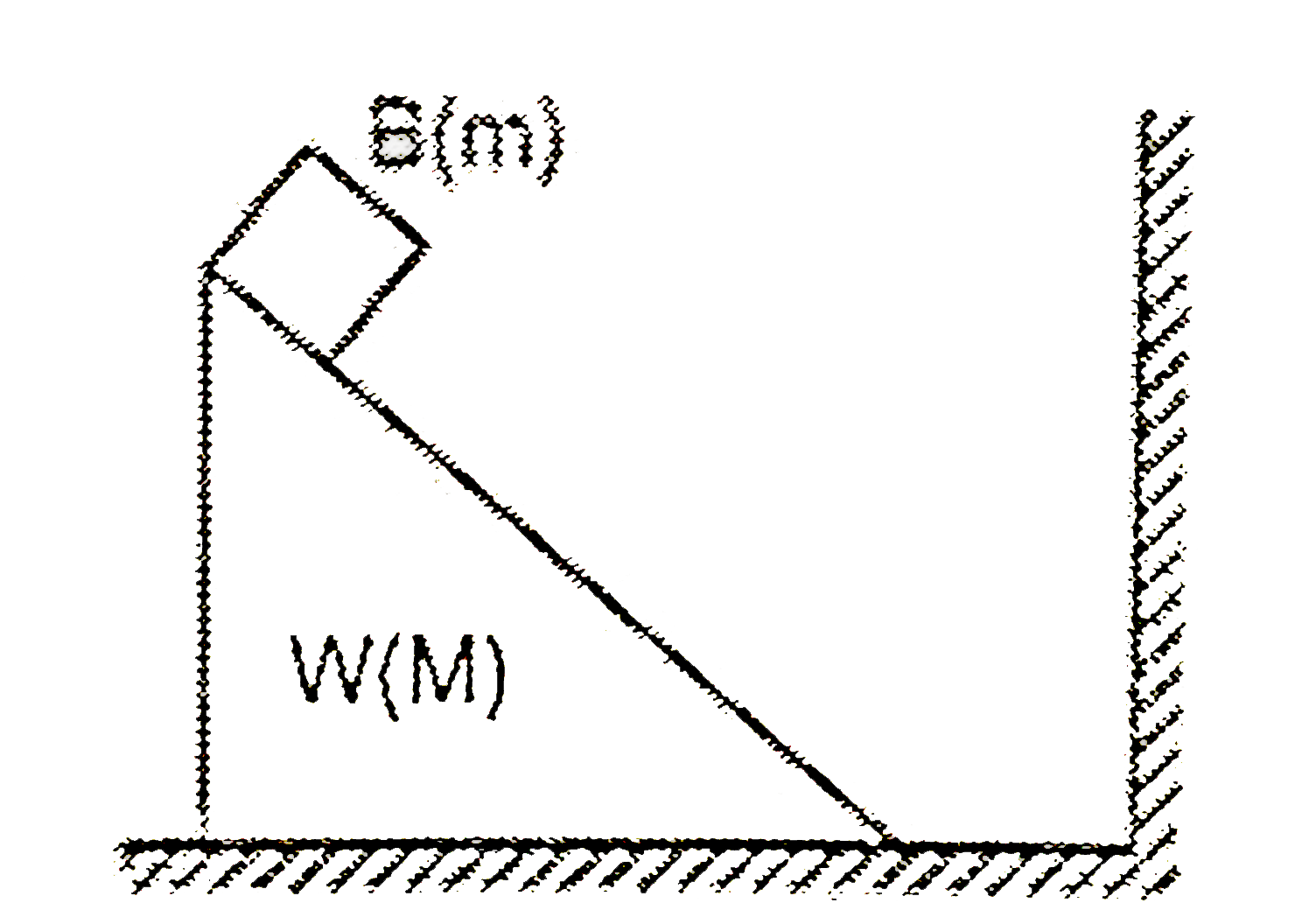
In the figure, the block B of mass m sta...


In the figure, the block B of mass m starts from rest at the top of a wedge W of mass M. All surfaces are without friction. W can slide on the ground. B slides down onto the ground, moves along it with a speed v, has an elastic collision with the wall, and climbs back two W.

Promotional Banner

Similar Questions

Explore conceptually related problems

In the figure, the block B of mass m starts from rest at the top of a wedge W of mass M . All surfaces are without friction. W can slide on the ground. B slides down onto the ground, moves along it with a speed v, has an elastic collision with the wall, and climbs back on to W .

In the figure, the block B of mass m starts from rest at the top of a wedge W of mass M . All surfaces are without friction. W can slide on the ground. B slides down onto the ground, moves along it with a speed v, has an elastic collision with the wall, and climbs back on to W .

A block of mass m is released from the top of a wedge of mass M as shown in figure. Find the displacement of wedges on the horizontal ground when the block reaches the bottom of the wedges. Neglect friction everywhere.

A block of mass m is released from the top of a wedge of mass M as shown in figure. Find the displacement of wedges on the horizontal ground when the block reaches the bottom of the wedges. Neglect friction everywhere.

A block of mass m rests on a stationary wedge of mass M. The wedge can slide freely on a smooth horizontal surface as shown in figure. If the block starts from rest

A block of mass m rests on a stationary wedge of mass M. The wedge can slide freely on a smooth horizontal surface as shown in figure. If the block starts from rest

A block of mass M is placed on the top of a bigger block of mass 10M as shown in fig. All the surfaces are frictionless. The system is releated from rest. The distance moved by the bigger block by the time the smaller block reaches the ground is

Block B has mass m and is released from rest when it is on top of wedge A, which has a mass 3m. Determine the tension in cord CD needed to hold the wedge from moving while B is sliding down A. Neglect friction.

Block B has mass m and is released from rest when it is on top of wedge A, which has a mass 3m. Determine the tension in cord CD needed to hold the wedge from moving while B is sliding down A. Neglect friction.

A block of mass M is placed on the top of a bigger block of mass 10 M as shown in figure. All the surfaces are frictionless. The system is released from rest, then the distance moved by the bigger block at the instant the smaller block reaches the ground :