

Home
Class 12
PHYSICS
a conducting wire os mass m slides down ...

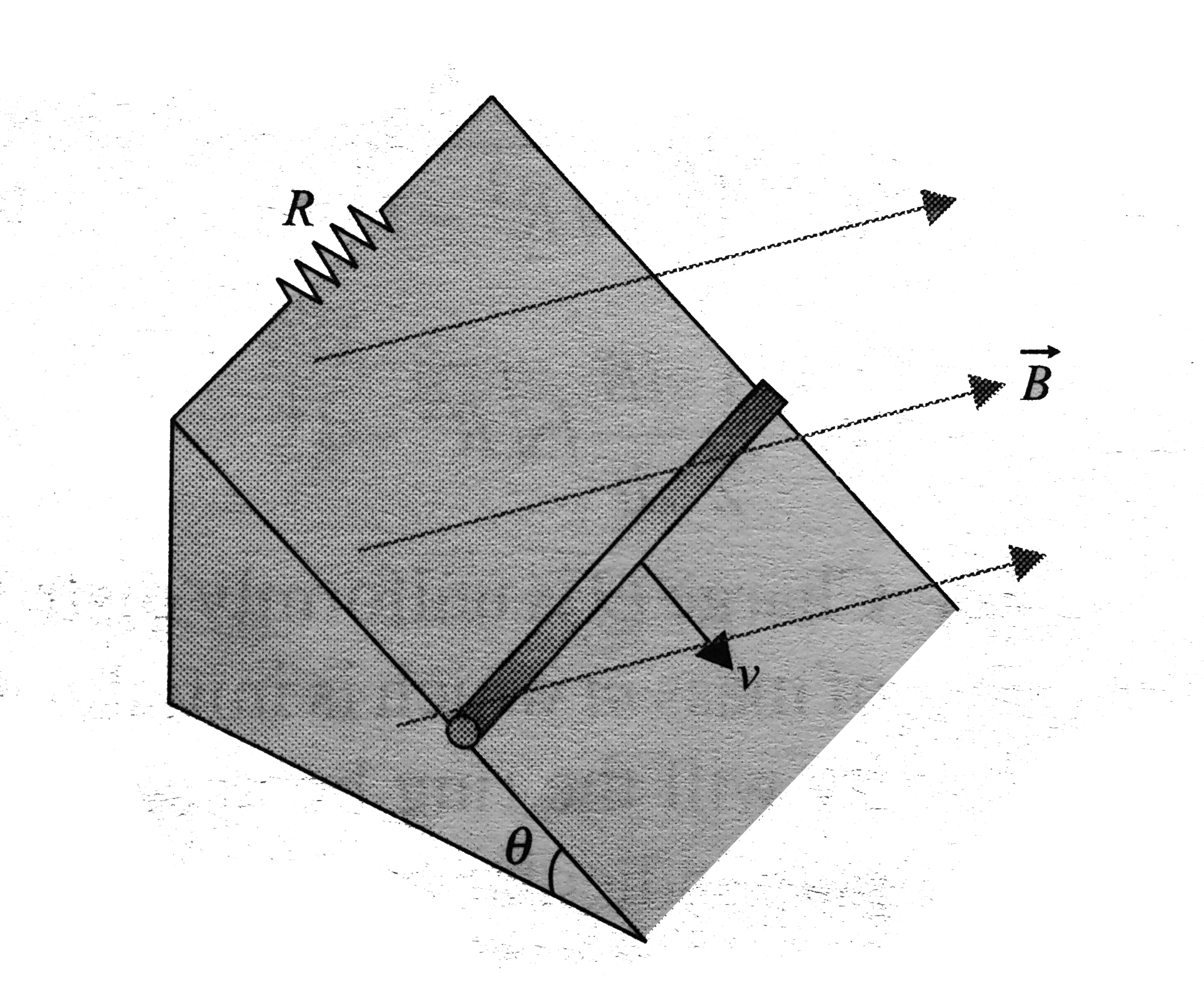
a conducting wire os mass `m` slides down two smooth conducting bars, set at an angle `theta` to the horizontal as shown in . The separatin between the bars is `l`. The system is located in the magnetic field `B`, perpendicular to the plane of the sliding wire and bars. The constant velocity of the wire is

Promotional Banner

Similar Questions

Explore conceptually related problems

A copper connector of mass m slides down two smooth cooper bars, set at an angle alpha to the horizontal due to gravity (Fig). At the top the bars is equal to l . The system is located in a unifrom magnetic field of induction B , perpendicular to the plane in which the connector slides. The resistances of the bars, the connector and the sliding contacts, as well as the self-inductance of the loop, are assumed to be negligible. Find the steady-state velocity of the connector.

A straight horizontal conductor PQ of length l, and mass_ m slides down on two smooth conducting fixed parallel rails, set inclined at an angle 9 to the horizontal as shown in figure-5.30. The top end of the bar are connected with a capacitor of capacitance C. The system is placed in a uniform magnetic field, in the direction perpendicular to the inclined plane formed by the rails as shown in figure. If the resistance of the bars and the sliding conductor are negligible calculate the acceleration of sliding conductor as a function of time ifit is released from rest at t= 0

A conducting wire xy of lentgh l and mass m is sliding without friction on vertical conduction rails ab and cd as shown in figure. A uniform magnetic field B exists perpendicular to the plane of the rails, x moves with a constant velocity of

A conducting wire xy of lentgh l and mass m is sliding without friction on vertical conduction rails ab and cd as shown in figure. A uniform magnetic field B exists perpendicular to the plane of the rails, x moves with a constant velocity of

A conducting wire xy of lentgh l and mass m is sliding without friction on vertical conduction rails ab and cd as shown in figure. A uniform magnetic field B exists perpendicular to the plane of the rails, x moves with a constant velocity of

A conducting wire is bent in the form of an angle theta . The wire moves with velocity v along the bisector of angleA'OB' as shown in figure. Find the emf induced between the two ends of the wire if a magnetic field is acting perpendicular to the plane of the paper and directed into it.

An angle aob made of a conducting wire moves along its bisector through a magnetic field B as suggested by figure. Find the emf induced between the two free ends if the magnetic field is perpendicular ot the plane of the angle.

An angle aob made of a conducting wire moves along its bisector through a magnetic field B as suggested by figure. Find the emf induced between the two free ends if the magnetic field is perpendicular ot the plane of the angle.

In a trapeze-shaped structure, two rigid wires of negligble mass support a conducting bar of mass m and length L as shown in Fig. A source of emf is applied to the wires so that a current I flows through the bar. A uniform magnetic field vec B is perpendicular to the plane of the wires and bar. a. Compute the current that the source of emf must provide so that there is no tension in the wires. b. If the current is reduced to half the value computed in (a) and the plane of the structure is moved through an angle theta , compute the tension in the wires and the magnitude of the net unbalanced force on the bar at the instant it is released from this angle.