

Home
Class 11
PHYSICS
A horizontal frictionless rod is threade...

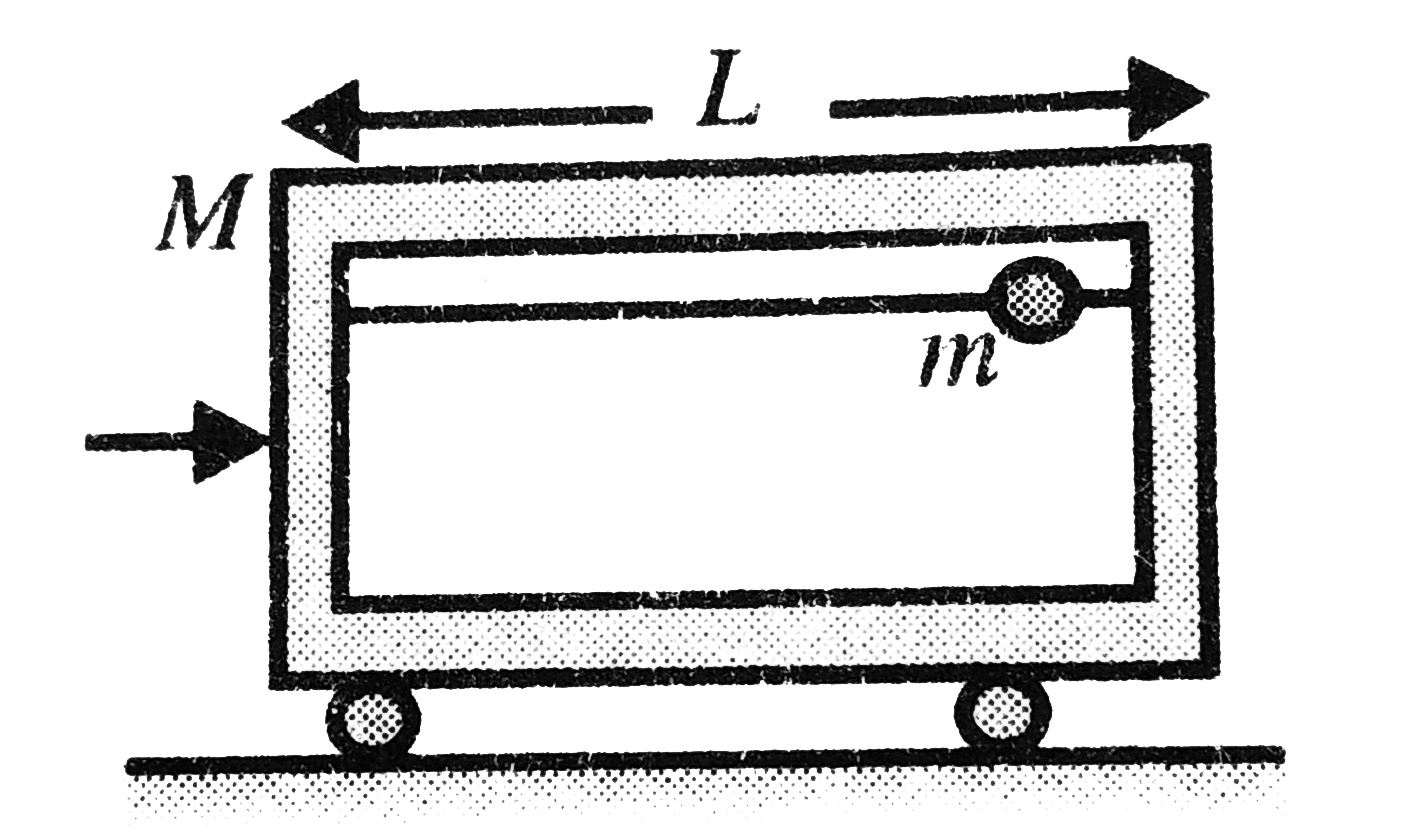
A horizontal frictionless rod is threaded through a bead of mass `m`. The length of the cart is `L` and the radius of the bead, `r`, is very small in comparison with `L(r lt lt L)`. Initially at (`t = 0`) the bead is at the right edge of the cart. The can is struck and as a result, it moves with velocity `v_(0)` towards right. When the bead collides with the cart's walls, the collisions are always completely elastic.

What is the velocity of the cart just after the first collision?

Promotional Banner

Similar Questions

Explore conceptually related problems

A horizontal frictionless rod is threaded through a bead of mass m . The length of the cart is L and the radius of the bead, r , is very small in comparison with L(r lt lt L) . Initially at ( t = 0 ) the bead is at the right edge of the cart. The can is struck and as a result, it moves with velocity v_(0) towards right. When the bead collides with the cart's walls, the collisions are always completely elastic. Velocity of bead just after the first collision is

A horizontal frictionless rod is threaded through a bead of mass m . The length of the cart is L and the radius of the bead, r , is very small in comparison with L(r lt lt L) . Initially at ( t = 0 ) the bead is at the right edge of the cart. The can is struck and as a result, it moves with velocity v_(0) towards right. When the bead collides with the cart's walls, the collisions are always completely elastic. Velocity of bead just after the first collision is

A horizontal frictionless rod is threaded through a bead of mass m . The length of the cart is L and the radius of the bead, r , is very small in comparison with L(r lt lt L) . Initially at ( t = 0 ) the bead is at the right edge of the cart. The can is struck and as a result, it moves with velocity v_(0) towards right. When the bead collides with the cart's walls, the collisions are always completely elastic. The first collision takes place at time ti and the second collision takes place at time t_(2) . Find t_(2)-t_(1)

A horizontal frictionless rod is threaded through a bead of mass m . The length of the cart is L and the radius of the bead, r , is very small in comparison with L(r lt lt L) . Initially at ( t = 0 ) the bead is at the right edge of the cart. The can is struck and as a result, it moves with velocity v_(0) towards right. When the bead collides with the cart's walls, the collisions are always completely elastic. The first collision takes place at time ti and the second collision takes place at time t_(2) . Find t_(2)-t_(1)

A bead of mass m moves on a rod without friction. Initially the bead is at the middle of the rod and the rod moves translationally in a vertical plane with an acceleration a_(0) in a direction forming angle theta with the horizontal as shown in the given figure. The acceleration of bead with respect to rod is

A bead of mass m is fitted on a rod and can move on it without friction. Initially the bead is at the middle of the rod moves transitionally in the vertical plane with an accleration a_(0) in direction forming angle alpha with the rod as shown. The acceleration of bead with respect to rod is: z

A bead of mass m is fitted on a rod and can move on it without friction. Initially the bead is at the middle of the rod moves transitionally in the vertical plane with an accleration a_(0) in direction forming angle alpha with the rod as shown. The acceleration of bead with respect to rod is: z

A bead of mass m and diameter d is sliding back and forth with velocity v on a wire held between two right walls of length L. Assume that th ecollisions with the wall are perfectly elastic and ther is no friction. The average force that the bouncing bead exerts on the one of the walls is :_

A bead of mass m and diameter d is sliding back and forth with velocity v on a wire held between two right walls of length L. Assume that th ecollisions with the wall are perfectly elastic and ther is no friction. The average force that the bouncing bead exerts on the one of the walls is :_

A bead of mass m and diameter d is sliding back and forth with velocity v on a wire held between two right walls of length L. Assume that th ecollisions with the wall are perfectly elastic and ther is no friction. The average force that the bouncing bead exerts on the one of the walls is :_